Olenin had entered into the life of the Cossack village so fully that his past seemed quite foreign to him. As to the future, especially a future outside the world in which he was now living, it did not interest him at all. When he received letters from home, from relatives and friends, he was offended by the evident distress with which they regarded him as a lost man, while he in his village considered those as lost who did not live as he was living. He felt sure he would never repent of having broken away from his former surroundings and of having settled down in this village to such a solitary and original life. When out on expeditions, and when quartered at one of the forts, he felt happy too; but it was here, from under Daddy Eroshka’s wing, from the forest and from his hut at the end of the village, and especially when he thought of Maryanka and Lukashka, that he seemed to see the falseness of his former life. That falseness used to rouse his indignation even before, but now it seemed inexpressibly vile and ridiculous. Here he felt freer and freer every day and more and more of a man. The Caucasus now appeared entirely different to what his imagination had painted it. He had found nothing at all like his dreams, nor like the descriptions of the Caucasus he had heard and read. ‘There are none of all those chestnut steeds, precipices, Amalet Beks, heroes or villains,’ thought he. ‘The people live as nature lives: they die, are born, unite, and more are born—they fight, eat and drink, rejoice and die, without any restrictions but those that nature imposes on sun and grass, on animal and tree. They have no other laws.’ Therefore these people, compared to himself, appeared to him beautiful, strong, and free, and the sight of them made him feel ashamed and sorry for himself.
To read Mykhailo Drahomanov’s detailed articles and essays from the latter half of the 19th century on the history of Ukraine, Russia, Germany, Poland, on anarchist-federalist pan-Slavism and the place of nationalism in broader radical democratic politics, the failures of “western” social-democrats before the political violence of “eastern” Europe, and at this time when Russia is invading Ukraine yet again, is of great value. This is not of course because history repeats itself, or because we would agree with everything that he wrote today, but because the depth and sensitivity of his understanding provides what the French Annales historians called la longue durée, a perspective that helps to understand the present events in ways otherwise impossible; especially when the media is saturated with the words of suddenly “humanitarian” politicians and “geopolitical experts”.
If “one of the most treasured aspects of the political culture of Ukraine, historically – the legacy of the Cossack hetmanate of the 17th century – was anarchism” (The Guardian), it is not amiss to endeavour to understand the sources and vicissitudes of this political culture beyond the usual, though important, references to the Makhnovschina.
Mykhailo Drahomanov (1841-1895) was an ethnographer, geographer, political theorist, journalist, political activist and anarchist. What we share below is a short selection of his writings from the larger collection posted by The Anarchist Library and originally published in English, in The Annals of the Ukrainian Academy of Arts and Sciences in the U.S., Vol. II, Spring, 1952, No. 1 (3).
To rethink war, what does it mean? To learn to look at the world strategically. The news, rights, the laws, the speeches, the images… To take them as operations, as forces (of occupation or resistance): not only what they say, but also what they do (with us).
Is it exaggerated? Don’t we live, here in Europe at least, in peaceful societies? Societies pacified rather, in a truce. But the truce is not peace, but the continuation of hostilities by other means.
What war is it about? The war to dominate the entire earth in the name of economic benefit: to subject life, knowledge and bodies, the countryside and the city, to calculation, to conquer in extension and intensity, to demolish everything that – inside or outside of ourselves – does not fit, to make a desert of it all.
War, said a German philosopher who understood this for a while, is a test of both strength and translation. What did he mean? On the one hand, it is a matter of violence: fear, repression, threat of physical destruction. On the other hand, it is a matter of meaning: to win is to convince, to install the categories of the dominant in the dominated.
Does thinking about war makes us soldiers? That only happens if we think of war as a mirror, war as defined by the other, the strong. But we can be deserters, practice guerrilla warfare, think defensively and not offensively, take on war without losing our tenderness, fight to live and not to die, to make a forest.
What is the war of those who do not have or want power, the war of those who do not want war?
The current war in Ukraine is difficult to grapple with and not only for those of us with friends and comrades who are over there, fighting or surviving, or who have already fled and now find themselves homeless, many of them for a second time, in the case of the many refugees who had taken shelter there over these last several years.
We Are Anarchists. We Occupy this property in protest against Putin and his world. This mansion is owned by a Russian Oligarch, Complicit in Putin’s invasion of Ukraine.
Do we need to remind you why Putin Sucks? The invasion of Ukraine is only the latest episode in a long series, from the support of Assad in Syria to the neo-nazi Wanger militia assistanting dictatorship, concentration camps for LGBT+ people, ecosides, brutal wealth inequality, far right troll farms and so on.
By Occupying this mansion, We want to show solidarity for the people on Ukraine but also for the people of Russia who never agreed to this madness. We want to show our sympathy to the brave protesters who have been in the belly of the beast, and suffer unjust imprisonment for staying up to Putin.
Finally a few words for the elites here in the UK, who have been Putins Minions for years. You received bribes, you managed Oligarch’s property, you even adopted Putin’s authoritarian attitude to protest and decent. FUCK YOU TOO.
This mansion will serve as a refugee support, for people of Ukraine and people of all nations and ethnicity.
SQUAT OLIGARCH’S PROPERTIES EVERYWHERE
A report on the occupation from The Guardian can be read here.
Does hegemony require a grand design? In a world where a thousand gilded oligarchs, billionaire sheiks, and Silicon deities rule the human future, we should not be surprised to discover that greed breeds reptilian minds. What I find most remarkable about these strange days – as thermobaric bombs melt shopping malls and fires rage in nuclear reactors – is the inability of our supermen to validate their power in any plausible narrative of the near future.
A reflection on anti-militarist politics before nation state war, before the russian invasion of ukraine, by Àlex Guillamón, for El salto diario(09/03/2022).
Whoever invented the term nation-state surely did not intend to describe reality so literally. But, certainly, today it is not the nations that own states, but the states that own their nations. The path from the Soviet Union to the current Russian Federation is a clear example: no matter how radically its political, economic and ideological wrapping has changed, the hard core of authoritarian state nationalism has preserved the historical continuity of Great Russia. We don’t have to go that far though, for we also have examples much closer to home.
The hard cores of the nation-states appear on the scene whenever it is necessary to “continue politics by other means”. They are sanctuaries in the shadows where the flame of supreme authority, unscrupulous and merciless violence, highly concentrated patriarchy, are cultivated and reproduced. Reasons of state allow them to retain ownership of the nation at any price.
Syrian Exiles on How Their Experience Can Inform Resistance to the Invasion
In March 2011, protests broke out in Syria against the dictator Bashar al-Assad. Assad turned the full power of the military against the ensuing revolutionary movement; yet for some time, it appeared possible that it might topple his government. Then Vladimir Putin stepped in, enabling Assad to stay in power at a tremendous cost in human lives and securing a foothold for Russian power in the region. In the following text, a collective of Syrian exiles and their comrades think through how their experiences in the Syrian Revolution can inform efforts to support the resistance to the invasion in Ukraine and the anti-war movement in Russia.
So much attention has been focused on Ukraine and Russia this past month that it is easy to lose track of the global context of these events. The following text offers a valuable reflection on imperialism, international solidarity, and understanding the nuances of complex and contradictory struggles.
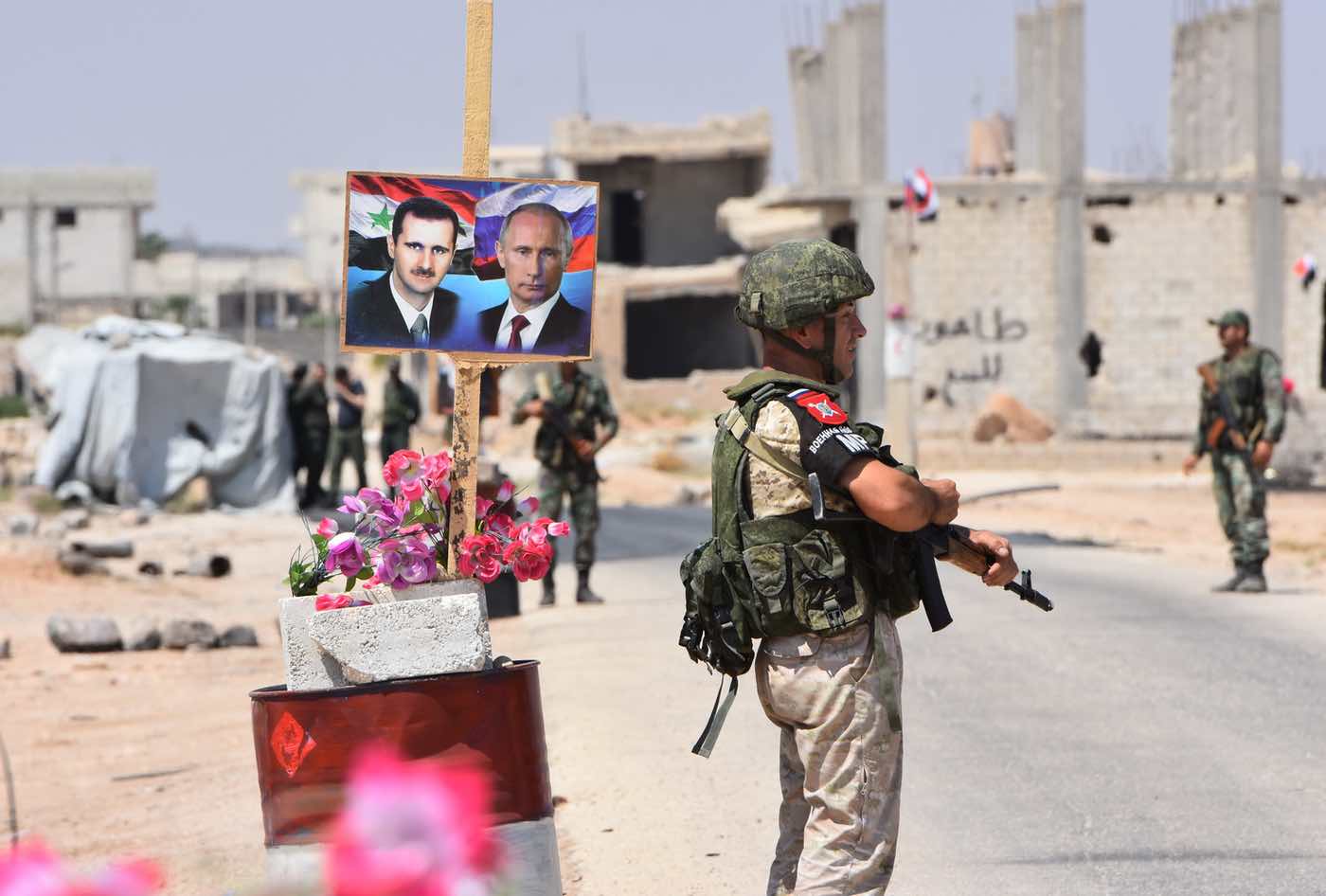
Portraits of Putin and Assad look on as armed soldiers patrol the ruins of Syria.Continue reading →
An interview with Noam Chomsky, by C.J. Polychroniou for Truthout (o1/03/2022).
Russia’s invasion of Ukraine took much of the world by surprise. It is an unprovoked and unjustified attack that will go down in history as one of the major war crimes of the 21st century, argues Noam Chomsky in the exclusive interview for Truthout that follows. Political considerations, such as those cited by Russian President Vladimir Putin, cannot be used as arguments to justify the launching of an invasion against a sovereign nation. In the face of this horrific invasion, though, the U.S. must choose urgent diplomacy over military escalation, as the latter could constitute a “death warrant for the species, with no victors,” Chomsky says.
Noam Chomsky is internationally recognized as one of the most important intellectuals alive. His intellectual stature has been compared to that of Galileo, Newton and Descartes, as his work has had tremendous influence on a variety of areas of scholarly and scientific inquiry, including linguistics, logic and mathematics, computer science, psychology, media studies, philosophy, politics and international affairs. He is the author of some 150 books and the recipient of scores of highly prestigious awards, including the Sydney Peace Prize and the Kyoto Prize (Japan’s equivalent of the Nobel Prize), and of dozens of honorary doctorate degrees from the world’s most renowned universities. Chomsky is Institute Professor Emeritus at MIT and currently Laureate Professor at the University of Arizona.
From the CrimethInc. collective (05/03/2022), an exile from Donbas and a protester in Russia tell their stories.
To help people understand what is taking place in Ukraine and Russia, we present accounts from anarchists in both countries. In the first, a displaced person from the capitol city of the “Luhansk People’s Republic,” one of the two areas of eastern Ukraine that was ruled by Russian-funded separatists until the invasion, describes his experience attempting to escape from the war zone and the conditions that prevail in Ukraine right now. In the second, a Russian protester describes the challenges that Russians are facing as they attempt to mobilize against the war under extremely repressive conditions.
For March 8, we share a rich reflection on “anarchafeminism” by Chiara Bottici, followed by a recorded performance of the same, as well as an earlier lecture on anarchism.
1. Why anarcha-feminism?
It has become something of a commonplace to argue that in order to fight the oppression of women, it is necessary to unpack the ways in which different forms of oppression intersect with one another. No single factor, be it nature or nurture, economic exploitation or cultural domination, can be said to be the single cause sufficient to explain the multifaceted sources of patriarchy and sexism. Intersectionality has consequently become the guiding principle for an increasing number of left-wing feminists, both from the global north and from the global south. As a result, there is hardly any publication in the field today that does not engage with the concept of intersectionality — whether to promote it, to criticize it, or simply to position oneself with regards to it.




Mykhailo Drahomanov: Anarchist echoes from Ukraine’s past
Olenin had entered into the life of the Cossack village so fully that his past seemed quite foreign to him. As to the future, especially a future outside the world in which he was now living, it did not interest him at all. When he received letters from home, from relatives and friends, he was offended by the evident distress with which they regarded him as a lost man, while he in his village considered those as lost who did not live as he was living. He felt sure he would never repent of having broken away from his former surroundings and of having settled down in this village to such a solitary and original life. When out on expeditions, and when quartered at one of the forts, he felt happy too; but it was here, from under Daddy Eroshka’s wing, from the forest and from his hut at the end of the village, and especially when he thought of Maryanka and Lukashka, that he seemed to see the falseness of his former life. That falseness used to rouse his indignation even before, but now it seemed inexpressibly vile and ridiculous. Here he felt freer and freer every day and more and more of a man. The Caucasus now appeared entirely different to what his imagination had painted it. He had found nothing at all like his dreams, nor like the descriptions of the Caucasus he had heard and read. ‘There are none of all those chestnut steeds, precipices, Amalet Beks, heroes or villains,’ thought he. ‘The people live as nature lives: they die, are born, unite, and more are born—they fight, eat and drink, rejoice and die, without any restrictions but those that nature imposes on sun and grass, on animal and tree. They have no other laws.’ Therefore these people, compared to himself, appeared to him beautiful, strong, and free, and the sight of them made him feel ashamed and sorry for himself.
Leo Tolstoy, The Cossacks
To read Mykhailo Drahomanov’s detailed articles and essays from the latter half of the 19th century on the history of Ukraine, Russia, Germany, Poland, on anarchist-federalist pan-Slavism and the place of nationalism in broader radical democratic politics, the failures of “western” social-democrats before the political violence of “eastern” Europe, and at this time when Russia is invading Ukraine yet again, is of great value. This is not of course because history repeats itself, or because we would agree with everything that he wrote today, but because the depth and sensitivity of his understanding provides what the French Annales historians called la longue durée, a perspective that helps to understand the present events in ways otherwise impossible; especially when the media is saturated with the words of suddenly “humanitarian” politicians and “geopolitical experts”.
If “one of the most treasured aspects of the political culture of Ukraine, historically – the legacy of the Cossack hetmanate of the 17th century – was anarchism” (The Guardian), it is not amiss to endeavour to understand the sources and vicissitudes of this political culture beyond the usual, though important, references to the Makhnovschina.
Mykhailo Drahomanov (1841-1895) was an ethnographer, geographer, political theorist, journalist, political activist and anarchist. What we share below is a short selection of his writings from the larger collection posted by The Anarchist Library and originally published in English, in The Annals of the Ukrainian Academy of Arts and Sciences in the U.S., Vol. II, Spring, 1952, No. 1 (3).
Continue reading →