The disaster has a name: Capitalism

A drone view shows vehicles in the area affected by the floods, in Encantado, Rio Grande do Sul state, Brazil, May 3, 2024. REUTERS/Diego Vara/ File Photo

From the Antimídia collective of Brazil, a short video documentary report-essay on the floods of early May this year, in the state of Rio Grande do Sul, and the popular collective responses to the catastrophe, more often than not in opposition to state authorities.

The video is available with Portuguese, Spanish and English language subtitles.

In the first days of May 2024, the territory known as the state of Rio Grande do Sul, in what is called Brazil, was hit by the largest climate catastrophe in its history. More than a week of intense rain caused several rivers to overflow, devastating dozens of cities and destroying everything in their path, before flowing into the Guaíba River, causing the biggest flood ever recorded in the Greater Porto Alegre region and other cities in the state. As of June 1, 171 deaths have been confirmed. Thousands of people lost everything. 614 thousand were left homeless. More than two million were affected. Entire cities were practically erased from the map by the force of the waters.

The State and the capitalist mode of production are directly responsible for the devastation of the planet, producing more and more catastrophes, from cutting down forests to make way for cattle, to monocultures and mining, degrading and making the soil waterproof with urban expansion. Amidst the horror, the complete inability of governments and the rich to care for our lives and our environment becomes evident.

At the center of this tragedy that heralds a new reality of increasingly frequent extreme events, anarchists, indigenous communities, quilombos and social movements have organised solidarity as they try to rebuild their lives and their seriously affected territories, whether asking for and distributing donations, calling for joint efforts to clean and return to affected properties, or to organise new occupations of empty buildings to house people who lost their homes.


Suggested Reading:

“The Disaster Is Already Here: Anarchists in Southern Brazil on the Floods of May 2024”, CrimethInc., 25/06/2024.

Posted in Commentary, News blog | Tagged , , | Leave a comment

From Revolution to Destitution

We are confronted with an expansion of the revolution that reaches the point of becoming something else. Today’s uprisings point toward an anthropological and no longer merely a political revolution, in which Marx’s distinction between political and social revolution begins to dissolve in favor of a new antagonism beyond the coordinates that were established by the workers’ movement at the end of the 19th century, and which remained dominant throughout the 20th century right up to May 68, when the idea of another (state) power was still in force. Such antagonism is no longer dominant. The protesters and those on the streets in the many riots are not out to take power. They have let go of the sovereignist principle; they refuse without affirming an alternative within the system. This opens up another territory beyond the known paradigms of revolt and revolution. This is the perspective of the new cycle of struggle.


From Ill Will (30/05/2024), we share a second essay by Mikkel Bolt Rasmussen that continues his analysis of the “politics” of contemporary protest movements/insurrections [The Movement of Refusal], as a movement or shift from revolution to destitution.


What happened to the notion of revolution? In this companion piece to “The Movement of Refusal,” Mikkel Bolt Rasmussen retraces the rise and fall of revolutionary theory from its earliest systematic expression during the First International to the first proletarian offensive of 1917-1921, and onwards to the crisis at the hands of a bourgeois “anti-fascism” that instrumentalized the specter of fascism as a means to save capitalism, before ditching it, after 1945, in order to integrate the laboring class into the nation state. Although the post-war welfare state was the great achievement of the workers’ movement, the price paid for it was the abandonment of radical transformation and the forgetting of the wretched of the earth. If May 68 signaled the brief retrieval and expansion of the idea of communist revolution, it also effectively announced its end, ushering in a period of crisis and confusion. 

Where do we stand today? Among the original insights offered by this long timeline is the link Bolt Rasmussen establishes between the deconstruction of communism in the 1980s and more recent efforts to rethink our image of radical transformation through a destituent key. The reinvention of communism as a lived process demanded that all existing political positions first be put through an “acid bath” allowing the shipwreck of classical politics to present itself in a new light. Henceforth, Bolt-Rasmussen argues, the only certainty left to us is the absence of certainties, combined with the urgency of a radical anti-political refusal here and now.

Continue reading
Posted in Commentary | Tagged , , , , , , , , , , , , , , , , , , | Leave a comment

Freedom and Joy with Uma Kiwe

From Ill Will (19/05/2024) …


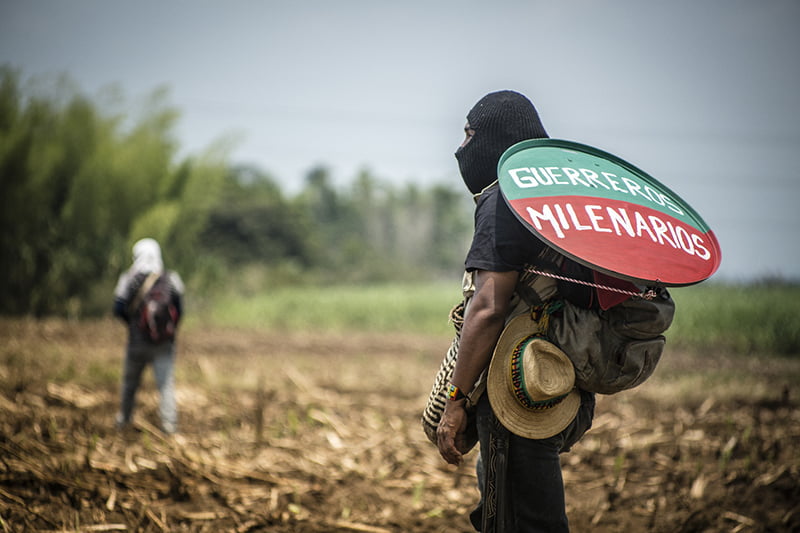
What we are going to do is to plant ourselves in a new time. This is the stage that the Nasa people have entered with the liberation of Mother Earth. It is the Earth that has called us to this time, and we have listened to her. When we say “new time,” we refer to an old time. Returning to the roots, little by little, to the deep wisdom of the Nasa people, which is the wisdom of the Earth. The future of planet Earth depends on the past. And as we have said: freeing the earth depends upon freeing the heart. Earth and heart: the same thing.


Mother Earth Liberation Process

“Freedom and Joy with Uma Kiwa” was collectively authored by Nasa indigenous people of Northern Cauca, Colombia, following the “Mother Earth Liberation Process” actions of 2015 and 2016. This movement, which has been active for almost twenty years now, practices the direct insurgent reclamation of ancestral lands and territories currently held by large sugar mills and major ethanol producers in Latin America. Translated for the first time into English, “Freedom and Joy” describes in vivid detail both the historical context and the autonomous practical methods by which the Nasa self-organize to expropriate and collectivize arable land, a direct struggle that pits them against agribusiness corporations, a neoliberal government, and paramilitary death squads. The text is preceded by a substantial new preface written especially for this edition, in which the authors describe the events leading from 2016 into the current moment.

Part of our ongoing series Weavings, which explores the new emancipatory tradition in Latin America.

Continue reading
Posted in Commentary, News blog | Tagged , , , , , | Leave a comment

Franz Kafka: “The Burrow”

Wenceslaus Hollar, Dead Mole, 1646. Etching; 2 3/4 × 5 1/2 in. Photo: CC0/Wikimedia Commons

Written between 1923 and 1924, and published posthumously, Franz Kafka’s short story “The Burrow” is an allegory on the madness of “rational sovereignty”.

We share the story to mark the centenary of Franz Kafka’s death.

Continue reading
Posted in Poiesis | Tagged | Leave a comment

Franz Kafka

Atelier Jacobi: Sigismund Jacobi (1860–1935)

… Kafka tears open the sky behind every gesture; but … the gesture remains the decisive thing, the center of the event.

Walter Benjamin, “Franz Kafka: On the Tenth Anniversary of his Death”


We mark the centenary of Franz Kafka’s passing not because we wish to appropriate Kafka to our or any political cause – as Michael Löwy summarily states it, his work “cannot be reduced to a political doctrine of any kind” -, but because his writing reveals, without explaining, dimensions of human life that lie between what Walter Benjamin described as “mystical experience” and the “experience of the big-city dweller” (“Some Reflections on Kafka”), thereby rendering this writing a sort of permanent siren call for those who dare approach it, as a child equipped only with a talisman might pass through a dreaded forest to reach a promised place beyond, of happiness.

Continue reading
Posted in Commentary | Tagged , , | Leave a comment

Antti Rautiainen: On the Russian anarchist and anti-war movement in the third year of full-scale war

From avtonom (29/05/2024) …

Anarchist group ANA Regensburg hosted my online-presentation on 16th of May 2024, in which I discussed tactics of anti-war activism in Russia, and reasons why the anti-war movement has not been able to make an impact to change the course of events yet. Cases of anarchists repressed for anti-war activities are presented, as well as strategies of support for political prisoners, and modest successes in supporting their struggles.

Listen in Spotify. The video follows.


Masthead picture is by MediaZona, you may read their report on anti-war arson attacks in Russia here.

Continue reading
Posted in Commentary, News blog | Tagged , , , | Leave a comment

Fundraiser for the anarchist Ruslan Siddiqui’s legal defence

From avtonom

The anarchist Ruslan Siddiqui is accused of attacking the Dyagilevo military aerodrome, using quadcopters, and of damaging railway lines (in Ryazan region) that were used to transport military equipment and fuel to the Russian army in Ukraine.


For an interview with Ruslan Siddiqui, clique here.

Posted in News blog | Tagged , , | Leave a comment

Louise Michel in New Caledonia

From the CrimethInc. collective (29/05/2024) …


In honor of Louise Michel’s birthday [29/05/2024] and the ongoing anticolonial resistance in New Caledonia, we offer an account of her time in exile there, beginning from her arrival in November 1873. This story illustrates how regimes force their own subjects into service in colonial projects, as well as the prisoners they capture in other colonial endeavors. It is also worth remarking that, like Mikhail Bakunin, Peter Kropotkin, and many other 19th-century anarchists, Louise Michel only came to formally identify as an anarchist after spending time with Indigenous people. While many of her colleagues nonetheless retained Eurocentric notions about “progress” and “civilization,” Louise Michel wholeheartedly sided with Indigenous resistance to French colonialism. She is remembered more warmly today than most French settlers in New Caledonia.

A work of literary nonfiction, this narrative draws on Michel’s memoirs, her book Légendes et chansons de gestes Canaques, and several other sources. For more background on Louise Michel’s time in New Caledonia, consult the reading list below.

Continue reading
Posted in Commentary | Tagged , , , , | Leave a comment

Giorgio Agamben: The snail’s shell

Joris Hoefnagel, Snail, c. 1575-80

A snail, after adding a number of widening rings to the delicate structure of its shell, suddenly brings its accustomed building activities to a stop. A single additional ring would increase the size of the shell sixteen times. Instead of contributing to the welfare of the snail, it would burden the creature with such an excess of weight that any increase in its productivity would henceforth be literally outweighed by the task of coping with the difficulties created by enlarging the shell beyond the limits set by its purpose. At that point, the problems of overgrowth begin to multiply geometrically, while the snail’s biological capacity can at best be extended arithmetically.

Ivan Illich, Gender, 1973


From Quodlibet

Whatever the deep reasons for the decline of the West, the crisis which we are living in all decisive senses of the term, it is possible to summarise the extreme outcome by taking up the icastic image of Ivan Illich, which one could call the “snail theorem”.

“If the snail,” says the theorem, “after having added a certain number of coils to its shell, instead of stopping, continued its growth, a single additional coil would increase the weight of its house by 16 times, and the snail would be inexorably crushed by it.” This is what is happening in the species that was once defined as homo sapiens as regards technological development and, in general, the hypertrophy of the legal, scientific and industrial apparatuses that characterise human society.

Continue reading
Posted in Commentary | Tagged , , | 2 Comments

Giorgio Agamben: God, man, animal

From Quodlibet

When Nietzsche, almost one hundred and fifty years ago, formulated his diagnosis of the death of God, he thought that this unprecedented event would fundamentally change the existence of men on earth. ““Where are we headed? Are we not endlessly plunging — backwards, sideways, forwards, in all directions? Is there an up and a down anymore? Do we not wander as if through an endless nothingness?” And Kirilov, the character of The Possessed/The Devils, whose words Nietzsche had carefully meditated on, thought of the death of God with the same sense of pathos and extracted from it as a necessary consequence the emancipation of a will without further limits and, at the same time, without meaning. and suicidal: “If there is no God, then I am God. … If God exists, all is His will and from His will I cannot escape. If not, it’s all my will and I am bound to show self-will. … I am bound to shoot myself because the highest point of my self-will is to kill myself with my own hands.”

Continue reading
Posted in Commentary | Tagged , | Leave a comment