… we actually live in a world in which human beings as such have ceased to exist for quite a while; since society has discovered discrimination as the great social weapon by which one may kill men without any bloodshed; since passports or birth certificates, and sometimes even income tax receipts, are no longer formal papers but matters of social distinction.
Hannah Arendt, We Refugees
French and british governments, politicians and media joust with each other over who is more lax in the control of “illegal” migrants, while everyday, these last months, hundreds, sometimes thousands, brave the passage through the Euro-tunnel from Calais to england (with over a dozen persons having died). More barriers, more surveillance systems, more police, more guard dogs are provided and promised, costing tens of millions of Euros. Laws, old and new, punish anyone who might “aid” those ignoring the borders (e.g. british landlords). Military and security metaphors proliferate in the speeches and public interventions of the guardians of order, mobilised to justify measures against migrants increasingly “naturalised” as sub-humans; David Cameron’s “swarms”.
We share below an essay by Aragorn Eloff reflecting upon the multiple and consequent relations between the philosophical work of Gilles Deleuze and Felix Guattari and anarchism. Originally presented as a talk at the 2015 Deleuze and Guattari and Africa conference (www.deleuzeguattari.co.za), it appears on Eloff’s blog, the overextended memotype, as well as having been posted on anarchistnews.org (in both cases, without citations).
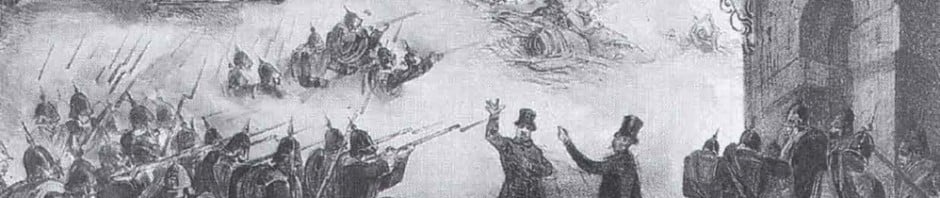
It is often said that the first victim of war is the truth. What is ignored in this common sense wisdom is that all war is, among other things, a war between truths, a war for the creation of truth. In the age of Empire, of global systems of control, the distinctions between internal and external enemy, combatant and non-combatant, vanish. They have of course always been fragile, but the contemporary State, a security node in the network of global capital, can only act to contribute to the undisturbed flow of capital. And the greater the pacification, the greater is that State’s capacity to function as a temporary pole for primitive capital accumulation and exploitation.
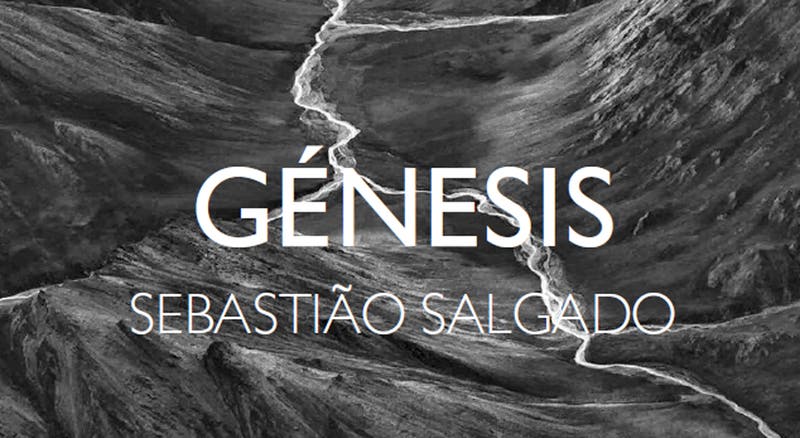
Sebastião Salgado’s most recent photographic work turns away from his now more traditional themes – e.g. labour, migration, war and genocide … what may be summarised as a concern with the violent dramas of the human condition – to capture “nature”: landscapes, animals, human communities. Lélia Wanick Salgado, who curated the exhibition of the photographs, describes them as a “tribute to a threatened planet”.
Libérer la vie, libérer la vie des prisons … c’est ça resister.
Gilles Deleuze, Abécédaire
Art for me is just a natural reaction. I just try to share this reaction to what I love, and want to share. The pleasure is to give out what you like the most. If you do it just for yourself, it is not really creativity. Creativity, for me, is mostly something that can be shared and appreciated by others.
Frédéric Back
In the world of Frédéric Back, we speak and live with animals and gods; the separations of our progress and modernity are preceded and forever grounded in a more primordial “chaos” of life, where individuality possesses no distinct boundaries, where with whom or with what we are is of far greater significance than who or what we are. Life is a flow, a perpetual movement, a river, like Back’s great St. Lawrence, with shapes and forms intermingling and interlacing with each other, and forever changing. The illusion is to want more, to seek to domesticate and dominate the energy of life, its rivers and lands, its plants and animals, even its gods; the illusion of sovereign separation from that we which ourselves are, living nature. We walk blindly into the shining lights of progress, seduced and silenced, happily building the prisons of our own incarceration. In Back’s Illusion, an Eden like vision of innocent childhood happiness expresses in an almost utopian manner the earthly passion of the Man who planted trees. But it is not an eccentric neo-primitivism that resonates in his films, but rather the celebration of life, even life moulded by human hands, as the rocking chair in Crac! Our tragedy is not that we have forgotten and abused nature; rather it is that that nature which we have touched and made ours with all that lives, we have cared nothing for. All living beings (and everything that interacts with us lives) change the natural-artificial world. The point then is not to cease to so effect it, but to endeavour to do so in ways where we may cherish that with which we live and that which we create.
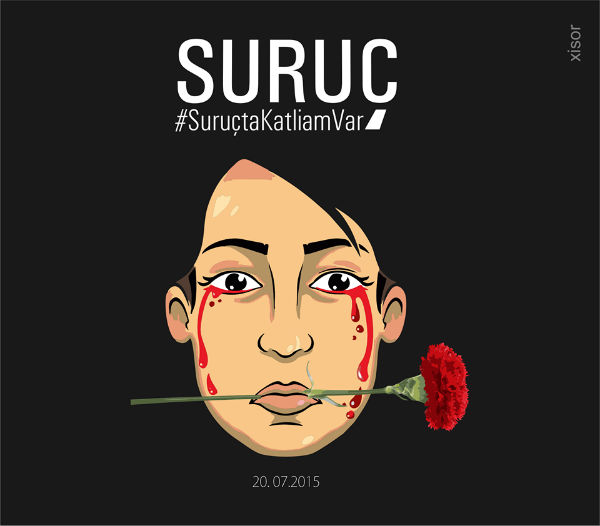
Over thirty people have died, and over seventy are injured, in a bomb attack in Suruç, turkey, on the turkish-syrian border accross from Kobane. The target was a gathering of the Federation of Socialist Youth Associations (SGDF) meeting at the Amara Cultural Center, before setting off to Kobane, to aid in the reconstruction of the city, now liberated from ISIL occupation. We have little sympathy for conspiracy theories, but as suspicions for the massacre fall upon an ISIL suicide bomber, it is difficult not to exclude altogether at least indirect (if not direct) responsibility to the AKP government in Ankara. Erdogan and the AKP have not only tacitly supported ISIL, in its war against the kurdish PYD in Syria, but have also armed them directly. (Reuters 21/05/2015) For the turkish government, kurdish autonomy in syria, and an autonomy that is experimenting with forms of radical self-government, is a far greater threat than islamic fascist fundamentalists, for the experiment may become contagious. The recent success of the leftist, originally kurdish based party, the HDP (People’s Democratic Party) in the country’s parliamentary elections, the still resonant events of the Gezi Park protests, and so on, may have pushed more extremist elements in the AKP to intervene more radically in events, attacking the socialist youth gathering. And as protests erupted in various cities throughout the country, the authorities could only respond with violence.
Wafaa Charaf was arrested and placed in preventative detention on the 9th of Januray 2014 in Tangier. Earlier she had made a formal legal complaint against unknown individuals for kidnapping, sequestering and threats on the 27th of April 2014, after a demonstration in support of labour activists fired by the company Grief after having organised a labour union local.
We share a text by Paul Beatriz Preciado, in translation, that was originally published in the french newspaper Liberation (26/09/2014): a critical reflection on feminism and more broadly on what Preciado calls “animalism” …
Following on the recent posting of an essay by Bruno Latour on post-environmentalism, we join to it a reflection on cyborg ecology and agriculture from the excellent blog “Out of the Woods” that is carried on libcom.org (17/07/2015), as means to further debate on the nature of a radical, anti-capitalist ecology …
Today is Sunday. Today they led me out into the sun for the first time. And for the first time in my life I stood immovable Amazed at how distant the sky was How vast, How blue Respectfully I sat down on the ground Leaned my back against the wall At this moment No falling into revolting waves at all At this moment no thoughts Of struggle Of freedom Of my wife. The soil, the sun and me … I am happy.
Nâzim Hikmet
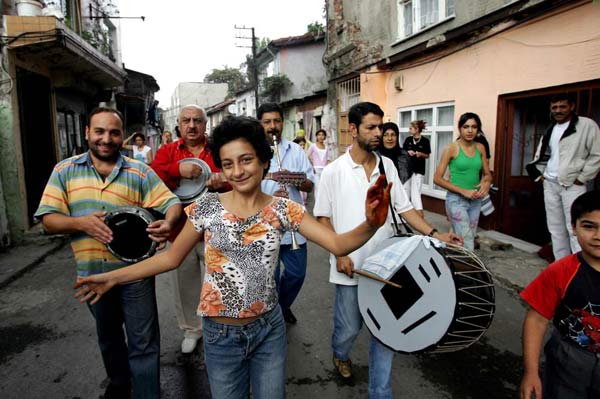
The house was a crack in the aluminum barrier that circumscribes the area marked for demolition and “renovation” in the neighbourhood of Tarlabasi; pulled away like the lid of a tin of sardines, a tattered house stood with three modest men seated upon the stairs of the porch, contemporary squatter-rebels against urban capitalist appropriation. A stone’s throw from Taksim square and the intense tourist economy of the Istiklal district, Tarlabasi is the lie to Erdogan’s and the AKP government’s capitalist fantasy of consumer plenty and middle class happiness. Like a sore or cancer on the healthy flesh of the bio-political body, it must be removed. Far too sick for proper rehabilitation, it can only be destroyed.




.jpg)

Migrants as border rebels
… we actually live in a world in which human beings as such have ceased to exist for quite a while; since society has discovered discrimination as the great social weapon by which one may kill men without any bloodshed; since passports or birth certificates, and sometimes even income tax receipts, are no longer formal papers but matters of social distinction.
Hannah Arendt, We Refugees
French and british governments, politicians and media joust with each other over who is more lax in the control of “illegal” migrants, while everyday, these last months, hundreds, sometimes thousands, brave the passage through the Euro-tunnel from Calais to england (with over a dozen persons having died). More barriers, more surveillance systems, more police, more guard dogs are provided and promised, costing tens of millions of Euros. Laws, old and new, punish anyone who might “aid” those ignoring the borders (e.g. british landlords). Military and security metaphors proliferate in the speeches and public interventions of the guardians of order, mobilised to justify measures against migrants increasingly “naturalised” as sub-humans; David Cameron’s “swarms”.
Continue reading →