
I want to try to urge you to think about the historical system of slavery and the prison, the institution of the prison together. And specifically, I want us to think about the extent to which the vast global apparatus of imprisonment and particularly corporate involvement in the business of punishment, that these developments are related to what I would call the sedimented history of slavery we are living out today. In other words, slavery has not yet been completely abolished.
Angela Davis, (September 19, 2003: 5th Annual Eric Williams Memorial Lecture at Florida International University; Title: “Slavery and the Prison Industrial Complex”)
In the next revolution we hope that this cry will go forth:
“Burn the guillotine; demolish the prisons; drive away the judges, policemen and informers — the impurest race upon the face of the earth; treat as a brother the man who has been led by passion to do ill to his fellow; above all take from the ignoble products of middle-class idleness the possibility of displaying their vices in attractive colours; and be sure that but few crimes will mar our society.”
The main supports of crime are idleness, law and authority; laws about property, about government, laws about penalties and misdemeanours; and authority, which takes upon itself to manufacture these laws and to apply them.
No more laws! No more judges! Liberty, equality, and practical human sympathy are the only effectual barriers we can oppose to the anti-social instincts of certain amongst us.
Peter Kropotkin, “Law and Authority”, 1886, The Anarchist Library
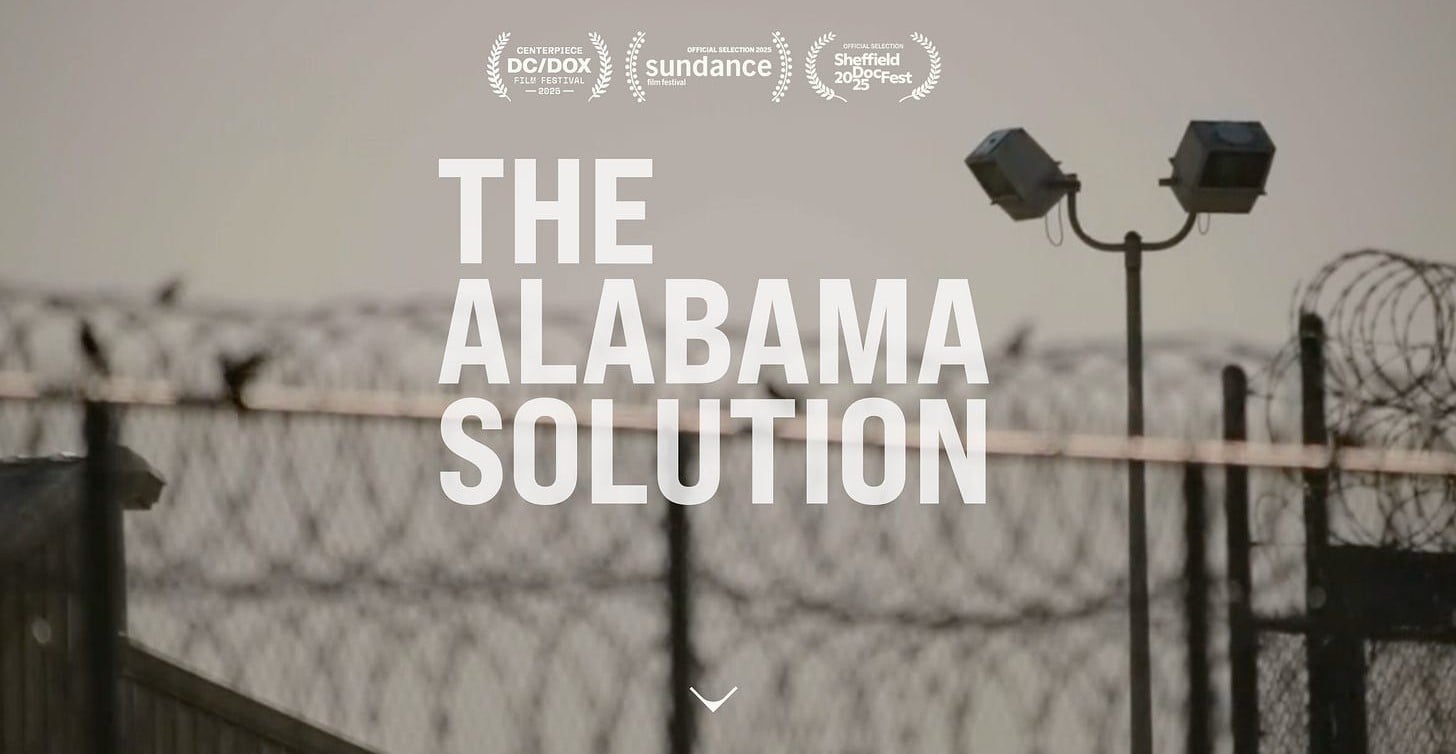
The 2025 documentary film The Alabama Solution, directed by directed by Andrew Jarecki and Charlotte Kaufman, is a journey into the carceral heart of darkness of U.S. society. Giving voice to prisoners and deeply courageous prison activists (notably, Bennu Hannibal Ra-Sun (Melvin Ray), Ricardo (Raoul) Poole, and Kinetik Justice Amun (Robert Earl Council)), the film peels away the thin veneer of any redemptive justification for the Alabama state prison system, revealing it as a particularly violent example of the “prison-industrial complex” of the country, but by no means alone (80 billion dollars a year is spent on prisons and jails, with nearly 2 million people incarcerated, in the US), and by no means exclusive to the United States, even if carceral systems reflect particular histories and societies.
The Alabama Solution is a study in modern slavery and if the only acceptable response to slavery is to demand and act for its abolition, then the abolition of such prisons is the only possible moral and political response to these institutions.
What the film so starkly and painfully shows is that prison institutions are not peripheral to the society, nor are its incarcerated “criminals” merely disposable.
On the contrary, the prison is a defining institution in the production and reproduction of social relations: it serves to generate and reinforce authoritarian state power, indeed, the state as such and its domestic or internal sovereignty, securing “law and order” against the racialised and subaltern “wretched” of society, and very blatantly, in the context of the USA, using the prison population as slave labour (as permitted by the 13th Amendment of the country’s constitution), and beyond this country, through incarceration, torture and murder, governing by and through fear.
Continue reading






Déjà vu and the Horizontal Reinstitution of Future
by Yavor Tarinski
We become epigones or spectators, but epigones or spectators of our very own potential-to-be.
Paolo Virno[1]
Within bureaucratic settings time seems to simultaneously rush and stay frozen – an endless cycle of past-presentism that shrinks leisure and creativity, producing a feeling of déjà vu and futurelessness. It is a condition that withers imagination and makes life miserable. It conditions us to simply observe our future, rather than allow us to inhabit and actively shape it. To alter this we first must obtain an understanding of why we tend to experience our present as stagnant and the structural architecture that corrodes our ability to imagine beyond the horizon of what currently exists.
Continue reading →