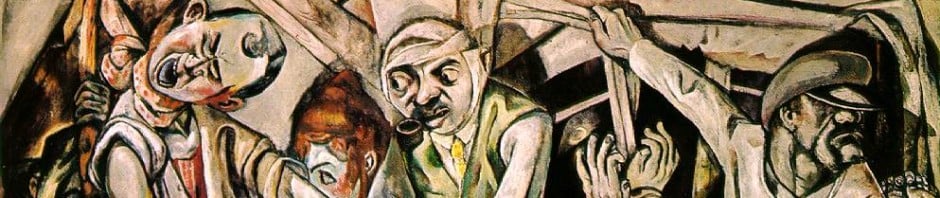

Capitalism, in the late stage of globalization, has abolished all communitarian bonds, autonomous cultures, sociability, collective practices, group identities, etc., stripping individuals of any direct and profound relation with their kind and their environment, and instead setting them at odds. Postmodern man, privileged or marginalized, is a psychological pauper, an unfeeling narcissist with an absolute lack of empathy; when you strip away the appearances and his function is terminated, when face to face with himself he really has nothing but loneliness and emptiness. The most widely-verified social experience in the technological world colonized by the commodity is that of absence and nothingness. This is what alienation is like during the period of decline. Most people try to escape, whether by demanding more security in order to plunge even deeper into a wretched private life, largely virtual and based on a flashy and affected pseudo-individualism [friki—derived from the English word, “freak”], or else by resorting to carefully constructed, and therefore fictitious, identities, seeking refuge, as people did in the past, in ideologies or religions. The times are favorable for both militant escapism and schizophrenia (the two were already connected by Gabel), for both false consciousness as well as for psychopathological reactions against a society that is viewed as a foreign and hostile environment. The doors are equally open to both the opportunity to enclose ourselves in an air-conditioned shell and the opportunity to throw ourselves off a cliff.
…
The revolutionaries of the sixties and seventies underestimated the capacity for survival of the capitalist regime, but they were not mistaken in their diagnosis. The fact that the critical minorities of that era were incapable of transmitting their views to a broader public, does not obviate the circumstance that the degree of dissatisfaction is increasing and that lucid protest can reappear and spread if an idea of another way of life—a crystallization of historical consciousness—can take root in a large enough part of the population where those who have been left behind are well-represented. Shortages and hunger can contribute to this development, but they are not the determining factors. Naturally, survival is the highest priority, but the impossibility of satisfying even the most minimal moral necessities that inform the community spirit is the principal element of revolt. This was true of the proletarian revolutions of the past and this is what can once again characterize the struggles in defense of territory, the only struggles that are currently replete with vital content and a capacity for idealism. The reconstruction of community bonds and the return of reason is still on the horizon of possibilities, but without any guarantees, since sufficient means of self-defense are lacking. Resignation is presently predominant, and careerists, predators and the mentally ill are numerous, but there cannot be the slightest doubt that the statist-market society is destined for the scrap yard. This is the only prediction that can really be made without any risk of being disproven. Of course, this does not imply the automatic triumph of the libertarian cause, for it might in fact signify the contrary—the State might emerge victorious, or nihilist barbarism might prevail—but we cannot entirely rule out the victory of freedom. There is still a lot of thread on the spool. History never stops and a period of darkness can be followed by an era of light.
Miguel Amorós
Miguel Amorós was friend and collaborator of Jaime Semprun, working with him on the Encyclopédie des Nuisances. And it is as such that we share a reflection by him inspired by and in continuity with Semprun’s essay, The abyss repopulates itself.
Amorós’ political baptism came with the not so distant events of May 68 (he was living in spain at the time). Engaged in anarchist politics both in france and spain, his theoretical work would endeavour to engage with the “rise and fall” of radical political practice from this period until the present.
Miguel Amorós is a writer whose work we have shared before, with essays on the passing of the working class as a revolutionary subject, on the Situationists and May 68, on the ZAD of Notre-dame-des-Landes and on the Catalan independence movement. (click here) And we post the text below as an engagement with the work of Jaime Semprun and as part of our series of essays authored by Jaime Semprun, Amedeo Bertolo and Eduardo Colombo.


Jaime Semprun: For a ruthless criticism of all that exists
In all the representations disseminated by catastrophism, in the way they are elaborated as well as in the conclusions they inspire, we see above all an astonishing accumulation of denials of reality. The most obvious is the one that refers to the ongoing, and already consummated, disaster, which is hidden behind the image of the hypothetical catastrophe, when it is not calculated or extrapolated. In order to be able to understand the extent to which the real disaster differs from the worst scenarios announced by catastrophism, we shall attempt to define it in a few words, or at least specify one of its principle features: by utterly ruining all the material foundations, and not just the material ones, on which it is based, industrial society creates such conditions of insecurity and generalized instability, that only an increase of organization, that is, of submission to the social machinery, can still cause this collection of terrorizing uncertainties to pass for a habitable world.
Jaime Semprun
The real catastrophe is not the one that our leaders are announcing, but the persistent blindness of the oppressed majority, which lacks the will to act on the causes of its oppression, and basically wants the same things that are offered by the owners of the world. We must face the fact that the deterioration of life is not driving the masses to revolt but to a condition of submissive adaptation. The most absolute conformism prevails without any effective opposition. Conflicts dissolve with shocking ease among citizens re-educated in green consumerism and internet voting. Disaster management underlies the policies of all States, which are, in their own way, environmentalists. The catastrophism of official propaganda justifies compulsory submission to the directives of a now-“sustainable” domination.
…
Those who try to oppose the system from within, who are treated so badly in the book, will accuse Jaime and René of being pessimists, or even defeatists. Nothing could be further from the truth. Rebels still exist, the critical imagination resides in those who have not thrown in the towel, who have not lost their taste for freedom and who fight to live without constraints …
Miguel Amorós, On Jaime Semprun (libcom.org)
The catastrophe of modern capitalist society is now behind us. Ours is the time of total social collapse (a time that calls for total critique). The representations of the catastrophe however continue to simplify it as a passing crisis (or at worse, a set of crises) and push it into a hypothetical future. The promised salvation then lies in further technological innovation and rational management of the conditions of survival. Ideologues of the “left” and “right” proffer recipes of redemption, but fail or ignore to contest the social relations of alienation which assure the collapse.
The “revolutionary working class” has succumbed to the temptations of spectacular consumption; pseudo-rebels and pseudo-revolutionaries go on about “citizenship”, the virtues of “consensus”, “rights”, “peaceful change”, “democracy”; nationalists sing the virtues of race, soil, religion: and all of this while, “wars” of dispossession and control continue apace, while the life-energy of nature is appropriated and destroyed, and while time, space, subjectivities are erased by the representations of fleeting, seemingly eternal commodities and social relations of exploitation.
Some will dismiss all of this as nonsense, and the purveyors of such ideas as deluded.
It was however from this place of “delusion” that Jaime Semprun insisted on speaking.
In our on going series of the “May 68 writers” dedicated to the work of Jaime Semprun, Miguel Amorós, Amadeo Bertolo and Eduardo Colombo, we share a late essay by Semprun, with Renè Riesel (posted on libcom.org).
Continue reading →