

Emancipation isn’t a problem of mechanics nor an issue that can be resolved through technical means. A worker may be able to run a factory or put in motion all the machinery of an industry, but there isn’t in those attitudes the moral capacity to prevent servility and elevate oneself to a higher level.
Emilio López Arango, Means of struggle
The struggle for bread is not enough. Let us capture in the consciousness of man the value of the loss of individuality, establishing a moral resistance to the monstrous constructions of capitalism and opposing to material reality a reality of spirit.
Emilio López Arango, The Resistance to capitalism
Argentina’s Federación Obrera Regional Argentina or the FORA, founded in 1905 as an explicitly anarchist-communist labour organisation, offers a rich example – an example theorised in the writings of Emilio López Arango – of a mass anarchist labour movement that endeavoured to navigate between the shoals of reformist labour unionism and anarcho-syndicalism.
If we take López Arango as our guide, the FORA’s ambition was to ground anarchist politics in the practices of everyday working class struggles, thereby overcoming the risks of ideological sterility (and authoritarianism) in the former and reformism in the latter.
The FORA would finally weaken under a variety of pressures – including the assassination of López Arango -, but it continues to offer an illustration of the necessity of anarchism to remain vitally tied to struggles, as they emerge in different contexts, pushing them always beyond their limits, multiplying their interconnections (an exclusive appropriation of the means of production, or a conquest of the State and nothing more, would be no revolution for López Arango), against the restraints of capitalist social relations.
Following Robert Graham’s Anarchism Weblog, we share a text by Scott Nappalos on Argentina’s FORA, and another text by one of the principal figures of the movement, López Arango …


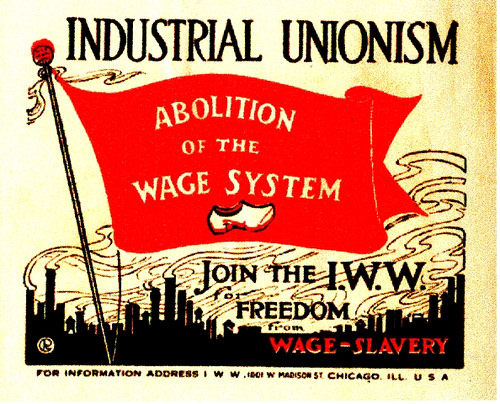




The limits of capitalism: Challenging the fetishism of labour and money
Capital is nothing more than value that must be valorized, which is to say augmented. Value empirically takes the form of money and in that sense its valorization can be illustrated in Marx’s famous formula M–C–M’ [M prime], that is money–commodity–more money. We can call this an end-in-itself motion because the same thing is at the beginning and the end of this endless augmentation loop: money is turned into more money. Value (in the form of money) therefore again and again refers to itself alone and the sole objective of this movement is the constant accumulation of surplus value. By its own internal logic, this end-in-itself motion does not recognize any limits. Because of its purely abstract-quantitative nature, it must, in principle, continue endlessly. That is the basis for the incessant drive for growth in capitalist society—which, as we all know, is destroying the basis of human existence on earth.
Norbert Trenkle
The marxist inspired critique of value offers an impressive theoretical framework for the understanding of the fetish-like nature of capitalist social relations. It challenges the illusions of anti-capitalist politics centred on the liberation of work from capitalist exploitation, or on the legally imposed reform of the conditions of work, or, more recently, on nationalist “populist” promises of getting everyone back to work. The problem is work itself, as the essential mediating relationship of all social life within capitalist societies. Thus any meaningful radical politics against the reign of capital must begin by challenging the centrality of labour, along with commodity production and money as the end of “economic” activity. Any piecemeal tinkering with these relations (through appeals to moral or legal restraint, calls for business ethics, for consuming more responsibly, demands for a “green” capitalism, and the like) will, at best, provide a brief respite for a privileged few, but ultimately, in our present of permanent crises, only render matters worse.
(This also obliges anarchists to critically reflect upon the creation of autonomous social relations under capitalism. This would not be to dismiss the effort – far from it – but rather to point to the need to constantly reflect upon practices that pretend, rightly or wrongly, to free us from capitalist social relations).
It is not that the critique value cannot also be criticised (especially when it tends to ignore the social conditions necessary for the reproduction of capitalist social relations and the fissures or cracks that appear in the social body, in the securing of these conditions; the very cracks where autonomies can be constructed). But much can also be learned from it.
We have on more than a few occasions translated and/or shared essays by authors such as Robert Kurz, Norbert Trenkle, Moishe Postone, Anselm Jappe and collective work by the Krisis collective, Manifesto Against Labour, of 1999. On this occasion, we share a keynote lecture by Norbert Trenkle given at the International Conference
“Rethinking the Future of Work”, April 27 – 28, 2018, ICUB Research Institute of the University of Bucharest.
Continue reading →