What follows is an extract from Gilles Deleuze’s Abécédaire/The ABC Primer, over a series of images of stereoscopic photographs of Palestine dating from the 19th century.
We have added below the English translation of this segment (and a little beyond, covering the letter “G as in ‘Gauche’” (Left)) of the Abécédaire, as it appears in the translation of the Deleuze Seminars at Purdue University.
If a contest were held for who publishes the most effective posters in my city, it would undoubtedly go to the Trotskyites because whatever is in the news that week they engage with and their message discipline is characteristically iron. At the top of their posters is the problem, and below that is the cause. They go like this:
Today, there is a proliferation of ‘doomerism,’ exhaustion, burnout, uptightness, depression, and anxiety on the left. Terrible things seem to happen all the time, and our ability to contest them looks weak. But I don’t think this is actually the case. The problem is that the left talks the left out of using its power: it tells itself it cannot make a difference. Weakness begets weakness. People from the outside listen in and hear our misery and can hardly be blamed for avoiding activism. “Don’t want to be like those miserable weirdos”, they probably think. Well, me neither! So, how do we undermine our own fighting spirit, and how can we regain it?
The liberal order overseeing and administering the genocide in Palestine is built upon the marriage of egalitarian values and exterminating violence, upon the intimate coupling of supposedly hallowed rights and the hell it unleashes upon the world. Arms must continue to be delivered, just as their use must be denounced and condemned. Demonstrations must be celebrated, just as orders must be given to smother them with tear gas. Everything thus burns twice, as the fuel of liberal politics and the fuel of liberal carnage, feeding an inferno whose fires rage ever more democratically. If there is no need to resolve the formal tension between its abstract ideals and its violent realities, this is because liberalism is the indefinite elaboration of this contradiction. For every sanctified constitution, there is a detention camp that will never close; for every promised equality, there is an economy imposing its cruel hierarchies upon every area of life; for each civic norm, a mob of police marching through the streets drunk on power.
The Portuguese experience between 1974 and 1976 shows that revolutionary activity does not develop as the result of strategies devised by system analysts or bourgeois planners … It emerges in the course of the struggle itself, and its most advanced forms are expressed by those whom it is a necessity to struggle.
Hundreds of thousands of workers entered the struggle. But the enemy constantly appeared before them in unexpected garb: that of their own organisations. Every time they set up an organisation they found it manipulated by so-called vanguards or leaders who were not of their class and who understood little of why they were struggling. Even the groups who paid lip-service to a critique of state capitalism did so because of their weakness. They were forced to support the base organisations for the time being. They were no less Leninist for having a critique of state capitalism for their denunciations proved to be denunciations of particular sets of bureaucrats, not critiques of the system per se.
The revolutionaries – on a massive scale were found to be part of the problem, not part of the solution. In this the Portuguese experience may prove to be a pre-figuration of revolutions to come. The lessons should be pondered while there is yet time. The alternative is clear. It was put concisely many years ago: ‘the liberation of the workers is the task of the workers themselves’
Phil Mailer, Portugal, The Impossible Revolution?
The Portuguese revolution brought a tremendous upsurge of political activity. Though it was brief, it gave rise to a dynamic mass movement involving people from all levels and sectors of society. Revolutions must not only bring changes in political structures; transforming a society requires transforming the lives of ordinary people too. In Portugal in 1974 and 1975, ordinary people challenged the social order forcefully, turning a military coup into an attempted revolution.
Their political activity arose in the context of their everyday lives. … The movements were concrete in their demands and their actions; people did not act in response to an abstract ideology. This was the revolution’s strength: because it was directly related to the lives of individual participants, they could appropriate the revolution and make it their own.
John L. Hammond, Building Popular Power: Worker’s and Neighbourhood Movements in the Portuguese Revolution
The Portuguese Revolution was a massive movement of social disobedience. The very dynamics of the day of April 25, which transformed a military revolt into a street insurrection in Lisbon, with unexpected and spontaneous popular participation, is an aspect little emphasized. What happened after April 25 was not foreseen in the plans of the rebel soldiers. The expanded possibilities were the fruit of popular intervention. Likewise, the second military intervention, on November 25, 1975, which ended the revolutionary period, signifies the end of possibilities that were considered impossible before April 25. It is the return to “normal” possibilities, the return to a society of obedience.
“Portugal: une révolution, cinquante ans d’état démocratique et, au final, le retour des monstre d’hier…”, Interview with Charles Reeve, lundi matin #425 (23/04/2024)
This year marks the 50th anniversary of the Portuguese revolution of 1974-1975, a revolution framed by two coups d’état: the overthrow of the fascist regime on the 25th of April, 1974, by a group of career military officers and the men they commanded (known as the “MFA-Movimento das Forças Armadas”) and the intervention of conservative elements of the military on the 25th of November, 1975, disbanding and arresting more “leftist” military units in the Lisbon area, then inaugurating a more widespread action against the revolution and creating the conditions for a “liberal-parliamentary democracy”.
By Frédéric Neyrat (of the collective Contre-Ciel), published in lundi matin#425 (22/04/2024)
That we can no longer say “free Palestine” without being qualified as terrorists, that the signifier Palestine is now banned, is often interpreted as a “fascist” or “totalitarian” drift of power. This interpretation perhaps misses something essential: the ban on the signifier Palestine as an effect of the ongoing geopolitical reconfiguration.
This reconfiguration is part of the history of the 20th century, the history of (anti)colonial conflicts and the divisions between capitalist “democracies” and socialist “democracies”, but once these divisions have been emptied of their meaning. Today there is no longer any geopolitics based on horizons of liberation. Only the arid ghosts of these divisions remain once the American Empire collapses; no longer Imperialism (mechanically implied by those who continue to use this term, “American imperialism”), but the compelling appetites of a post-global era; eco-nationalist impulses, driven by Russia, China, India, the United States of America, Turkey, and all the contenders. These appetites are polarized between on one side a devitalised simulacrum of the West, the USA-Israel-France-Germany-England-Japan, etc., and on the other, an alliance of China-Russia-Niger-Iran-North Korea, etc. . None of these camps carries any emancipatory ideal.
Within this logic, saying “Palestine” means siding with one camp. In the camp of the “West”, to say “Free Palestine” is therefore to occupy the position of the enemy. The fundamental question is therefore not that of fascism or totalitarianism, but that of war.
What can we do ? Reject the geopolitics of carnage. Today there is no geopolitical support to be expected, from any country, from any bloc. All that remains for us to do is to find within ourselves a philosophical, spiritual, ethical and political resource in a situation of war – we will help ourselvesin this by reading Tolstoy, Gandhi, Rosa Luxemburg, Jean Jaurès and Judith Butler. This resource could take the form of pacifism, antimilitarism, citizen self-defense, a new post-national horizon (planetary, terrestrial). Once discovered, this fulcrum must be shared as quickly and as widely as possible. Because without this, we will be unable to deactivate the physical and symbolic violence of States. Caught in war, States will repress without restraint because they will be incapable of doing otherwise, obeying the logic of “either me, or the other”. They will then finance all the carnage, all the genocides, and will devastate the Earth.
Each and everyone must therefore learn today how to deactivate war.
We publish below a pamphlet generously shared with us by Tomás Ibáñez that tells the story of the circled A as an anarchist symbol, a symbol whose 60th anniversary falls on this year.
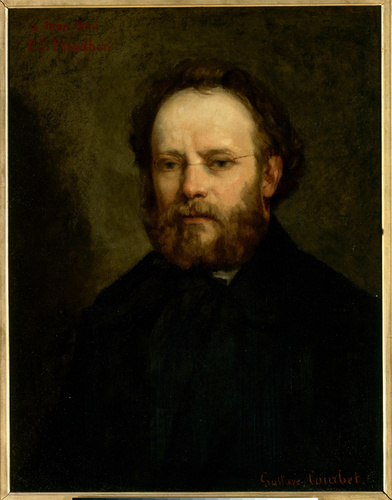
Portrait of Pierre-Joseph Proudhon (1809-65) 1865 by Gustave Courbet (1819-77)
We learned from a recent interview with Catherine Malabou by the Lundi Matin collective (for their Lundi Soir series of video recorded interviews – see below) that she has published a new work centred on Pierre-Joseph Proudhon’s essay, What is Property? (1840) and entitled Il n’y a pas eu de Révolution: Réflexions sur la propriété privé, le pouvoir et la condition servile en France (Éditions Payot & Rivages, Paris, 2024).
In this work, Malabou offers a close, careful and brilliant reading of Proudhon’s essay, from which she then moves on to contemporary debates around private property, democracy and anarchism.
Our enthusiasm for this, her new work, led us to venture an English language translation of the first chapter, because it is our belief that her interpretation of Proudhon’s essay is of considerable importance, not only for understanding Proudhon, but also for rethinking anarchism. And this essay comes in the wake of her earlier work, Au voleur! Anarchisme et Philosophie/Stop Thief! Anarchism and Philosophy (and it continues this earlier work), in which she critically analysed the appropriation of the concept “anarchy” by philosophers who however refused to consider the complex relations between that concept and anarchism.
What we offer below is of course no substitute for whatever English language translation-publication may be eventually forthcoming. Until then, let this stand as a modest introduction for those who are not entirely comfortable with French.
As for the significance of this more recent work and Malabou’s interpretation of Proudhon, a brief translator’s note is necessary on our part. We have left unchanged throughout the text the French words aubaine and aubain and let them stand as they are – however strange this may read -, because there is no obvious translation for these terms in English. And our reasons for doing so will, we hope, become evident (see Malabou’s footnote 15 below on this subject) in the reading of the chapter. Part of the significance of Malabou’s reading of Proudhon’s What is Property? lies precisely in fixing on the terms aubaine and aubain.
In the aftermath of the Holocaust and the formation of Israel, Jews’ position in the Global North transformed from racialized minority into fully white members of “Judeo-Christian” society. As Gilbert Achcar shows in this essay, however, this assimilation into “super whiteness” relies on Jews placidly accepting their equation with Zionism and thus Israel’s racist discrimination and violence against Arab Muslims.
No, we do not want to catch up with anyone. But what we want is to walk in the company of man, every man, night and day, for all times.
Frantz Fanon, The Wretched of the Earth
How can we not question ourselves even more each day in the face of Israel’s bloodthirsty and senseless headlong flight, this endless one-upmanship. Whatever the word to define, extermination, carnage, butchery, ethnocide, deportation, genocide, “on the way to…”; the desire of Israeli State to be done with the Palestinian population is now indubitable and irreversible.
Luis Andrés Bredlow (left) and Agustín García Calvo
From Lundi Matin (#420, 18/03/2024), we share below an interview with Luis Andrés Bredlow and a memorial to him by Anselm Jappe (Lundi Matin #115, 30/09/2017) after Bredlow’s death.Our hope is that these may serve as a modest introduction to an author who is largely unknown in the English speaking world.
We take the opportunity of the publication of Luis Andrés Bredlow’s Essais d’hérésie by Éditions Crise & Critique editions, to publish the translation that we received of an unpublished interview dating from 1995 and briefly present this author whose work we have published before, with the article “De la machine sociale à la révolution biologique”. For a more detailed presentation, we refer the reader to the portrait “Souvenir de Luis Bredlow” that his friend Anselm Jappe wrote at the time of his death.
Luis Andrés Bredlow (1958-2017) taught the history of philosophy at the University of Barcelona. Poet, translator, essayist, philosopher, specialist in Parmenides, after having contributed to the dissemination of Situationist ideas in Germany from the end of the 1970s through the journal Ausschreitungen, which he co-founded with the publisher Klaus Bittermann. He also participated in the Barcelona magazines Archipiélago, Mania and Etcétera, in which he published numerous articles of social criticism, as well as translations of texts of critical value theory. We owe him, among other things, a translation of the passage “The fetish character of the commodity and its secret” from Marx’s Capital (introduced by Anselm Jappe), an edition of Max Stirner’s Minor Writings [Écrits mineurs], commented translations of the works of Gorgias and Diogenes Laertius, an introduction to the philosophy of Plato and that of Kant, as well as a critical edition of the Parmenides’ Poem, in collaboration with Agustín García Calvo. In addition to the Essais d’hérésie, the reader will be able to read in French his article “La contradiction et le sacré” published in issue nº 6 of the journal Jaggernaut, as well as his introductions to the works translated into French by Agustín García Calvo (La société du Bien-être, Le pas de côté, 2014; Histoire contre tradition. Tradition contre Histoire, La Tempête, 2020 ; Qu’est-ce que l’État?, Atelier de création libertaire, 2021 and Apophtegmes sur le marxisme, Crise & Critique, 2022).






A B [Cinétract/Film-tract]
Gilles Deleuze, revolution, Palestine and stereoscopy
From Lundi Matin #427, (06/05/2024) …
What follows is an extract from Gilles Deleuze’s Abécédaire/The ABC Primer, over a series of images of stereoscopic photographs of Palestine dating from the 19th century.
We have added below the English translation of this segment (and a little beyond, covering the letter “G as in ‘Gauche’” (Left)) of the Abécédaire, as it appears in the translation of the Deleuze Seminars at Purdue University.