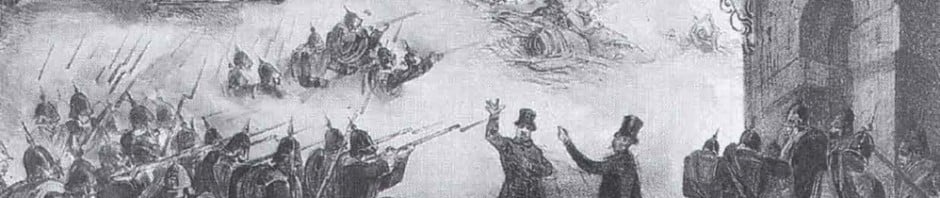

Martin Bernetti/AFP
subMedia announces the first episode of their new documentary series, InterRebellium, featuring a deep dive on the 2019 uprising in Chile.
Continue readingsubMedia announces the first episode of their new documentary series, InterRebellium, featuring a deep dive on the 2019 uprising in Chile.
Continue reading
A passage from Sergio Bettini’s book on L’arte alla fine del mondo antico [Art at the End of the Ancient World] describes a world that is difficult not to recognise as similar to the one we are living in. “The political functions are assumed by a state bureaucracy; the bureaucracy is accentuated and isolated (anticipating the Byzantine and medieval courts), while the masses become abstentionist (germ of the popular anonymity of the Middle Ages); however, within the state new social nuclei are formed around the various forms of activity (germ of the medieval corporations) and the latifundia, rendered autarchic, are a prelude to the organization of some of the great monasteries and of the feudal state itself.”
Continue reading
It wasn’t as though we didn’t know how overwhelmingly the army outnumbered us. But the strange thing was, it didn’t matter. Ever since the uprising began, I’d felt something coursing through me, as overwhelming as any army.
Conscience.
Conscience, the most terrifying thing in the world.
The day I stood shoulder to shoulder with hundreds of thousands of my fellow
civilians, staring down the barrels of the soldiers’ guns, the day the bodies of
those first two slaughtered were placed in a handcart and pushed at the head of
the column, I was startled to discover an absence inside myself: the absence of
fear. I remember feeling that it was all right to die; I felt the blood of a hundred
thousand hearts surging together into one enormous artery, fresh and clean … the sublime enormity of a single heart, pulsing blood through that vessel and into my own. I dared to feel a part of it.At one o’clock in the afternoon, while the speaker in front of the Provincial
Office was playing the national anthem, the soldiers opened fire. I’d been
standing in the middle of the column of the demonstrators, but when the bullets
came flying, I turned and ran. That sublime feeling that I’d been tapping into,
that enormous heart I’d felt briefly a part of, was smashed to pieces, strewn over the ground as so much rubbish. And the gunfire wasn’t only in the square;
snipers were also positioned on the roofs of the surrounding buildings. Beside
me and in front of me people crumpled to the ground, but I kept on running.
Only when I was sure I’d left the square far behind did I let myself stagger to a
stop. I was so out of breath I genuinely thought my lungs would burst. My face a mask of sweat and tears, I sank to my knees on the steps leading up to a shop
door. Its shutters were down. A small group had gathered in the street, and I
heard them talking about raiding the police stations and reserves barracks to get guns. They were clearly made of much sterner stuff than I was. We’re sitting
ducks like this. They’ll gun us down, the lot of us. Paratroopers even broke into
the houses in my area. I was so scared I slept with a kitchen knife by my pillow.
Shooting hundreds of rounds like that in broad daylight – I’m telling you, the
world’s gone mad!One of them jogged off to fetch his truck, and I stayed there slumped on the steps until he drove back. I thought about whether I really had it in me to carry a gun, to point it at a living person and pull the trigger.
It was already late at night by the time the truck I was riding in returned to the
centre. We’d twice taken a wrong turn, and when we’d got to the barracks we’d
found that the guns had already been looted, so it turned out to be a wasted trip. In the meantime, I had no way of knowing how many had fallen in the street fighting. All I remember is the entrance to the hospital the following morning, the seemingly never-ending line of people queuing up to give blood; the doctors and nurses striding through the blasted streets, white gowns bloodstained, hands gripping stretchers; the women who handed up stale rice balls, water and strawberries to the truck I was riding in; the strains of the national anthem, and ‘Arirang’, which everyone was singing at the top of their voice. Those snapshot moments, when it seemed we’d all performed the miracle of stepping outside the shell of our own selves, one person’s tender skin coming into grazed contact with another, felt as though they were rethreading the sinews of that world heart, patching up the fissures from which blood had flowed, making it beat again. That was what captured me, what has stayed with me ever since. Have you even known it, professor – that terrifying intensity, that feeling as if you yourself have undergone some kind of alchemy, been purified, made wholly virtuous? The brilliance of that moment, the dazzling purity of conscience.Han Kang, Human Acts (2014)
Forty-five years on from the Gwangju uprising, we revisit an event that is only comparable, according to George Katsiaficas, to the Paris Commune or that can only be understood in what the author Han Kang calls “the ‘absolute community’ of self-governing citizens”. (Nobel Prize Lecture, 2024)
And we celebrate and mourn this event as part of the tradition of the oppressed, recalling Walter Benjamin’s words, and the more recent words of Han Kang.
Continue readingThe tradition of the oppressed teaches us that the ‘state of emergency’ in which we live is not the exception but the rule. We must attain to a conception of history that is in keeping with this insight. Then we shall clearly realize that it is our task to bring about a real state of emergency, and this will improve our position in the struggle against Fascism. One reason why Fascism has a chance is that in the name of progress its opponents treat it as a historical norm. The current amazement that the things we are experiencing are ‘still’ possible in the twentieth century is not philosophical. This amazement is not the beginning of knowledge—unless it is the knowledge that the view of history which gives rise to it is untenable.
Walter Benjamin, On the Concept of History (1940)

Revolution is now able to pose its true terrain of struggle, whose centre is everywhere, but whose place is nowhere. Its task in this sense is infinite: to destroy domestication and engender the infinite manifestation of the human being of the future.
Jacques Camatte
We recently learned of the death of Jacques Camatte, a key figure in the revolutionary thinking of the 60s and 70s. Some of his writings, which appeared in the journal Invariance that he edited, had a major influence on many. His contributions to the analysis of changes in capitalism, and therefore to revolutionary theory, were invaluable and decisive. As a tribute to his work, we share below his essay Contre la domestication [Against Domestication], published in 1973, in the 3rd issue of Invariance. Though that was 52 years ago, it remains, like so much of Camatte’s work, powerfully relevant.
The source for the essay below is the Jacques Camatte archive, at the Marxist writers archive. The libcom.org website also houses a collection of his writings.
For an introduction to and analysis of Camatte’s work, see: Michele Garau two part essay The Community of Capital (published in English by Ill Will, 2022, pt. 1 and pt. 2). And for a short memorial, see: Maxence Klein, In memoriam: Jacques Camatte (1935-2025) (published in English by Ill Will, 04/05/2025)
Continue reading
We share below a recent talk given by Tomás Ibáñez at the Ateneo Libertario La Idea, Madrid, on the 27th of February. The importance and urgency of its subject matter requires no introduction.
(Source: Redes Libertarias, 17/03/2025)
I shall begin with a note that is merely conceptual, or perhaps simply terminological.
I – Fascism and Neo-fascism
It is well known that fascism proper, classical fascism, is a historically situated phenomenon which, despite their differences, usually encompasses both Mussolini’s fascism and Hitler’s National Socialism. We also know that this term has been extrapolated to designate both regimes that bear a certain resemblance to those that prevailed in the 1920s and 1930s, and to qualify political positions and movements that claim to be based on the ideologies of those regimes, with a few minor updates, if any.
Continue reading
We publish below an essay generously shared with us by its author, Simón Royo Hernández. Hernández’s work has endeavoured to engage philosophically with the tradition of political anarchism, as others have tried to do, in significant ways.
We know that many criticise such endeavours, even perhaps citing Bakunin in their favour: “No theory, no ready-made system, no book that has ever been written will save the world. I cleave to no system. I am a true seeker.” And yet Bakunin was no stranger to philosophy and he did not hesitate to also criticise “philosophically” ideas that he thought problematic. More importantly, the refusal of the refusal of theoretical systems is not a refusal of philosophy, for what Hernández in part explores is precisely the anti-systemic or anti-totalising nature of anarchist thought.
Whatever one’s judgement about such an exercise, to dismiss it categorically is itself intellectually arrogant.
And what kind of action or praxis would be imaginable or possible without thought?
Continue reading
From ctxt: Contexto y acción (28/03/2025) and Lobo suelto (28/03/2025)
A few days ago I received an invitation from an American association to participate in a conference to be held in Chicago on 5, 6 and 7 April. The theme of the convention is, “Is there a left in the 21st century?” I quickly replied:
“Unfortunately, my health is so precarious that I cannot make the trip to Chicago. So I will not be able to be with you in person. However, I will write a text and publish it before April so that you can read my reflections if you are interested in my views. Thank you for the invitation.”
Frankly (beyond my physical frailty), I have no desire to go to the United States, to that terrifying country where a mafia of aggressive racists rules over a population of unhappy individuals living in a frenzied competition for survival.
However, the question to be discussed at the convention is a good starting point for a much-needed reflection on the future (or non-future) of social subjectivity in this century. Here is my response.
Continue reading
From Freedom News (11/04/2025)
Algorithms, facial recognition, and tightening protest laws signal a deepening surveillance state
by Blade Runner
The UK is expanding its use of predictive policing and surveillance, framing it as a response to crime, protest, and public safety. But the direction is clear: more monitoring, earlier intervention, and more control over dissent.
In early April, The Guardian revealed that the Ministry of Justice is developing a “murder prevention” system. The tool aims to identify individuals judged to be at high risk of committing lethal violence, based on data drawn from multiple agencies—social care, policing, education. The government has framed the project as a research initiative to improve risk assessments and early intervention. But its underlying logic marks a shift toward ‘precrime’—managing individuals on the basis of what they might do, rather than what they’ve done.
Continue reading
Imagining an anarchist-ecological possibility from our shared, collective past, with Peter Gelderloos.
From In These Times (03/02/2025)
The mainstream climate framework is utterly failing to solve the climate crisis. What could a real solution look like?
In one way of measuring it, the mainstream framework to address the climate crisis has been a huge success. Promoting green energy, electric vehicles, conservation zones, carbon credits, carbon capture, and other new technologies has made billions of dollars for companies like Tesla, Google, NextEra Energy, British Petroleum, Saudi Aramco, Tongwei Solar, McKinsey & Company, and BlackRock. Governments have gained power through increased interventions in economic planning, and authoritarian regimes from China and India to Canada and the U.S. now have a new justification to carry out land theft against Indigenous and rural populations. And millions more NGO directors, aid workers, diplomats, accountants, entrepreneurs, engineers, academics, and scientists get a hand-out in the form of high salary employment managing the crisis.
Continue reading
David Graeber: Hatred has become a political taboo
A season is set for everything, a time for every experience under heaven: … A time for loving and a time for hating …
Ecclesiastes, 3:1,8
By the end of the twentieth and beginning of the twenty-first century, it is the one emotion that is considered intrinsically illegitimate. We have legal categories like “hate speech,” “hate crimes.” For a public figure, to profess or even publically acknowledge feelings of hatred towards anyone—even their bitterest rival—would be to instantly place themselves outside the pale of acceptable political behavior. “Haters” are bad people. In no sense can it ever be legitimate to base a political or social policy on hatred, of any kind. It has come to such a pass that one can barely encourage hatred even against abstractions. Christians used to be encouraged to “love the sinner, hate the sin.” Such language would never have been coined today. Even to encourage others to feel hatred for envy, pride, or gluttony might be considered slightly problematic.
Continue reading →