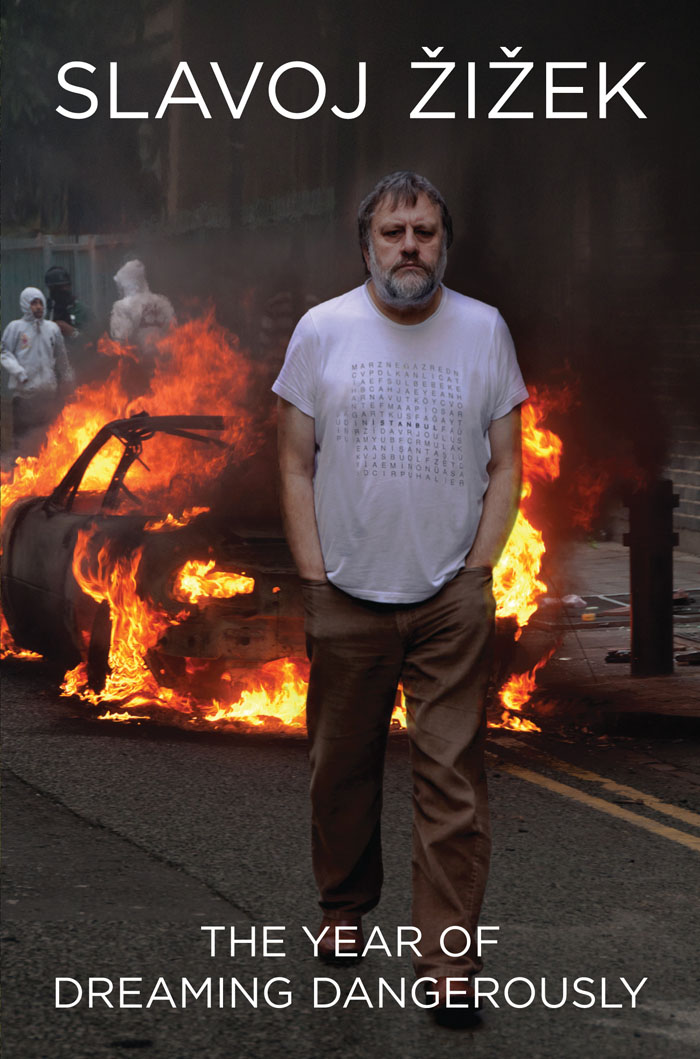
“…one should learn the art of recognizing, from an engaged subjective position, elements which are here, in our space, but whose time is the emancipated future …”
Slavoj Žižek, The Year of Dreaming Dangerously
Reflecting on the year 2011, a year that Žižek describes as involving the “revival of radical emancipatory politics all around theworld”, the year following, 2012, brings evidence of “how fragile and inconsistent that awakening was, as the signs of exhaustion begin to show.” (127) His diagnosis, at least of Occupy Wall Street, of what he calls the indignados of spain and the protests in Syntagma square of Athens is simple and unambiguous: they “express an authentic rage that remains unable to transform itself into even a minimal positive program for socio-political change. They express a spirit of revolt without revolution.” (78) Euphoric, ecstatic, carnivalesque: such words and others like them capture the passion that is experienced by many involved in the movements. “But carnivals come cheap – the true test of their worth is what happens the day after, how our everyday life has or is to be changed.” (77) For Žižek, this “requires difficult and patient work” (77), something that can only be carried out by “a strong body able to reach quick decisions and realize them with whatever force maybe necessary”; something that Lenin was acutely aware of. (82) It is evident, for Žižek, that not only did such a body fail to materialise, the movements ideologically also completely failed to define themselves in any adequate manner.
Continue reading →




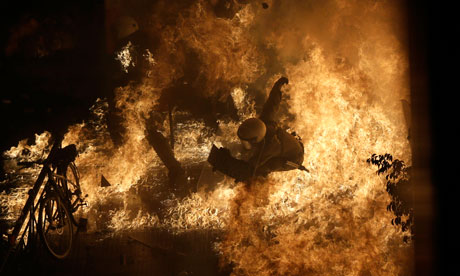



Žižek dreaming, or Žižek, the dialectical trickster
“…one should learn the art of recognizing, from an engaged subjective position, elements which are here, in our space, but whose time is the emancipated future …”
Slavoj Žižek, The Year of Dreaming Dangerously
Reflecting on the year 2011, a year that Žižek describes as involving the “revival of radical emancipatory politics all around theworld”, the year following, 2012, brings evidence of “how fragile and inconsistent that awakening was, as the signs of exhaustion begin to show.” (127) His diagnosis, at least of Occupy Wall Street, of what he calls the indignados of spain and the protests in Syntagma square of Athens is simple and unambiguous: they “express an authentic rage that remains unable to transform itself into even a minimal positive program for socio-political change. They express a spirit of revolt without revolution.” (78) Euphoric, ecstatic, carnivalesque: such words and others like them capture the passion that is experienced by many involved in the movements. “But carnivals come cheap – the true test of their worth is what happens the day after, how our everyday life has or is to be changed.” (77) For Žižek, this “requires difficult and patient work” (77), something that can only be carried out by “a strong body able to reach quick decisions and realize them with whatever force maybe necessary”; something that Lenin was acutely aware of. (82) It is evident, for Žižek, that not only did such a body fail to materialise, the movements ideologically also completely failed to define themselves in any adequate manner.
Continue reading →