
This essay is the child of an earlier reflection on time and revolution, as well as of work on the 15th of May movement in spain, Pasolini and anti-fascism, and other essays posted on Autonomies, from which it borrows generously.
I am nobody! Who are you?
Are you nobody, too?
Then there’s a pair of us – don’t tell
They’d banish us, you know.
Emily Dickenson
The inferno of the living is not something that will be; if there is one, it is what is already here, the inferno where we live every day, that we form by being together. There are two ways to escape suffering it. The first is easy for many: accept the inferno and become such a part of it that you can no longer see it. The second is risky and demands constant vigilance and apprehension: seek and learn to recognise who and what, in the midst of the inferno, are not inferno, then make them endure, give them space.
Italo Calvino
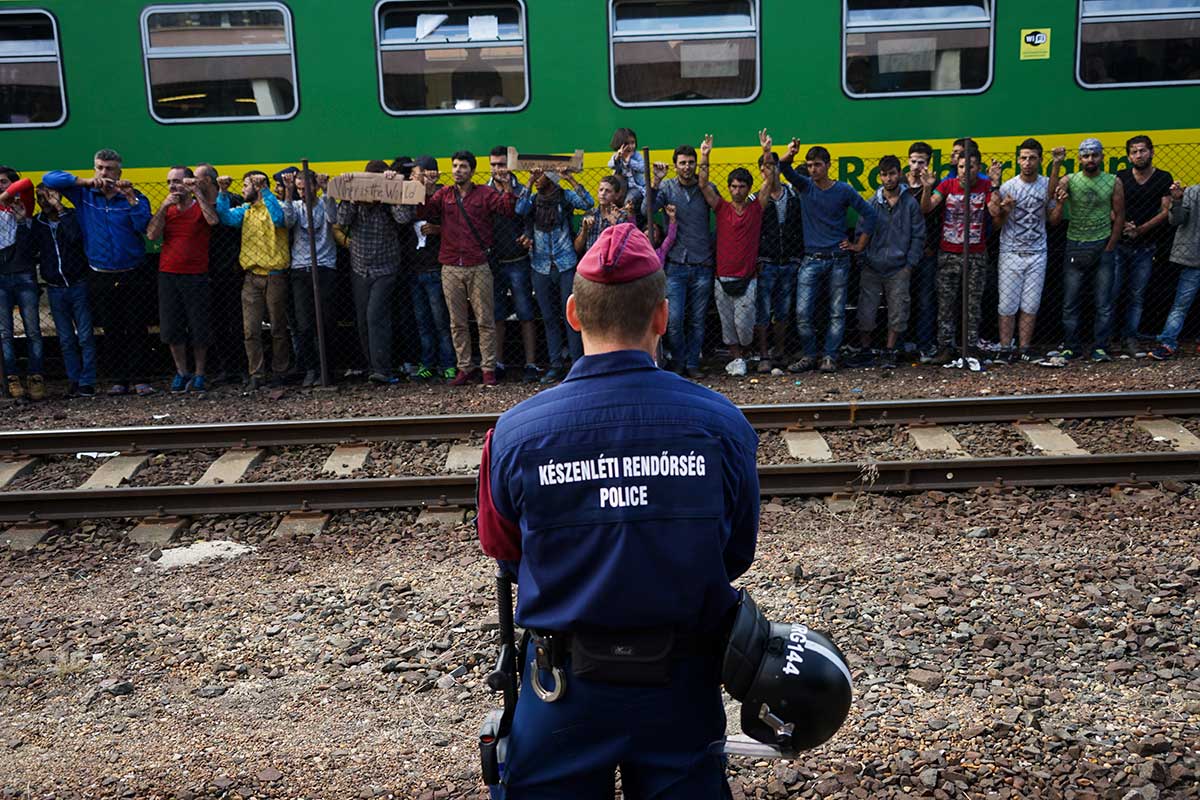
1. Politics are not to be assimilated to the State and police authority, if we follow Jacques Rancière. Of the police, he wrote, in an often cited passage, that they are first “a reminder of the obviousness of what there is, or rather, of what there isn’t: ‘Move along! There is nothing to see here!’” There is nothing to see other than the “space of circulation”. “Politics, in contrast, consists of transforming this space of ‘moving-along’ into a space for the appearance of a subject: i.e., the people, the worker, the citizens: It consists in refiguring the space, of what there is to do there, what is to be seen or named therein.”[1] If for Rancière, the category of the political subject, the unseen “we” that makes itself visible, is constituted in the act of litigious dissent, lacking therefore any “proper” place nor possessing any “natural” qualities as subject, it remains nevertheless a subject in the making, “the operator of a particular mode of subjectification and litigation through which politics has its existence”;[2] in other words, the political subject is a subjective possibility, an anarchic subject that will define itself only in the provisional moment of demonstration. What is suggested in this reflection, in light of the wave of occupations of city streets and squares that began in 2011 and as a counter-hypothesis for our times, is that the nothingness that is secured through perpetual movement has erased subjects, with their specific times and places. The presumed “hidden” agency of dissent in and through which a proper space must be configured is a fiction. Consequently, if a radical “we” is to emerge, it will do so from the smooth space of “moving-along”. This however will be a “we”-subject without depth, without interiority, anonymous; a community of all of those who no longer say “we”, who’s only common tie is that they are all nothing, but that in being nothing, they can possibly become anything. And “we” are legion.
Continue reading →




Defending the ZAD, creating autonomy: Notre-Dame-des-Landes
On the 20th of October, the french prime minister, Manuel Vals, speaking before the country’s national parliament, reaffirmed “the engagement of the government and thus of the State to advance with the project and to put an end the challenges to State authority on the part of a violent minority.” (Le Monde 24/10/2015) The project that Vals was speaking of is the construction of the new airport of Notre-Dame-des-Landes, some twenty kilometres north of Nantes. The “violent minority” is a reference to the Zadists, the hundreds, at times thousands, who have squatted the forests fated to be destroyed for the airport, and who since the winter of 2012-13, have both resisted persistent and violent police harassment and interventions and created an autonomous, self-managed community. The forest of Notre-Dame-des-Landes has become a ZAD, a zone à défendre/zone autonome déterminé against State-Capital.
Continue reading →