

To share, from Roarmag (31/07/2016), an essay by Theodoros Karyotis on the “leftist” Syriza government’s attack on the solidarity work with migrants of social movements in greece.
Continue readingTo share, from Roarmag (31/07/2016), an essay by Theodoros Karyotis on the “leftist” Syriza government’s attack on the solidarity work with migrants of social movements in greece.
Continue reading
Emancipation is for us the meaning of nihilism.
Gianni Vattimo
By Arran James & Michael Pyska (the occupied times, 01/11/2014), a reflection on what we are tempted to call passive and active nihilism, following Nietzsche, with our two previous posts still echoing in our minds …
Continue reading
Photographs by Christer Strömholm
Essays, translations, new postings of already published texts flow with the contingency of events and the chance encounters with persons, ideas, experiences … The presumption that all flows smoothly from antecedent ideological choices and positions is purely illusory; and it is a dangerous illusion. From the our most recent translation of an essay by Paul Beatriz Preciado, to the current post by Alyson Escalante (libcom.org 22/06/2016), resonances and contagions are felt and desired between anarchism, queer politics and nihilism …
Continue reading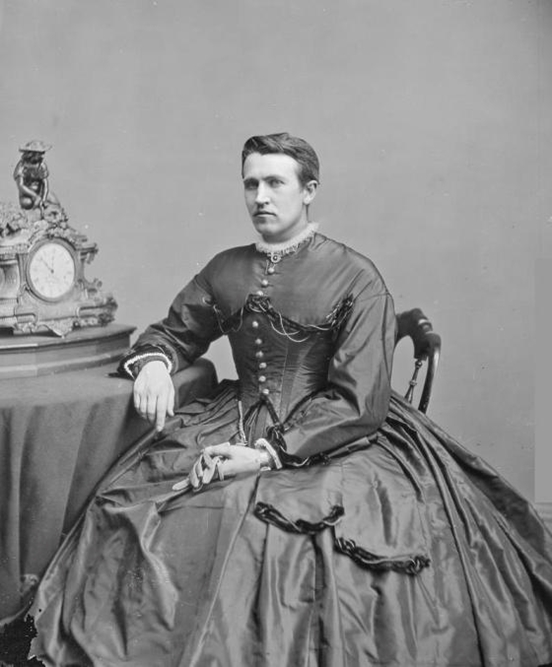
From Paul B. Preciado (Liberation 27/05/2016 – in translation), reflections on the radicalness of trans and migrant “identities”, identities that must be refused as fixed identities, identities that are rather lines of flight that put into question, contend with, mechanisms and apparatuses of oppresssive social reproduction, of truth production, and open up spaces beyond truth and falsity, spaces of autonomies.
Continue reading
For every image of the past that is not recognised by the present as one of its own concerns threatens to disappear irretrievably. … In every era the attempt must be made anew to wrest tradition away from a conformism that is about to overpower it.
Walter Benjamin, Theses on the Philosophy of History
Revolutions never die as long as their memory lives; and there memory lives in every gesture of resistance and rebellion. In this sense, memory, history, are fields of battle, where the struggles of the present bring forth the past. It is with this sense of a past that can be made present and thereby be re-written, that we remember spain’s revolution of 1936.
The occasion calls for far more than the essay below, but we hope that it will be but our first opportunity to recall what is the most radical revolutionary experience of the 20th century.
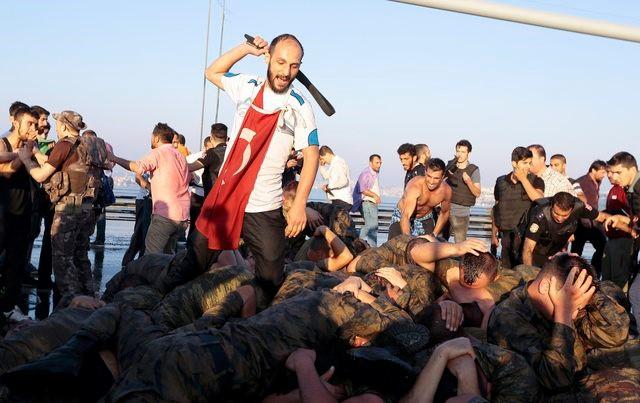
In the wake of the failed coup attempt in turkey on the night of the 15th of July, Erdogan and his AKP government has unleashed the only weapon by which he rules those who fall outside his religious-nationalist ambitions, fear and terror: public humiliations and lynchings of soldiers (in what is still a largely conscription army), attacks on ethnic minorities (Alevi, Kurdish, Syrian), political leftist opposition groups, opposition newspapers, and those engaging in habits deemed unreligious. In a recent announcement, Erdogan promises to build the military barracks in Taksim Square, the project that lay at the origin of the Gezi Park uprising in 2013. All memory of dissidence and rebellion is in sum to be erased.

Anarchism has historically been essentially comprised of those who sought to live a world without authority and exploitation. The forms that this desire took, and continue to take, have varied greatly ideologically, organisationally, practically. The desire though has remained constant; it is a desire that has defined an ethics, a way of being in the world.
We share a modest part of an example of such an ethics, in the life of Lucio Utubia …

Encounters between feminism and islam, in the wake of the arab spring, are the themes of an interview given by the algerian lawyer and feminist activist Wassyla Tamzali to the spanish newspaper, Periódico Diagonal (03/06/2016). Whatever differences we may have with Tamzali’s reading of the situation, there is much below to feed debate. We offer the interview in translation …

The protagonists of class struggles are many, as are the stages upon which they are enacted and re-enacted. What defines them is not historically pre-determined; revolutionaries and reactionaries playing out the assigned roles of objective social contradictions are all fictions of impoverished and fantastic sociological thinking. Instead of subjects, let us imagine existing, fragmented, desiring subjectivities. Instead of contradictions, let us speak of cracks that fissure along unpredictable lines.
The scenes of class struggle are thus plural, diverse, and heterogeneous, and they are so lived. If capitalist social relations constitute a system, the system is not a given, but must be made and re-made into a composite of unlike and incongruous elements. And the fragility of the mosaic resides in its cracks: cracks to be found and forced, thereby giving substance to anti-capitalist protest and rebellion.
André Laude, anarchist poet
For André Laude (1936-1995), for his poetry, for his fiery beauty …
Toute mon expérience poétique s’articule autour de cette perspective : la poésie doit changer la vie.
André Laude: Working class family. Exiled to Paris, will later rejoin his homeland: Occitanie. School under Nazi occupation. First masturbations and first revolts. Very early writing and dreaming of becoming a journalist. Comes to know a band of anti-conformist poets and painters. Anarchist militant. Self-taught … . Learns with difficulty to make love well. Meets André Breton, Benjamin Péret and a few other “lights”. War of Algeria: horror and suffering. Quits Europe for several years. Journeys: Cuba, the Orient, Asia … Returns to Europe. Writes in a hundred newspapers and magazines. Publishes collections of poetry. Poverty, humiliation. Lets his beard grow to hide the scars. A unique desire: to live and enjoy without limits while aging his flesh.
André Laude
Continue reading →