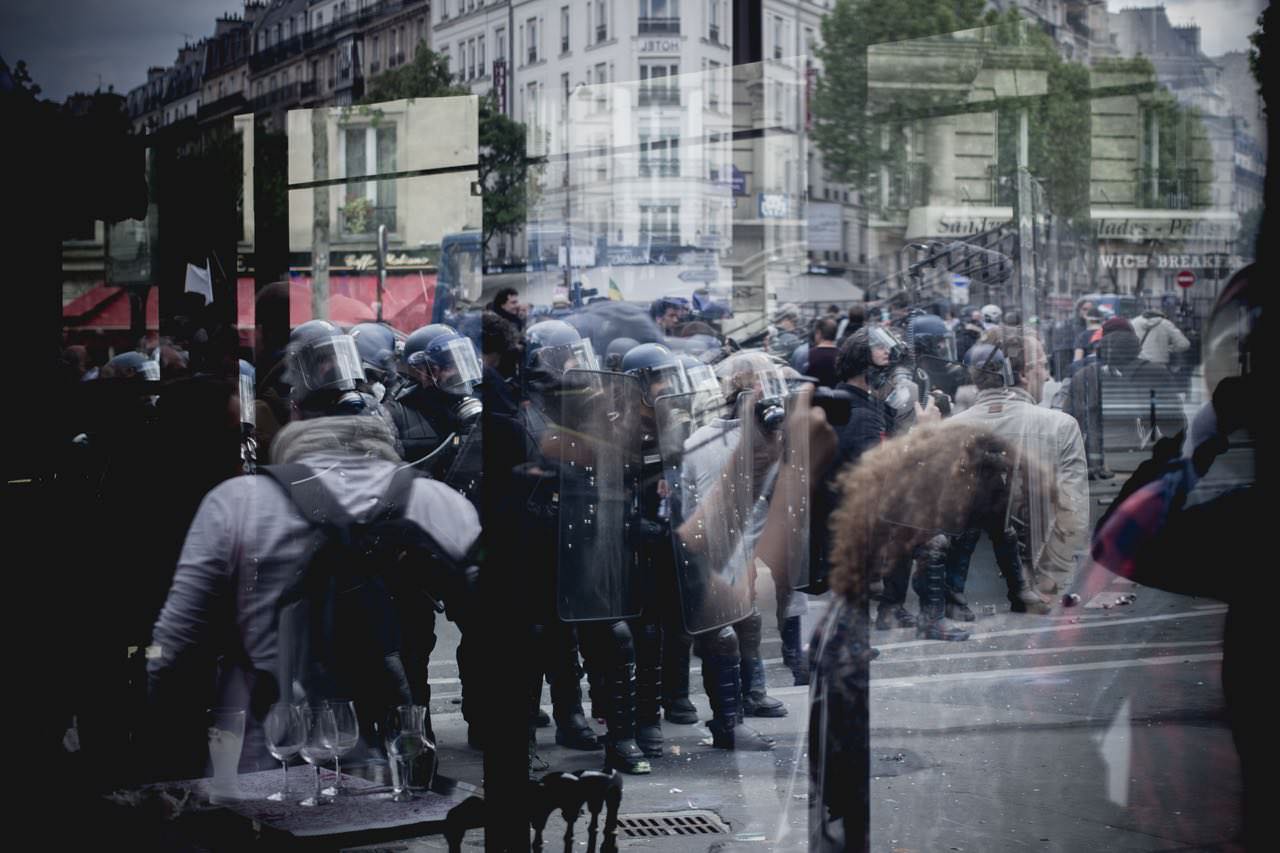
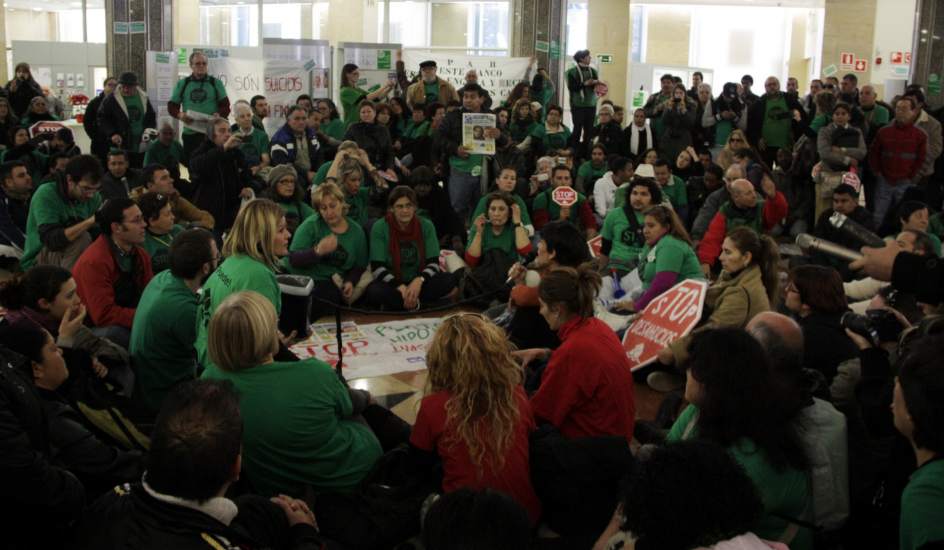
Anarchism in the streets: Federación de Anarquistas Gran Canaria (FAGC)

Get into the neighbourhoods, don’t be afraid of hostility, suspicion, quarrels and base passions, that, I assure you, you will encounter.  Take advantage rather of the fact that the virtual recuperation penetrates even into those with an empty stomach.  Seek out those with no house, salary, health, assistance, hope.  Convene a whole neighbourhood and confront it with the idea that it is in their hands to change the situation.  Continue to grow, one step at a time, with effective assemblies, free of pompous discourses.  Offer reality, naked and harsh reality.  And begin to take, take and take, until nothing remains that you don’t manage yourselves.  It may frighten, but it is the vertigo before a revolution that begins.  You only have to assume it.  You won’t be able to?  Well at least, dammit, you will have tried. … [I]f they exploit misery, then it is for us to organise it.

Ruymán Rodríguez, Anarquía a pie de calle

We return to the Federación de Anarquitas Gran Canaria (FAGC), with two texts describing the collective’s militant activity and a closing text by Ruymán Rodríguez analysing the politics of okupation …

Continue reading

Posted in Commentary, News blog | Tagged , , , , , , | Leave a comment

Renzo Novatore: My iconoclastic individualism

Anarchy is not a social form, but a method of individuation. No society will concede to me more than a limited freedom and a well-being that it grants to each of its members. But I am not content with this and want more. I want all that I have the power to conquer. Every society seeks to confine me to the august limits of the permitted and the prohibited . But I do not acknowledge these limits, for nothing is forbidden and all is permitted to those who have the force and the valor.

Consequently, anarchy, which is the natural liberty of the individual freed from the odious yoke of spiritual and material rulers, is not the construction of a new and suffocating society.’ It is a decisive fight against all societies — christian, democratic, socialist, communist, etc., etc. Anarchism is the eternal struggle of a small minority of aristocratic outsiders against all societies which follow one another on the stage of history.

Renzo Novatore

As a complement to our post, the essay “The limits of community” by Ruymán Rodríguez, we share the second of two essays, among others cited by Rodríguez, that help to further understand the bases of his reflection.  This second essay, if it should so be called, by Renzo Novatore, is entitled “My Iconoclastic Individualism” and is also available at the Anarchist Library.

Continue reading
Posted in Commentary | Tagged , , , , | 1 Comment

Élisée Reclus: On anarchist colonies

As a complement to our last post, the essay “The limits of community” by Ruymán Rodríguez, we share the first of two essays, among others cited by Rodríguez, that help to further understand the bases of his reflection.  The first essay, by Elisée Reclus, is “On anarchist colonies” and is posted, in english, on libcom.org.

Continue reading
Posted in Commentary | Tagged , , , | Leave a comment

The limits of community

We share an essay by Ruymán Rodríguez that critically evaluates the radical poltical potential of the idea of community.  Without defending the need to abandon the creation of communities as part of a larger anarchist political project, Rodríguez nevertheless argues that the concept, as well as the history of constructing alternative communities, is plagued by uncertainties, illusions and dangers.  There is a fundamental urgency then to think through and clarify the concept, for both theory and practice.

Rodríguez’s argument is not without difficulties (e.g., he seems to assume that the distinctions are clear between what is politically possible and impossible for a community, between private and public, as well as individual and group concerns, between the means and ends of revolutionary political action, when we would argue they are not, or at least not always).  But the essay has the virtue of being rooted in and reflecting Rodríguez’s considerable involvement with the Federación de Anarquistas de Gran Canaria (FAGC), one of the most active anarchist collectives in spain (see: the Esperanza Commune).  His is an “anarchism in the streets” whose voice cannot be easily ignored.

The essay below is published on the site alasbarricadas.org (27/08/2016) and is shared here in translation to english.

Continue reading

Posted in Commentary | Tagged , , , , , , , | Leave a comment

Dancing life: Radical gestures of okupied social centres

Today okupied social centres play today a fundamental role in the renewal, constitution and radicalisation of social movements.  Where there presence is marked (e.g. greece, spain, italy), they themselves often constitute a challenge to both State and an economy based on the sacral nature of private property.  But beyond that, and perhaps even more fundamentally, they are temporary spaces for the making of autonomous and solidarity based ways of life in largely urban settings.  In the violence that is everyday life in the capitalist city, a violence both conscious and sub-conscious, somatic, they are moments of rupture, heterotopian spaces in the distopias of universally imposed salaried labour and consumption.  If they cannot offer a complete alternative to money and commodities, if they are admittedly politically fragile, they nevertheless can be, and frequently are, thresholds for freer ways of being.

We share below a reflection on one such social centre, in Rome, from a friend of autonomies …

Continue reading

Posted in Commentary | Tagged , | Leave a comment

Infrastructure against borders

What follows is the second of a two part essay from the collective Out of the Woods, posted on Libcom.org, reflecting on refugees-migrants, climate change, the violence of border politics, anti-migrant populisms and no borders politics.

Continue reading

Posted in Commentary | Tagged , , , , , , , , , | Leave a comment

Refuges and death-worlds

What follows is the first of a two part essay from the collective Out of the Woods, posted on Libcom.org, reflecting on refugees-migrants, climate change, the violence of border politics, anti-migrant populisms and no borders politics.

Continue reading

Posted in Commentary | Tagged , , | Leave a comment

The Commodification of Moments

photo

Reflections on the appropriation of intimacy, affectivity, of moments as commodity, from a friend of Autonomies, danny champion …

Continue reading

Posted in Commentary | Tagged , | Leave a comment

The plunder of tourism: Lisbon

There are eyes everywhere. No blind spot left. What shall we dream of when everything becomes visible? We’ll dream of being blind.

Paul Virilio

Mass urban tourism condemns a city to branding, a product to be consumed, a spectacle to be observed and to be rendered observable.  It transforms urban space, its buildings, streets and squares into speculative real estate, its commercial activity into merchants of the local-exotic, its politics and security services into instruments assuring the free and safe flow of tourist, its ecology into entrances and exits, its multiple, complex and intense ways of life into purchasable “authenticity” removed from time and frozen in space and within all of which its inhabits must either flee, for lack of economic means to survive the pillage or become themselves actors for the selling of the city.

Continue reading

Posted in Commentary, Film | Tagged , , , | Leave a comment

Fidel Castro and the fetishism of power

Talking to us of homeland and freedom is a waste of time unless they start by guaranteeing our independence as individuals; we are not about to redeem the homeland while we are all left slaves.

The measure of the homeland’s independence can be gauged by the amount of independence enjoyed by her children, and, as we have already said, there can be no free homeland while her children are slaves.

Enrique Roig de San Martin

El Productor, (Havana) 12 May 1889

The day following Fidel Castro’s death on the 25th of November, graffiti appeared in Lisbon reading, “Obrigado Fidel/Thank you Fidel”, accompanied by a hammer and sickle.  Ignoring the intentions of the author, and leaving aside delusional nostalgia for “revolutionary pasts”, there is a perhaps strange and modest echo of moral-political truth in these words, for the Portuguese and for others.

Continue reading

Posted in Commentary, News blog | Tagged , , , , , , , | Leave a comment