Olivier de Sagazan and the dancing self

(All sculptures, paintings and photographs by Olivier de Sagazin)

For Genouni …

All pictorial or plastic work is useless: let it then be a monstrosity that frightens servile minds, and not sweetening to decorate the refectories of animals in human costume, illustrating the sad fable of mankind.

Tristan Tzara, Dada Manifesto 1918 

If our life lacks a constant magic it is because we choose to observe our acts and lose ourselves in consideration of their imagined form and meaning, instead of being impelled by their force.

Antonin Artaud, The Theater and Its Double

The body is the Figure, or rather the material of the Figure. Above all the material of the Figure is not to be confused with the material structure in space which is separate from this. The body is a Figure, not structure. Conversely, the Figure being a body, is not a face and does not even have a face. It has a head, because the head is an integral part of the body. It can even be reduced to its head. … There is a big difference between the two. For the face is a structured spatial organization which covers the head, while the head is an adjunct of the body, even though it is its top. It is not that it lacks a spirit, but it is a spirit which is body, corporeal and vital breath, an animal spirit; it is the animal spirit of man: a pig-spirit, a buffalo-spirit, a dog-spirit, a bat-spirit… This means … unmaking the face, rediscovering or pulling up the head beneath the face.

Gilles Deleuze, The Logic of Sensation

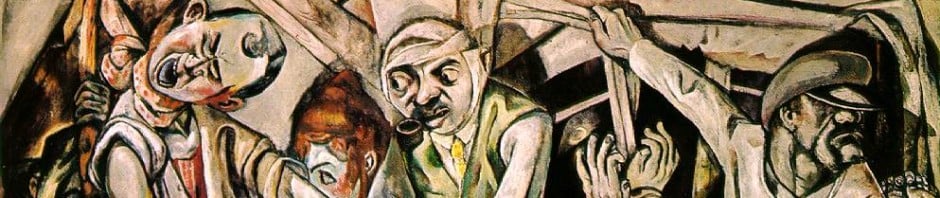
Painting and art in general appear to me as an instrument of war, a Trojan horse.  Artists are viruses.  I want to colonise consciousnesses with images, disturbing and fantastic, to try to re-make the face an enigma.  I am a stranger to myself!  I am at the service of my interior, cellular milieu (Claude Bernard) and not the opposite.  One must scream it, draw it without end.  Disfiguration is the art of deregulation, the skewed path, the search for new forms.    

Olivier de Sagazan

Domination seeps deeply into a social fabric.  It is in no way the privilege of autocratic and authoritarian States.  If States are agents of domination, they are so because they are able to capture, appropriate (and render possible and reinforce) the many, overlapping relations of power that so commonly characterise societies.

Continue reading

Posted in Poiesis | Tagged , | 1 Comment

Nietzsche and anarchy

I don’t say that my values and desires are the right or true ones. For instance, I don’t say that it is right or true to love anarchy and hate domination. I affirm my values. This affirmation is not like saying “anarchy, you’re right”, but more like saying “anarchy, you’re beautiful, I love you”. A declaration of love is an affirmation that demands no explanation. I also reflect on my values, I test and develop them and try to make them more coherent and powerful. And I put them into action.

I also try to spread anarchic values and desires. Again, not because I call them right or true. But I do think that others, at least some others who are already inclined in this direction, may also find joy and freedom in pursuing anarchy. And also, more selfishly, I want more comrades and allies.

I know that most people would disagree with my values, perhaps think they’re crazy. I don’t think I’m going to convince many people otherwise by a reasoned argument demonstrating the truth of my assertions and the falsity of theirs. I don’t think that’s how desire works. I think desires spread by seduction, by incitement and contagion.

Shahin, Nietzsche and Anarchism


Anarchism, as a movement, has never found its source or justification in any one philosophy. Though not without “principles” (for example, mutual aid, autonomy), when efforts have been to justify them, the inspirations have been many.

What we share below, in what is for Autonomies an exceptionally long essay, is an experiment-exercise of interpretation and justification that endeavours to explicitly bring anarchism together with Nietzsche.  And if we do share it, it is with the conviction that the essay is excellent.

What follows then is an essay entitled Nietzsche and Anarchy, authored by Shahin, published in hard copy by Elephant Editions and Active Distribution 2016 and also posted on The Anarchist Library.

Continue reading

Posted in Commentary | Tagged , , , , | Leave a comment

Rebel neighbourhoods: Vallcarca, Barcelona

As we once wrote of Madrid’s Carabanchel neighbourhood …

“There are cities where particular neighbourhoods guard a memory of past disobedience and rebellion. They were in the past often referred to as working-class neighbourhoods, or quartiers populaires, to employ the French expression. They recall that past however not as something distant, to be relived only sentimentally, but rather as a living past that keeps possibilities open in the present, possibilities of contestation, protest and insurrection.”

Today share stories from Barcelona’s Vallcarca.  What follows, in translation, is an interview with the anarchist collective Heura Negra of Vallcarca conducted by the Alasbarricadas media collective (02/01/2017).

If we do share these stories, it is because of our belief that anarchism must in the end be in the streets.

Continue reading

Posted in Interview, News blog | Tagged , , , , | Leave a comment

On the road

Nature is always historical and capitalism (as all social relations of the past) is always in nature. There is no pristine, untouched nature to return to today (against neo-primitivisms), nor a non-human nature to serve as standard for our development (against all sustainable development).  We live amidst a nature “contaminated” by our presence, from the macro to the micro-scale: we change geological cycles, as we tamper with the genetic and the molecular.  Nature has become monstrous in our hands, and these, our children, we cannot simply abandon, or somehow shutdown, for they will simply not go away with a wave of the magic wand, anarchist or otherwise. (Consider an anarchist “revolution” inheriting nuclear or plastic waste, at current levels, to cite but two examples; what could it possibly mean to “return” to nature in such circumstances?)  What is first necessary is to admit our maternity-paternity, and then to care for our monsters, to care for them in the sense of deciding collectively which are worthy of ongoing concern, and which should be quietly to sleep, in a euthanasia of technology.  None of this is easy or obvious (what criteria for the choice of which technology to put to a good death?  How are such decisions to be taken and by whom?), and the most that is desired here is to share modestly one of those monsters, the humble road

Continue reading

Posted in Commentary, News blog | Tagged | Leave a comment

On the death of a portuguese “revolutionary”: Mario Soares and the inseparability of ideology and reality

For every image of the past that is not recognised by the present as one of its own concerns threatens to disappear irretrievably.

Walter Benjamin, Theses on the Philosophy of History

It is a mistake to understand ideology as something that merely covers over reality, an instrumental lie that blinds us to the truth, and that once swept away, that we will see things as they are and be liberated.  Ideology is constitutive of social relations.  It is as much a part of reality as any other social agency or force.  Social reality is therefore intrinsically ideological, insofar as beliefs and ideas of different social actors struggle to mould it.  In other words, rather than being two distinct dimensions of social life, with ideology the simple servant of power, they form an inseparable whole.  And in the age of generalised capitalist spectacle, ideology is the principal mechanism of social reproduction.

The death of portugal’s Mario Soares, anti-fascist militant, political prisoner and exile, a founder of the country’s socialist party (1972), prime-minister and president of the republic (holding both offices on two occasions: 1976, 1983; 1986, 1991, respectively), and a major protagonist in the political events following the 25th of April, 1974, “Carnation Revolution”, has prompted a parade of media-political consensus around his role in these events.  It is the extent of this saturating consensus that begs comment.

Continue reading

Posted in Commentary, Film, News blog | Tagged , , | Leave a comment

Turkey: Meydan anarchists: “we are being cornered”

Late last month the editor of Meydan anarchist newspaper in Istanbul was sentenced to a year and three months in prison for “supporting terror,” the latest in a string of attempts by the Turkish State to shut down dissenting voices against Erdogan’s government. Today we share a translation of Meydan’s uncompromising response, from their latest edition. (Freedom 05/01/2017)

Continue reading

Posted in News blog | Tagged , | Leave a comment

For John Berger (1926-2017)

For John Berger, for all that he taught us about how to see …

Continue reading

Posted in Commentary, News blog, Poiesis | Tagged , | Leave a comment

In solidarity: Editor of turkish anarchist paper jailed for “terror propaganda”

From Freedom News …

The editor of Meydan Gazette in Istanbul was jailed for a year and three months on December 22nd for “propagandising the methods of a terror organisation” in a free-speech case which dragged on for nearly a year.

Continue reading

Posted in News blog | Tagged , | Leave a comment

Tapping the rhythms: Moondog

I find the greatest freedom in the stricture of a form
that paradoxes abnormality within a norm.

I would bow down before just one–
one who bows before none.
I should know who that one might be who could do that to me
I am that one
and I bow down before me

Moondog

Reflections on art inspired by the life, music and poetry of Moondog (Louis T. Hardin), who, were he with us today, would celebrate his 100th birthday this year.

Continue reading

Posted in Commentary, Poiesis | Tagged , , | Leave a comment

For the syrian revolution

Dancers and the dictator, Wissam Al Jazairy

Without any pretense of a well founded critical evaluation of political events in syria, in the context of a multi-front civil conflict between imperialist and proto-state actors, we share two anarchist reflections on the country’s revolution, in the wake of the fall of Aleppo to the Bashar al-Assad regime.

Continue reading
Posted in Commentary | Tagged , , | Leave a comment