The maturity of man – that means, to have reacquired the seriousness that one had as a child at play.
Friedrich Nietzsche, Beyond Good and Evil
A fragment from the prologue to Amador Fernández Savater’s recently published essay, Habitar y gobernar; inspiraciones para una nueva concepción política (Ned ediciones, 2020). (lobo suelto 15/10/2020)
What to do is the quintessential question of the classical revolutionary imaginary, posed by Lenin in the book of the same title. It is the question of a model: the dominant model of revolution in the 20th century, both triumphant (as a seizure of power) and a complete failure (as an experience of emancipation).
There were, of course, other revolutions in the twentieth century (such as the Mexican or the Spanish), but they were somehow obscured by “the shadow of October”. October became the model of every revolution, the physiognomy of the revolution, exported all over the world. The images of change in October became the images of change par excellence: of what had to be done, of what could be expected, etc.
The social malaise spreads moment by moment. The endless sequence of confinement – de-confinement – re-confinement – is the rope that slowly asphyxiates us. It is the rope that a State, incapable and seized by panic, holds to, to try to impose its new normal. Now we know that the announced new normal is nothing more than the continuation of this nightmare. When it all started, it seemed that we were in a science fiction movie, and that we were masked protagonists. The contained emotion of the first month was made up of fear and relief; the fear of dying and the relief of not having to work. The balconies strove to open up to the sky. Now there are no songs. The slogan “Everything will be fine” sounds even more stupid, and we have learned that we are only the useful fools of a moment in the history of capitalism. The plot can be summed up in a few words: unbridled capitalism – what is usually known as neoliberalism – produces a virus that capitalism itself reuses to control us. In the silence of the night subjected to a curfew, the cry of “Enough!” is heard. We are tired, fed up with so much uncertainty, fed up with so many falsehoods and, above all, fed up with so much arbitrariness.
The Latin expression is a biblical quotation that Pierre-Joseph Proudhon put on the cover of his fundamental work, The System of Economic Contradictions, or The Philosophy of Poverty (1846), and it reflects very well the dual approach that anarchism has given to the struggle against domination and oppression. On the one hand, the clear understanding that key aspects of the dominant system cannot be recovered, but rather have to be radically confronted. It is the radicalism that is also shown in successive confrontational tactics at different times in anarchism’s history, in which destruam has been used in a literal sense, with a propaganda of the deed that smelled more of gunpowder and death than of the construction of a new world. It is the one that is still present in slogans that we can hear in a demonstration, such as “A fired worker, a hung employer”. In this case, it has more of an innocuous bravado than a serious threat, but in other cases it is clear that violent opposition is needed at a certain moment, a position that the Black Bloc consistently picks up, or that Peter Gelderloos supports in his essay against of non-violence as a priority strategy. Domination and oppression will not fall without a serious “push” to bring them down.
However, I return to the deep ethical sense of anarchism, for which the ethical criterion that must regulate all actions of struggle and radical transformation of society must be the coherence between ends and means: the end never justifies the means. The use of violence, which in some cases may be justified, is a rather incoherent resource in order to build a free and solidary society. Mikhail Bakunin himself was clear: «But be careful! A problem solved by force is still a problem”. In classical Spanish anarchism, some thinkers were very reluctant to use violence, such as Ricardo Mella, and others resisted, such as Salvador Seguí, although they had to face the extreme violence of the bosses’ gunmen.
Mutual aid is the over-riding principle in human existence. It is greater than that of class struggle, which is the result of impositions upon society. Faced with a child drowning, only those inculcated with the artificial pressures of capitalism will ask what profit he will gain by diving in. Only those coarsened by racially divisive propaganda will ask first about the ethnic origins of the child (one recalls Bessie Smith bleeding to death, refused admission to a “whites only” hospital). Only those who have succumbed to State conditioning will walk around plaintively asking, “What are they doing about it? Where are the police, the fire brigade, the coastguards? What do we pay our taxes for?”
Repatriating Indigenous land and organizing anti-state Indigenous-Black-POC Power alternatives is better than pouring resources into the liberal-progressive vote.
Let Empire collapse: why we need a decolonial revolution
Mohamed Abdou
I am part of a We that says: “Let Empire collapse.” A We that says to build alternatives to Empire, we must expose the illegitimacy of the dreadful dream we are in. Instead of trying to shore or salvage the world as it is, we need to recognize with Audre Lorde that “the master’s tools will never dismantle the master’s house.”
I am part of a We that says: “We love and respect you, Angela Davis and your behemoth ongoing legacy of indispensable teachings that are fundamental to the centuries-old struggle we confront,” but we will not be castigated into voting or fall into the trap of “lesser of two evil” arguments that have been critiqued time and time again.
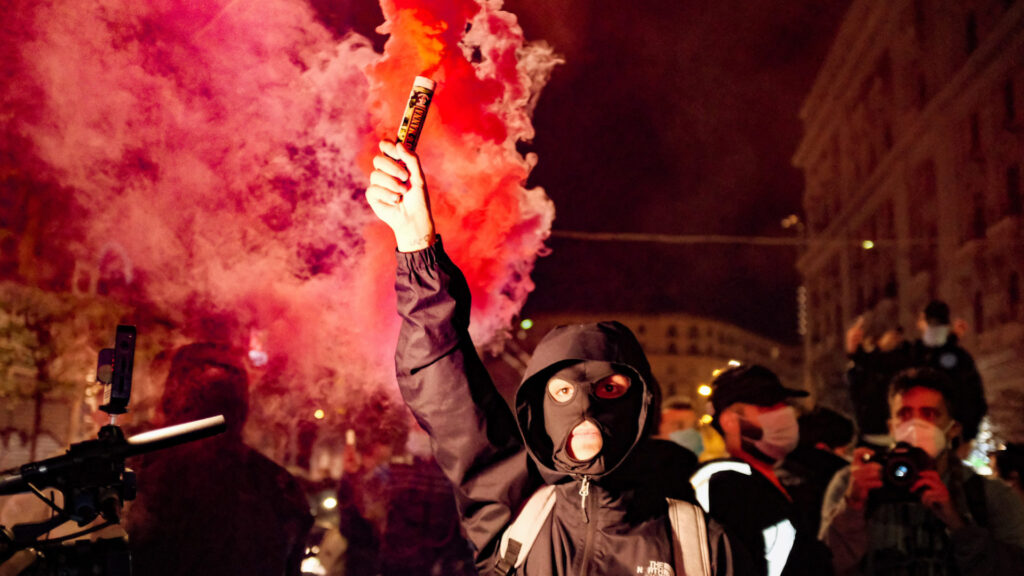
Italian authorities have blamed “fringe elements” for the violence during the anti-lockdown protests, but the reality on the ground tells a different story.
The complexity of Italy’s anti-lockdown protests
I wasn’t surprised by what I saw, we have said this over and over: another lockdown without a welfare support system was a ticking time bomb.
Alfonso De Vito, Napolitano activist Interviewed by Sarah Gainsworth for Dinamo Press
Salvatore Prinzi
Over the past weeks, the people of Naples have been protesting further public health restrictions proposed by the regional government to halt the spread of the coronavirus. Following months of relatively low case numbers during the summer, COVID-19 is on the rise in Italy, and the national government along with various municipalities are re-instituting closures of commercial businesses including cafes, bars, movie theaters, gyms and so on.
After months of lockdown, during which the state continued to rape, murder and massacre, Colombians are out in the streets again to protest their criminal government.
After lockdown, anti-government protests resume in Colombia
José Antonio Gutiérrez D.
By late 2019, a historic wave of anti-government protests was sweeping through Latin America, with unprecedented uprisings taking place in Chile, Ecuador, Peru, Haiti and Colombia. For the besieged governments that were part of a new pack of right-wing parties that had come to power after the receding of the pink tide, help arrived in the form of the global COVID-19 pandemic and the ensuing national lockdowns which effectively — but temporarily — quelled the protests.
… although she [nature] made all other animate creatures face the earth for grazing,she made the human alone upright and roused him to look on the sky,as if on his family and former home; and she shaped the appearance of his face so as to mold in it the character hidden within.
Cicero, On the laws
All living beings are in the open/in openness; they show themselves and communicate to each other, but only humans have a face, only they make their appearance and their communication with others their own fundamental experience, only humans makes of the face the place of their own truth.
“ … All we want to do is keep the knowledge we think we will need, intact and safe. We’re not out to incite or anger anyone yet. For if we are destroyed, the knowledge is dead, perhaps for good. We are model citizens, in our own special way; we walk the old tracks, we lie in the hills at night, and the city people let us be. We’re stopped and searched occasionally, but there’s nothing on our persons to incriminate us. The organization is flexible, very loose, and fragmentary. Some of us have had plastic surgery on our faces and fingerprints. Right now we have a horrible job; we’re waiting for the war to begin and, as quickly, end. It’s not pleasant, but then we’re not in control, we’re the odd minority crying in the wilderness. When the war’s over, perhaps we can be of some use in the world.”
“Do you really think they’ll listen then?”
“If not, we’ll just have to wait. We’ll pass the books on to our children, by word of mouth, and let our children wait, in turn, on the other people. A lot will be lost that way, of course. But you can’t make people listen. They have to come round in their own time, wondering what happened and why the world blew up under them. It can’t last.”
“How many of you are there?”
“Thousands on the roads, the abandoned rail tracks, tonight, bums on the outside, libraries inside. It wasn’t planned, at first. Each man had a book he wanted to remember, and did. Then, over a period of twenty years or so, we met each other, travelling, and got the loose network together and set out a plan. The most important single thing we had to pound into ourselves was that we were not important, we mustn’t be pedants; we were not to feel superior to anyone else in the world. We’re nothing more than dust-jackets for books, of no significance otherwise. Some of us live in small towns. Chapter One of Thoreau’s Walden in Green River, Chapter Two in Willow Farm, Maine. Why, there’s one town in Maryland, only twenty-seven people, no bomb’ll ever touch that town, is the complete essays of a man named Bertrand Russell. Pick up that town, almost, and flip the pages, so many pages to a person. And when the war’s over, some day, some year, the books can be written again, the people will be called in, one by one, to recite what they know and we’ll set it up in type until another Dark Age, when we might have to do the whole damn thing over again. But that’s the wonderful thing about man; he never gets so discouraged or disgusted that he gives up doing it all over again, because he knows very well it is important and worth the doing.”
Ray Bradbury, Fahrenheit 451
What would a God be to whom neither prayers nor sacrifices were addressed? And what would a law be that knew neither command nor enforcement? What is a word that has neither meaning nor command, but is truly held in the beginning—indeed, before the beginning?
Giorgio Agamben
Reading our times with Giorgio Agamben, we share below parts of his recent essay entitled, Quando la casa brucia (Quodlibet) and which was translated and published by (and which can be read in its entirety at the site of) the ill will editionscollective. We have interspersed our own comments among the selected passages.
If we have pursued this exercise, however modest, it is because we believe that Agamben’s contribution to our self-understanding continues to be fundamental.





Amador Fernández-Savater: Like lost children
The maturity of man – that means, to have reacquired the seriousness that one had as a child at play.
Friedrich Nietzsche, Beyond Good and Evil
A fragment from the prologue to Amador Fernández Savater’s recently published essay, Habitar y gobernar; inspiraciones para una nueva concepción política (Ned ediciones, 2020). (lobo suelto 15/10/2020)
What to do is the quintessential question of the classical revolutionary imaginary, posed by Lenin in the book of the same title. It is the question of a model: the dominant model of revolution in the 20th century, both triumphant (as a seizure of power) and a complete failure (as an experience of emancipation).
There were, of course, other revolutions in the twentieth century (such as the Mexican or the Spanish), but they were somehow obscured by “the shadow of October”. October became the model of every revolution, the physiognomy of the revolution, exported all over the world. The images of change in October became the images of change par excellence: of what had to be done, of what could be expected, etc.
Continue reading →