Maria Callas and Pier Paolo Pasolini on the set of Medea
Pier Paolo Pasolini interviewed by Louis Valentin (1970)
A 1970 interview with Pier Paolo Pasolini, on the youth revolt of the sixties, culture, love, his film “Oedipus Rex”, the heterosexual couple, homosexuality, and more.
LV: You have often been accused of being a pornographer. Does this bother you?
PP: People who say my films are pornographic only cast suspicion on themselves. Anyway, I have nothing against pornographic films. They belong to a type of subculture, but that’s no reason to prohibit their directors or producers from making them, for that would be repression. Maybe, some day, if there are too many such films or they are too badly produced, no one will go to watch them. It’s the politics of the worst, of saturation….
To speak of reflections after Stonewall is not to suggest any logical chronology in which thought follows practice. But the Stonewall Riots do express a moment of intensity in the practice and thought of the radical gay rebellion of the period against the everyday violence of normative heterosexual capitalism, a rebellion mutually sustained by parallel dissidences of women, blacks, the colonised; a rebellion whose resonances continue to move through societies, and to which institutionalised powers are obliged to respond, with relative openness and/or rejection.
To cite Michel Foucault,
“Since the nineteenth century, great political institutions and great political parties have confiscated the process of political creation; that is, they have tried to give to political creation the form of a political program in order to take over power. I think what happened in the sixties and early seventies is something to be preserved. One of the things that I think should be preserved, however, is the fact that there has been political innovation, political creation, and political experimentation outside the great political parties, and outside the normal or ordinary program. It’s a fact that people’s everyday lives have changed from the early sixties to now, and certainly within my own life. And surely that is not due to political parties but is the result of many movements. These social movements have really changed our whole lives, our mentality, our attitudes, and the attitudes and mentality of other people – people who do not belong to these movements. And that is something very important and positive. I repeat, it is not the normal and the old traditional political organizations that have led to this examination.”
On the occasion of the anniversary of the Stonewall Riots, we share four authors, their writings or interviews with them, who marked the epoch and whose creative work both contested oppressive authorities and powers, and helped to experience differently and rethink the complexity of domination: Guy Hocquenghem, Pier Paolo Pasolini, Mario Mieli, Michel Foucault.
Guy Hocquenghem, active in events of May 1968 in france, was a pioneer of homosexual liberation in the 1970s and founding member of Front homosexuel d’action révolutionnaire. He would radicalise the legacy of May 68, both in his writing and in his life, through a vehement criticism of fetishistic conceptions of politics and revolution.
Can we think anarchism? This Monday we wanted to know if anarchism was thinkable. We didn’t ask the question. We didn’t know that perhaps it had not been. Thanks to Catherine Malabou and her book Au voleur! Anarchisme et Philosophie we found an answer.
A full-scale war in Ukraine has been going on for over three months now. The anarchist movement has responded to the Russian invasion in different ways during these three months – some have begun unconditionally supporting their comrades in Ukraine, while others continue to repeat the story of NATO aggression in the region. We also felt it necessary to make a statement about our view of events.
Paula Rego in her studio, 1987, The Times/News Licensing
It seems to me that what you are often drawn to are the half-hidden stories – the stories that we can, as we look at your work, continue to unriddle in our heads. Is it possible to paint a secret?
I think it is. You discover things in the making of a painting. It can reveal things that you didn’t expect. Things you keep secret from yourself.
We continue to share below film-maker and journalist Alexis Daloumis’ ongoing news reports and interviews in ukraine, this time on mutual aid work in the city of Kharkiv. (from Freedom News 01/06/2022). The fist two reports we shared focused on anarchist solidarity with ukrainians in Eastern and central europe (see here and here).
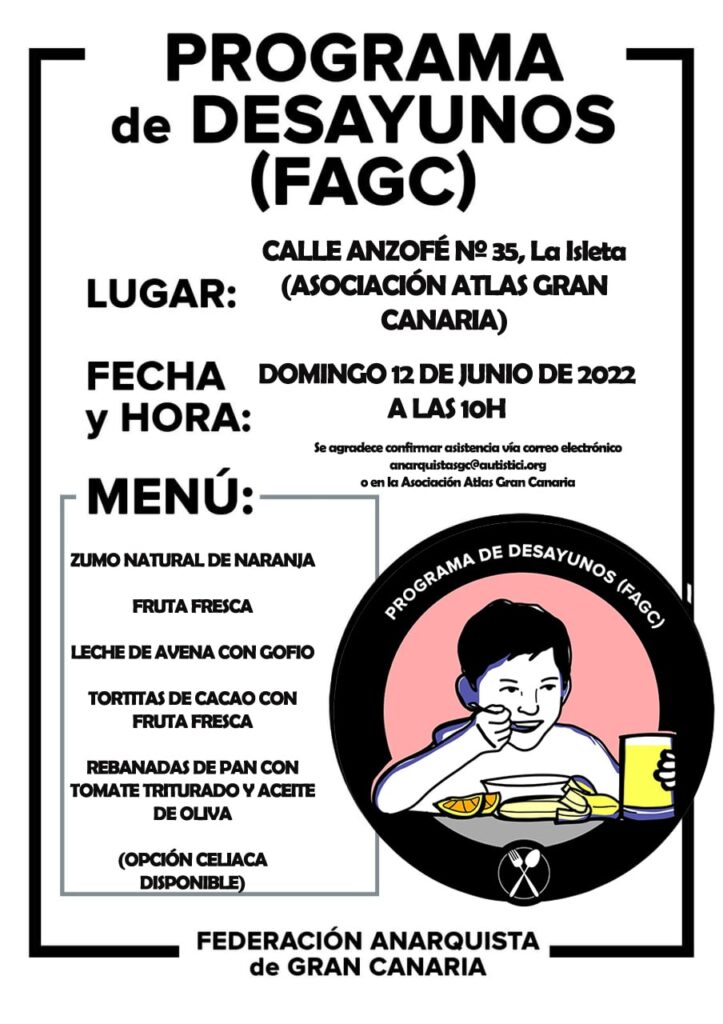
News from the FAGC – Federación Anarquista de Gran Canaria (01/06/2022) …
The Canary Islands has one of the highest levels of child poverty in Europe. 35% of the minors residing on the Islands are malnourished. This statistic, and this prior to a devastating pandemic, implies that their only source of food comes from school canteens and breakfast aid programmes.
Decolonising anarchism, according to Jesse Cohn, amounts to freeing it from its modernist assumptions: that culture is opposed to nature, that human culture progresses by an expanding autonomy from the heteronomy of nature, a progress grounded in the technological dominion over the natural world (and the human worlds closest to nature, e.g., those of the “indigenous” of the americas) and the freedom of human thought and life from the illusion of its dependency on transcendent sources (e.g., religion). To the extent that anarchism is imbued with or assumes such ideas, it is modernist and colonialist, susceptible to all of the hierarchies and forms of oppression that it has claimed to contest in its brief modern history.
It is for this reason that Cohn speaks of decolonising anarchism as a demodernisation of anarchism, something which then implies re-thinking and possibly repudiating notions of autonomy if conceived in opposition to nature (with this last equally in need of re-conceptualisation), that is, endeavouring to imagine freedom rooted in a nature no longer perceived as inanimate matter or as living, but “unthinking and unfree”. Technologies would also have to be evaluated on the grounds of their contribution to communities of conviviality rather than to a blind instrumental efficacy that threatens to engender new forms of ever greater and more intensive control. And equally significant, a non-modern anarchism could then, and should, re-evaluate its impetuous dismissal of religion or spirituality, if thesecan be thought of and illustrated historically by immanent and non-alienating forms (e.g., animism).
Liberated then from their modernist garb, anarchists and the historical tradition of anarchism may more fruitfully engage with and learn from, as well as contribute to, other ways of being in the world that fail or refuse to assume a place in the developmental narrative of enlightenment and capitalist progressivism.
Cohn’s essay is an important contribution to what will continue to be an ongoing theoretical reflection on and practical experimentation with other ways of living anarchy. It calls to mind the earlier work of the recently deceased anarchist, Peter Lamborn Wilson/Hakim Bey on “spiritual anarchism”, or older “anti-modernist” and/or Christian anarchists.
Difficult questions however remain, it seems to us, for any effort to spiritualise anarchism. Contrary to what Cohn seems to suggest, there is not one modernism or a single story of modernity. European modernity was always a changing confluence of multiple intellectual tributaries, far too unstable to be reduced to the nature-culture divide, or to this divide being interpreted without ambiguity.
The invitation to explore the indigenous worlds of the “new world” and their “philosophies”, their “ontologies” and “ethics”, is of enormous significance, but if merely placed in opposition to a european modernity, it suggests two doubtful simplifications: european modernity versus indigenous “holism”. Europe’s modernity however was never homogeneous or completely totalising (however “genocidal” it could be, to speak with Pier Paolo Pasolini), as the indigenous worlds have never been a single cultural monolith from which could be read a single, ethically good way to be (as Cohn himself suggests when he cites Eduardo Galeano: “I believe in the legacies that multiply human freedom, and not in those that cage it . . .. I am not proposing a return to the sacrificial rites that offered up human hearts to the gods, nor am I praising the despotism of the Inca or Aztec monarchs.”).
Without wishing by any means to dismiss the idea of demodernising and spiritualising anarchism, it is by no means obvious that these later must or even can involve some form of animism, at least beyond the worlds where such forms no longer exist. But even if it were possible, and desirable, would this radically or completely eliminate the nature-culture divide if this latter is interpreted as a simplified conceptual reflection of something much deeper, namely, that distance that all reflexive thought must assume in relation to what is thought, as a condition for its very possibility. This is not to divorce thought, the mind, culture, from nature, but rather to point to the disharmony and dissonance that can always exist between these dimensions of human existence and which are the experiential sources of what we designate by the word “autonomy”. One could imagine these different dimensions, and others, as modes of a singular reality (echoing Spinoza), in which case they would not be fated to produce the violent dualisms inherent in modern, colonial european thought and practice, but rather could serve as the basis for a critical ontology of that same modernism.
One can also ask whether or not anarchists really need to lose any time with these questions when what is at stake are matters of justice and that it is upon common issues of justice that more general political struggles can emerge. The anarchist theorist has to give way to the anarchist militant, and it will be in struggle that ideas will emerge, as has always been the case with anarchism.
In sum, the paths towards a decolonisation and demodernistation of anarchism are potentially many, and it is not even clear that these are the most appropriate terms for what is called for, or that if they are, they must be employed with considerable caution and care.
Jesse Cohn does just that and our questions are meant only to push along the debate.
Once again, by way of Lundi Matin (#341, 30/05/2022), we share below the third episode of Diamant Palace, with Alain Damasio et Vinciane Despret, from Le Biais Vert (available with english language subtitles). For the first episode, click here.
“A robot may not injure a human being” is the first law of robotics formulated by science fiction writer Isaac Asimov. At what moment can it be stated that a technical development can hurt us, do us harm? Is it still synonymous with human, ecological and social progress? What is the worldview of the handful of people who control the tech industries? Is the machine still seen as a tool for human use or does it now develop itself for itself, according to its own logic? Will technologies save us from the climate disaster? On the 1310th day of occupation of the Diamant Palace, the pirate radio questions the place of technologies in our contemporary societies and projects itself into the future. Meanwhile, in the techno-chapel, spied on by the portraits of the new great tech gurus, Alain and Vinciane are building a Kapla tower.
It’s been almost two years since the 2020 protests in Belarus. The anarchist movement, just like the rest of activists and jounalists, has faced the biggest crackdown ever. Many activists had to leave the country, others got behind bars. ABC-Belarus continues its activity and needs support more than ever. At the moment, there are about 30 imprisoned anarchists and antifascists in Belarus and the number keeps growing.
We are in the middle of a big trial with 10 defendants that would probably last for the whole summer. Read more about the case here. Every week just this case alone costs us 3000 euros. Without your help, we won’t be able to provide support in this trial for long, meaning that the activists will lose their opportunity to get legal aid. Other comrades need lawyer’s visits, food parcels, appeals – all this requires more money than we are able to gather.
Any donations are more than welcome! Please share this call with your comrades and groups, organize fundraising events for us and spread the word about Belarusian imprisoned anarchists.




Reflections after the Stonewall Riots: Pier Paolo Pasolini
Pier Paolo Pasolini interviewed by Louis Valentin (1970)
A 1970 interview with Pier Paolo Pasolini, on the youth revolt of the sixties, culture, love, his film “Oedipus Rex”, the heterosexual couple, homosexuality, and more.
LV: You have often been accused of being a pornographer. Does this bother you?
PP: People who say my films are pornographic only cast suspicion on themselves. Anyway, I have nothing against pornographic films. They belong to a type of subculture, but that’s no reason to prohibit their directors or producers from making them, for that would be repression. Maybe, some day, if there are too many such films or they are too badly produced, no one will go to watch them. It’s the politics of the worst, of saturation….
Continue reading →