
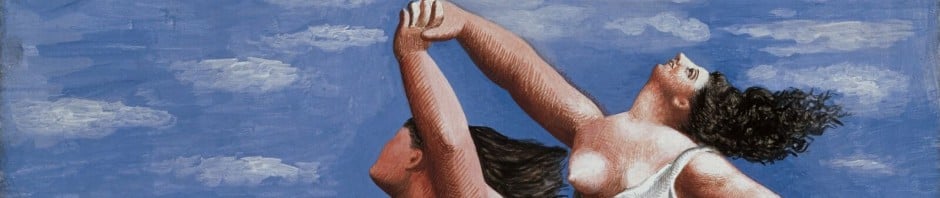
(All the paintings in this post are by the turkish artist Yuksel Arslan)
La poésie ouvre le vide à l’excès du désir.
Georges Bataille
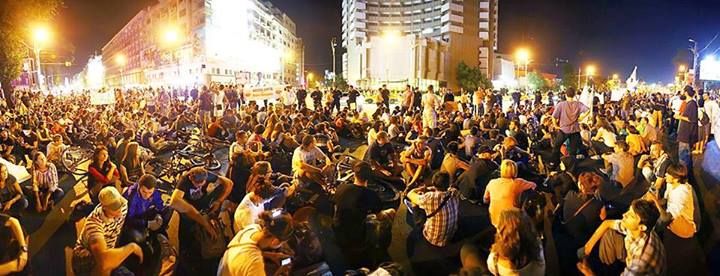
For ten days, from the 1st to the 11th of June, Taksim became … a free zone where, sheltered behind barricades where one could read Taksim Commune, people walked about happily. On the weekend of the 8th and 9th of June, hundreds of thousands of persons came to discover gezi park, its stands, its library, they sang and danced together. They felt safe precisely because the police was far away. At the centre of this zone, the occupants of the Park succeeded in creating a space of life, a concrete space for the sharing of practices, completely different therefore from a shopping centre. In this spatial dichotomy, each discovered what is precious in such a place of encounter, each discovered to what degree one could find pleasure in being there and staying.
Ferhat Taylan, “Taksim, a vital square”, Le Revue des Livres, n°012
The resonances of the occupation of Gezi Park-Taksim Square continue in Istanbul and beyond: in the gathering of neighbourhood assemblies, in the mobile protest picnics marking the end of daily fasting during the month of ramadan, protests during football matches, and so on. And all of this carried through in the face of ongoing harassment, persecution and violence from State authorities and AKP (turkey’s ruling Justice and Development Party) hirelings.
Readings of the Turkish events now abound, often in the context of broader efforts to interpret them comparatively with other protests in North Africa, Brazil, Peru, Chile, etc. and within a time frame that begins with the “Arab Spring” of 2011.
Continue reading →



Performing the government of crisis: greece
The permanent state of emergency/exception that characterises the government by crisis continues unabated in greece. To eliminate the reality-memory of resistance, squats are brought an end to throughout the country (29/08/2013: the eviction of the squat Antiviosi in Epirus; 02/09/2013: the eviction of the Orfanotrofio squat in Thessaloniki). Their role as points of passage, spaces of resonance, for larger struggles, is thus removed, thereby possibly weakening those struggles, or the possibility of ongoing and future forms of resistance. It is unclear what response is emerging from greek anarchist and other anti-capitalist movements, but their inability to slow or stop this repression invites questions. State-Capital does not of course only seek to undermine or destroy opposition in this instance; it also displays, performs, its own power, thereby making it real through the agency of increasingly militarized police forces. In the state of exception that is crisis, the police-military is the state in its concrete expression. And it “proves” itself, “legitimates” itself in operations of pacification, whether by evicting squats, or hunting out immigrants. The ideal of our time for State-Capital is that nothing should happen, nothing should disturb, the “public” spaces through which capital circulates. Thus the public space is cleared of all dissonance: a smoothed space patrolled by mobile machines of surveillance and control.
Continue reading →