Radical politics amid hurricanes

http://www.dissentmagazine.org/wp-content/files_mf/1352805691strikedebt_large.jpg

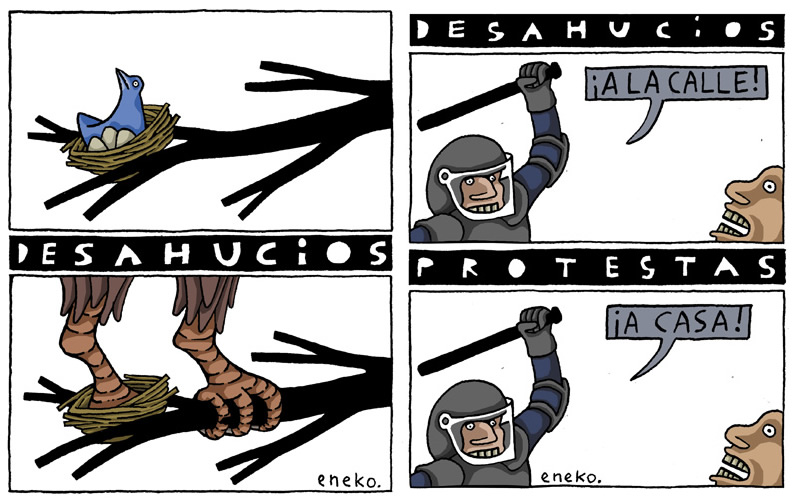
Silvia Frederici, in the last number of Tidal, contends that “debt has become a key means of capital accumulation”.  Having spread ever more broadly throughout the world, it has become the most “general category through which exploitation is organized”.  The collective, always potentially conflict ridden space, of labour exploitation is ever more supplanted by the self-managed exploitation of the debtor.  “In this scenario, as wages and jobs vanish and the lending/debt machine becomes the dominant work relation, exploitation is more individualized and guilt producing”.  If credit-debt is increasingly the means of dominating populations in the “richer” countries (through debts for housing, education, health, and so on), the rapid expansion of micro-credit has brought about similar consequences since the 1980s in the “poor” countries.  Yet it is in the latter that we find a lesson of resistance to debt.

Continue reading

Posted in Commentary | Tagged | Leave a comment

From film of denunciation to the revolutionary use of film

R. Magritte, La trahison des images

Le monde est déjà filmé.  Il s’agit maintenant de le transformer

Guy Debord

Contemporary social movements have contributed to and have been sustained by a proliferation of media production, often described as alternative, in reference to the “truths” they present in opposition to the falsifications of corporate controlled media.  The current and intense efforts to document through film the “arab spring”, 15M in spain, Occupy in the united states, and similar movements elsewhere, are examples.

Continue reading

Posted in Commentary, Film | Tagged , , | Leave a comment

Weaving protest into revolution

It is only when grounded in the ubiquity of resistance that revolution becomes a possibility.

John Holloway, Change the World Without Taking Power

As the tides of protest swell and subside, in these our interesting times of rebellion, their limits are exposed.  Protest is judged largely within a logic of measurable consequences, of effectiveness.  It measures its strength against the power of states and corporations, with success being finally evaluated against the concessions forced from power.  Battle lines are identified, opposing forces are mobilised and arrayed, and the stronger will then triumph.

It is an invigorating picture of political conflict and revolution.  Yet it is a false picture; false even on those occasions where the drama of politics seems to reduce all to a final conflagration.

Continue reading

Posted in Commentary | Tagged , | Leave a comment

A revolution freed

On March the 5th, Hugo Chavez died.  Our silence at his passing was motivated in large part by our ignorance of the complexity of the Revolución Bolivariana and of Venezuela.  Equally, we were silenced by the torrent of media attention that his death, as his political life before, brought down upon him.  But it is difficult to ignore completely the death of someone that Tariq Ali, in his obituary, described as “one of the political giants of the post-communist era”; (The Guardian 06/03/2013) someone who, for many, both inside and outside Venezuela, is considered a socialist revolutionary of great significance.

Our judgement is more skeptical, and more knowledgeable voices than ours have had occasion to question the supposed radical nature of the political process initiated by Chavez, especially after 2004.

Continue reading

Posted in Commentary, News blog | Tagged , , | Leave a comment

A timeless spring

(Image from the Ecole de la Montagne Rouge)

The Québec student movement of the printemps érable of 2012, which began as a protest movement against proposed increases in university tuition fees, very quickly became a much broader social movement that in its most radical expressions questioned the very foundations of State-Capital in the province, with multiple resonances beyond Québec.  If the movement then contributed to the fall of one government, and the suspension of the proposed increases, it continues to echo today in the demand for completely free education.

Continue reading

Posted in Commentary, News blog | Tagged | Leave a comment

Revolution from below: Cooperativa Integral Catalana

In continuity with an earlier post about an initiative that originated in Catalonia calling for the creation of an international network/space for the ideological and practical elaboration of autonomies beyond capitalism (integrarevolució), a return to one of the groups, members of which are involved in this initiative: the Cooperativa Integral Catalana.

Continue reading

Posted in Commentary, News blog | Tagged , , | Leave a comment

From factory occupations to revolution?

Vio.Me. - Occupy, Resist, Produce!

The occupation of factories, of the industrial fabric of a society, is essential to any broad revolutionary movement against State-Capital.  It is however by no means sufficient.  Occupations can only be a part of a more general effort to create spaces of autonomy, economically, politically and so on.  Left to themselves, either as isolated occupations, or as legally recognised cooperatives, they will perhaps survive, but with enormous difficulties, including sustained opposition to their success.  And what are often not addressed are even more fundamental questions about the purpose of factory occupations.

Continue reading

Posted in Commentary | Tagged , | Leave a comment

A call to revolution

http://1.bp.blogspot.com/-FdBRUi_pwfI/UR0LUjKi0eI/AAAAAAAABb0/Da3CsxHiWE0/s1600/integra+revolucio.png

From Catalunia comes a call to create an international network/space for the ideological and practical elaboration of autonomies beyond capitalism (integrarevolució).  Originating among people involved with Radi: Revolució, Acció, Desobediència, Integral and the Cooperativa Integral Catalana, as well as Derecho de Rebelión (who published Rebelaos last Spring), it is an appeal for collective rebellion.  To share …

Continue reading

Posted in News blog | Tagged , , | 1 Comment

Grândola Vila Morena: 2nd of March

http://c9.quickcachr.fotos.sapo.pt/i/Bb414796f/14653532_w9mZn.jpeg

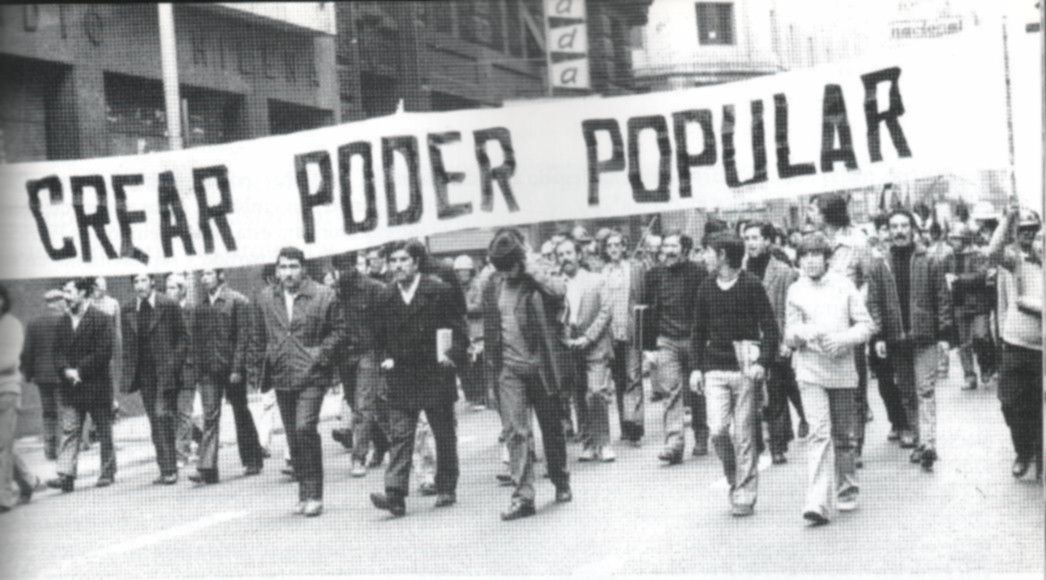
On March the 2nd, a million and a half people in portugal filled the cities’ streets to the music of Zeca Afonso’s Grandola Vila Morena.  The song thus resonates from a historical moment in the country’s imaginary, the Revolution of the 25th of April, of 1974.  To give it life anew, at this moment, is to open up possibilities, is to call forth desires, which one can only share.  But one week on the heels of the mareas protests in spain, the weaknesses of the mareas are multiplied in Portugal.

Continue reading
Posted in Commentary, News blog | Tagged | Leave a comment

Reflections amid violence

(Photograph by Francesca Oggiano, from the series The Stolen Eyes)

in memory of Walter Benjamin

for n.m.


A historical materialist approaches a historical subject only where he encounters it as a monad.  In this structure he recognizes the sign of a Messianic cessation of happening, or, put differently, a revolutionary chance in the fight for the oppressed past.

Walter Benjamin, Theses on the Philosophy of History


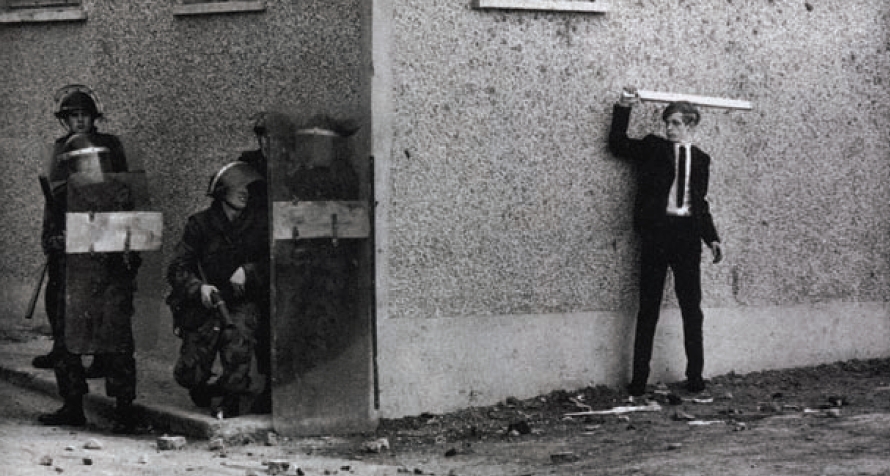
As the many protests of spain’s united mareas ebbed to a close on the night of February 23rd, the police of Madrid could not resist a melee of violence.  The images call forth memories of earlier violence, a state violence that has marked the brief history of spain’s 15M.

Continue reading

Posted in Commentary | Tagged , , , , | Leave a comment