Plastic bodies: Queering walls, Queering life

(Yves Klein)

Our creativity is potentially boundless; the limits that it encounters are of our own making, rooted in our fears and our oppressions.  Nowhere perhaps is this more evident than in/with our bodies.  Our freedom extended to them violates, stretches, confounds what we often consider to be the boundaries of the body, its borders, both physical and moral.  To freely live them is thus to queer them, that is, to queer ourselves.

Continue reading

Posted in Commentary | Tagged | Leave a comment

The metamorphoses of walls

Walls, structures of division and separation, systems of confinement, markers of property, obstacles to movement, channels of passage; walls trace lines of sovereignty and frame the government of populations.  They are, along with the paths that they trace, the most ubiquitous feature of human space.  Pierced as they may be by pathways, gates and windows, such points of passage rarely leads to anything other than more walls, like a castle with numberless walls and no centre.  Their literal and complete physical destruction is impossible, their transgression often only the occasion for new walls.  To move beyond them calls for a gesture of a different order, a movement of blindness, an apprehension and agency that takes the wall as a space of possibility, as a non-wall upon which new forms emerge: the wall as point of passage, as a frame which is in turn framed, without end, bringing thereby an end to or suspending all frames.  The wall becomes a canvas, a field, a stage: life spills out from its frames, moving with surfaces formerly limited to prohibition.  Plants overrun them, animals mould them with play and pursuit, and out touch brings to them shape and colour.  The walls come to speak of worlds, but unseen.  And like children, we again see with surprise.

Continue reading

Posted in Commentary | Tagged | Leave a comment

Mapping the state of exception: greece

Sharing the interventions of the collective The City at the time of Crisis …

Landscapes of Emergency is a brief glance over the undeclared state of emergency that casts its shadow over the functions and the phenomena of public space in Athens today, at this time of crisis.

Continue reading

Posted in Commentary, Film | Tagged , | Leave a comment

Spaces of Autonomy: Self-Management and the Commons in Contemporary Greece

What you will read below is about the formation of a new revolutionary subject. If workers’ councils were the self-creation of the working class during moments of rebellion in the early 1900s or later in the 1950’s the current movement towards self-management that is taking place in Greece (and other countries) is something entirely novel that is expanding the practice of self-management where self-management in the sense of workers self-management is a moment of a self-managed community. Perhaps there is a certain affinity with aspects of the anarchist movement of Spain in the 20s and 30s.

Continue reading
Posted in Commentary | Leave a comment

Rebellion in the city: brazil

Seuls des groupes, classes ou fractions de classes sociales capables d’initiatives révolutionnaires peuvent prendre en charge et mener jusqu’à plein accomplissement les solutions aux problèmes urbains ; de ces forces sociales et politiques la ville rénovée deviendra l’œuvre.

Henri Lefebvre, Le droit à la ville

“Without collective transportation, no life exists in cities.”  But as this transportation is organised according to the ambitions of profit and the administrative control of populations, the “struggle for the right to transportation … means the struggle for freedom, for the right to the city in opposition to the control of public space.” (Colectivo Passa Palavra, “Lutas Socias pelo transporte: uma breve introdução”)

Continue reading

Posted in Commentary, News blog | Tagged , , | Leave a comment

The revolution as trans/queer

(poster by Javi Larrauri)

… only those who find themselves in opposition to the institutionalised Norm can play a fully critical role. In other words, only feminist self-consciousness and homosexual awareness [29] can give life to a vision of the world that is completely different from the male heterosexual one, and to a clear and revolutionary interpretation of important themes that have been obscured for centuries, if not actually proscribed, by patriarchal dogma and the absolutising of the Norm.

Mario Mieli, Towards a Gay Communism

Continue reading

Posted in Commentary, News blog | Tagged , , , | Leave a comment

It is necessary to create autonomous spaces: Carlos Taibo

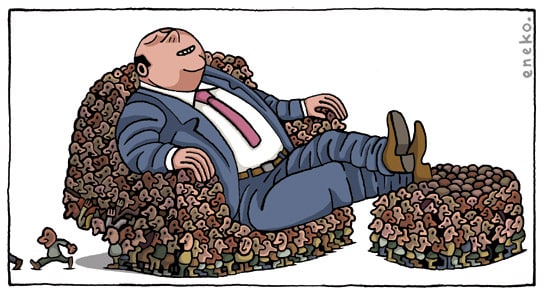
http://mrzine.monthlyreview.org/2011/images/eneko_the_system.jpg

The Ego of autonomy is not the absolute self, the monad cleaning and polishing its external-internal surface in order to eliminate the impurities resulting from contact with others.  It is the active and lucid agency that constantly reorganzes its contents, through the help of the same contents, that produces by means of a material and in relation to needs and ideas, all of which are themselves mixtures of what it has already found there before it and what it has produced itself. … And this is why there can never exist any truth that would be the 'suject's own' in any absolute sense.

Cornelius Castoridis, The Imaginary Institution of Society

If autonomy is, and has been, the central concern of all anti-capitalist movements, how autonomy has been conceived of and the ways in which it is proposed to be attained, have varied enormously.  And the idea itself has been seriously challenged for assuming the possibility of a fully transparent and self-controlled subjectivity, understood individually or socially.  If taken however in this latter sense, then of the idea is impossible.  We are far more than what we are conscious of and we always will be.  What we take ourselves to be inheres in realities that far transcend any self-consciousness.  Autonomy is not only therefore invariably relative, but also, and more importantly, a process, a becoming, and not a state.

Continue reading

Posted in Commentary | Tagged , , | Leave a comment

After Syntagma: Stavros Stavrides

http://roarmag.org/wp-content/uploads/2011/07/Syntagma-popular-assembly.jpg

What follows is a partial translation of a presentation made by the architect and greek activist Stavros Stavrides in CSO Patio Marvillas of Madrid, the transcription of which done by Eva García y Beatriz García of the Observatorio Metropolitano de Madrid and was published in Periódico Diagonal. (06/06/2013)  A video of Stavrides' presentation is available on line (Contested Cities Madrid Stavros Stavrides), though what follows is not a transcription and any discrepancies between the translation and the actual communication should be understood as a consequence of the betrayal of translation.  The question period that follows Stavrides’ presentation has not been translated, nor was it filmed, but it can be consulted in the original Spanish translation in Periódico Diagonal.

Continue reading

Posted in Commentary | Tagged , , | Leave a comment

We are the crises: John Holloway

http://media.roarmag.org/2012/12/Crack-Capitalism.jpg

In our interesting times of rebellion, with protests across north africa, europe, the americas, the work of John Holloway provides us with conceptual tools that help to understand and act in our present …

Continue reading

Posted in Commentary | Tagged | Leave a comment

Gezi/Taksim: So that memories are not erased, and the future is not closed

Video that gathers the lived experience of the occupations of Gezi Park/Taksim square, and beyond …

Continue reading

Posted in Film, News blog | Tagged , , , | Leave a comment