The desire of rebellion: Okupation

https://www.diagonalperiodico.net/sites/default/files/styles/multimedia_630x426/public/foto-slideshow/20140118184254.jpg?itok=juRNmIMZ

Insurrection is the self-constitution of a temporality splitting and proliferating.

Franco Berardi “Bifo”

We need to be disciplined to be undisciplined.

Saul Newman

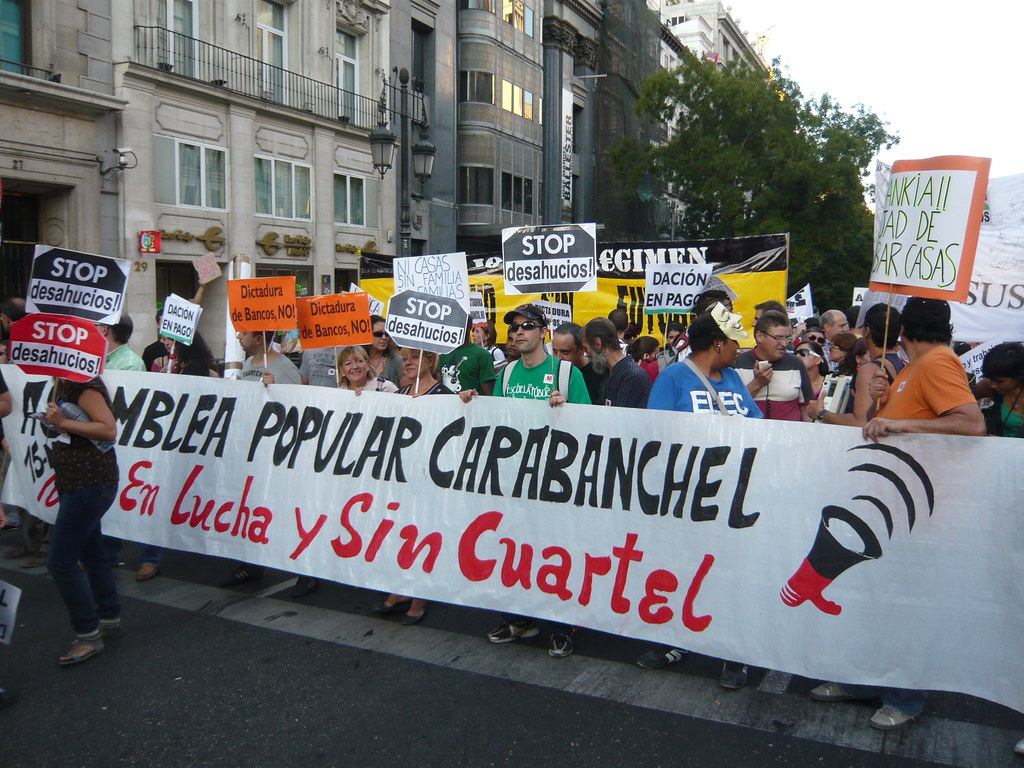
This post is inspired by the ongoing struggle of so many to create and defend Autonomous Okupied Social Centres.  On the 18th of January, 3000 people demonstrated in the streets of Madrid, in defense of the 16 year old CSOA La Casika, threatened by eviction.  A testimony to rebellion … "Diez, cien, mil centros sociales".

Continue reading

Posted in Commentary | Tagged , , , | Leave a comment

Insurrection in the city: Gamonal Resists

http://4.bp.blogspot.com/-i_IwE8fxAOM/UtSEESxb3yI/AAAAAAAAAz8/Tyf7fdJ0KRM/s640/154477-620-282.jpg

…the revolution in our times has to be urban – or nothing.

David Harvey, Rebel Cities

The greater part of the human species now dwells in cities; more correctly, in urban spaces, which for the most part exist in a continuum with the “country-side”.  In some sense, the entire surface of the planet is an essentially urban space.  The city thus becomes the central stage upon which political and economic relations are made and unmade, in struggles of power.  These struggles in turn shape the kinds of people, subjects, subjectivities, that we are and desire to be.

Continue reading

Posted in Commentary, News blog | Tagged , , , , , | Leave a comment

The plurality of autonomy

Autonomies are woven in different ways, at different levels.  The self-understanding of those who participate, the goals and means employed, may vary enormously.  It is far too easy then to criticise such initiatives from a puritanical and ultimately impotent ideological stance, when it is precisely in and through such efforts that ways of living emerge in opposition to State-Capital.

Continue reading

Posted in Commentary, News blog | Tagged , , | Leave a comment

Revolution as Destituent Power

Only if we’re able to disentangle the future … from the traps of growth and investment, will we find an escape from the vicious subjugation of life, wealth, and pleasure to the financial abstraction of semio-capital. … the future is over, and we are in a space that is beyond the future …

Franco “Bifo” Berardi, The Uprising

La tradition politique de la modernité a pensé les changements politiques radicaux sous la forme d’une revolution qui agit comme le pouvoir constituant d’un nouvel ordre constitué.  Il faut abondonner ce modèle pour penser plutôt une puissance purement destituante, qui ne saurait être captée par le dispositif sécuritaire et précipitée dans la spirale vicieuse de la violence.  Si l’on veut arrêter la dérive antidémocratique de l’Etat sécuritaire, le problème des formes et des moyens d’une telle puissance destituante constitue bien la question politique essentielle qu’il faudra penser au cours des années qui viennent.

Giorgio Agamben, Le Monde Diplomatique (January 2014)

A tension haunts our “time of riots” (Badiou), one as old as the war against State-Capital, but which has found a recent conceptual formulation in the opposition between rebellion/revolution as a constituent versus a destituent power.

Continue reading

Posted in Commentary, News blog | Tagged , , , , | Leave a comment

Photographs of ecstasy: The Spanish Revolution

A face of revolution, the joy of rebellion triumphant captured in the eye of a camera lens; an icon of freedom in a spain struggling against fascism through social revolution. 

1936 and the fleeting image of a revolution; fleeting, yet alive in the lives of all who continue to struggle to create ways of freedom and equality.

Behind the icon, the 17 year old Marina Ginestà, journalist and anti-fascist militant; beyond the icon, resistance and revolution as the greatest expression of human beauty …

We were journalists and our profession was to never let our morality waver; we defended the motto of Juan Negrin, “with or without bread, resist”.  And we belived it.

Marina Ginestà died on Monday, January 7, 2014, at the age of 94.


Obituary El Pais.

Posted in News blog, Poiesis | Tagged , | Leave a comment

Taking/making the food

… human history is a history not only of cruelty, but also of compassion, sacrifice, courage, kindness.
What we choose to emphasize in this complex history will determine our lives. If we see only the worst, it destroys our capacity to do something. If we remember those times and places—and there are so many—where people have behaved magnificently, this gives us the energy to act, and at least the possibility of sending this spinning top of a world in a different direction.
And if we do act, in however small a way, we don’t have to wait for some grand utopian future. The future is an infinite succession of presents, and to live now as we think human beings should live, in defiance of all that is bad around us, is itself a marvelous victory.

Howard Zinn

An anti-capitalist politics of food is essential in the construction of autonomy.  Politics intervenes in its production, distribution, and/or consumption, and in the very understanding of the nature of food.  From agricultural cooperatives and communes, collective and self-managed urban gardens, to consumer food cooperatives, free self-managed food banks, to self-managed collective kitchens, freeganism: all are among the faces of autonomy.  If the hunger strike is a weapon of protest, the former protest, but also construct alternatives to the reigning commodification of food.

Continue reading

Posted in Commentary, News blog | Tagged , | Leave a comment

Desiring bodies, loving bodies: The art-activism of Zanele Muholi

I continue to bleed each time I read about rampant curative rapes in my ‘democratic’ South Africa.
I bleed every time queer bodies are violated and refused citizenship due to gender expression and sexual orientation within the African continent.
I constantly bleed when I hear about brutal murders of black lesbians in our townships and surrounding areas.
I’m scarred and scared as I don’t know whose body will be next to be buried.
I bleed because our human rights are ripped.
I cry and bleed as mothers, lovers, friends, relatives lose their beloved ones, let alone the children that become orphans because of trans/queerphobic violence.
We bleed, our life cycles invaded, we bleed against the will of our bodies and beings.

Zanele Muholi

Continue reading

Posted in Poiesis | Tagged , , | Leave a comment

Carlos Taibo: What is happening with 15M?

Carlos Taibo continues to be one of the more reflective and lucid commentators/activists in spain’s 15th of May movement.  What follows is a recent and succinct analysis of the state/diffusion of the movement, published in the Madrid based 15M newspaper Madrid15m (number 20) that is terribly timely at this moment …

Continue reading

Posted in Commentary | Tagged , , | Leave a comment

Performing Revolution: the Orange Alternative

This post comes to us from a friend of Autonomies

 “The more our daily life appears standardized, stereotyped, and subject to an accelerated reproduction of objects of consumption, the more art must be injected into it in order to extract from it that little difference which plays simultaneously between other levels of repetition, and even in order to make the two extremes resonate—namely, the habitual series of consumption and the instinctual series of destruction and death”.

Gilles Deleuze, Difference and Repetition, 293

Can you treat a police officer seriously, when he is asking you: “Why did you participate in an llegal meeting of dwarfs?”

Waldemar Fydrych

“I enjoy, therefore I am”

Manifesto of Socialist Surrealism,  Waldemar Fydrych

On the 13th of December 1981, martial law was declared in Poland as a counter measure to the growing opposition, already politically lucid through the actions of the Solidarity Movement. In an attempt to reverse the uncontested popularity of Solidarity, the government of Wojciech Jaruzelski sought to turn Poland into what could arguably be described as a detention camp, only that it was extended over the territory of a whole country. Martial law elevated the techniques of surveillance and control to a whole new level, from banning public meetings to closing airports, to censoring mail posts and basically infiltrating quotidian life at every level. The law was totalizing, but it was effective. The Solidarity Movement was seemingly crushed and many of its members were arrested. Although the law was lifted in 1983 due to general discontent, the general living conditions in Poland did not change. In fact, they radically deteriorated. Political alternatives were also limited; there was the Church and there was Solidarity, and both were practically allies. Beyond them, there was only the regime.

Continue reading

Posted in Commentary | Tagged , | 1 Comment

The violence of capitalism … and the resistance to it: Stories from spain

Video, No Job Land, by Olmo Calvo, Eva Filgeira and Gabriel Pecot …

Continue reading

Posted in Film | Tagged , | Leave a comment