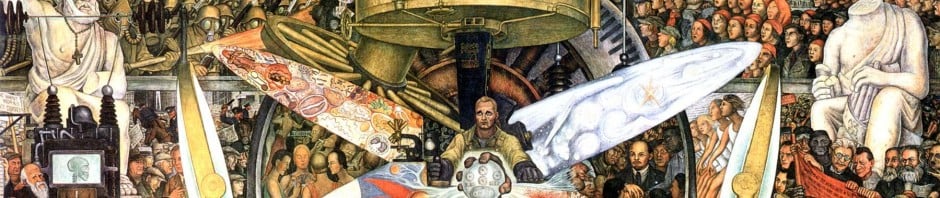

From the Guardian (18/03/2015), we have learned today that students of the London School of Economics have occupied the central administration room at the university in protest at what they call the marketisation of higher education.
From the Guardian (18/03/2015), we have learned today that students of the London School of Economics have occupied the central administration room at the university in protest at what they call the marketisation of higher education.

The revolution takes place in our everyday present …
Manresa, a small city of the region of Bages, in Catalonia, is an industrial centre in decline, with numerous industries closed or in a state of terminal crisis. Like a sort of small Detroit, the city lives in permanent crisis. In urbanistic terms, this translates into half-empty apartment buildings, new buildings left unused, and a historical centre that abounds with buildings in a state of ruin and closed commerce.

(Yuksel Arslan)
Capitalism’s need for wealth extraction in an increasingly urbanised human space can only force it to turn upon itself, to consume itself, in gestures of commodity autophagia. But if cannibalism could once serve as a mode of sacrificial regeneration, capitalism’s urban self -consumption is driven by a growth without redemption; by processes of displacement, segregation, destruction, all driven by a State that secures the conditions for capital accumulation.
.jpg)
In our ongoing endeavour to translate Carlos Taibo’s Rethinking Anarchy: Direct Action, Self-Management, Autonomy (La Catarata, Madrid, 2013), what follows is “Chapter 5”. We have already translated and posted the “Prologue” and the “Chapter 1″ of this work (Click here), “Chapter 2″ (Click here), “Chapter 3″ (Click here) and “Chapter 4” (click here). And we hope to continue in what will be the complete translation of the book. In this way we hope to share with English readers the work of one of the most significant anarchist voices today in spain.
The recent debacle of Syriza should come as no surprise. Neither should we cringe at the attempts of the right in Greece to use it for its own odious and morbid purposes. For the left of the politicians and the political parties, they have discredited themselves a long time ago, and if it were not for people’s inability to give up on the alure of idols and saviours, the “left” would have disappeared long time ago.
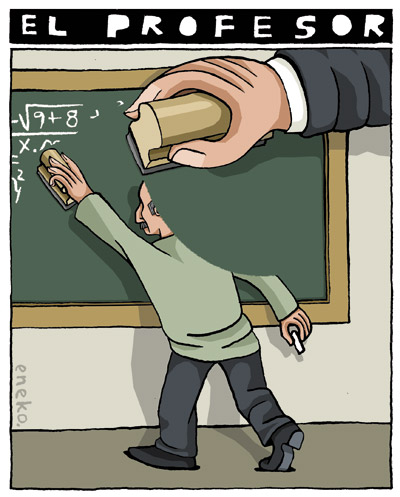
Education is the Art and Practice of making people free.
Pepita Martrín Luengo
Plato´s early reflections upon education were grounded in the conviction that the ethical nature of the individual and society depended in equal measure on it. Justice was impossible in either case without education. If today, Plato´s Republic is less than seductive, it is not because of his conception of education as such, but rather because of his belief that human potential is naturally dictated and distinguishable between social classes and not individuals, thus serving to simultaneously constitute and justify an authoritarian social hierarchy.
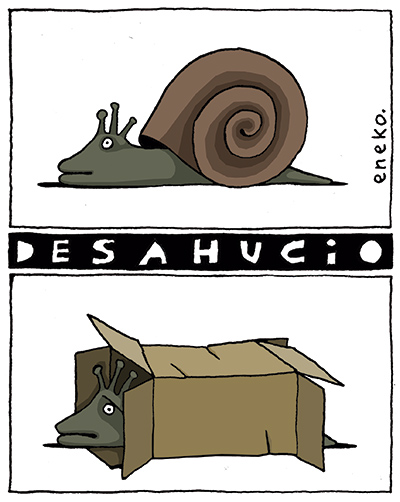
The politics of eviction is the political expression of the protection of Capital …

If the Syriza government of greece prefers to speak of the “institutions” rather than the “troika” (a group of “experts” of the principal creditors of the country: IMF, European Central Bank, European Commission, responsible for negotiating and verifying austerity reforms imposed on the country), it is the “troika” that remains very much in control. At the Eurogroup meeting between Eurozone finance ministers and the greek government on Monday, February 9, the latter was forced to accept and to negotiate anew with the same experts. And on the evaluation of the government’s proposed reforms will depend the continuation of the financial “aid” to the country; aid without which greece faces bankruptcy.

Since late 2014, students of the University of Amsterdam have engaged in protests against planned budget cuts and the restructuring of academic programs, especially humanities programs, all part of the University´s overall austerity measures dictated by an institutional debt crisis, itself fed by the institution’s speculative real estate investment.
Okupations and strikes amidst students: Amsterdam and Toronto
With each passing day of the New University/Amsterdam student occupation, the movement resonantes locally and beyond the country’s borders. The commodification of education is global; if restrained in the past, it is today without leash, and runs amok among the commons that are systems of State-public education. Without being apologists for State managed schooling, its creation was not without unpredictable political consequences for regimes of social reproduction. And what today rises in its stead, radically privatised institutions of learning and curriculum determination, is arguably far more oppressive.
Continue reading →