David Graeberis an anthropologist at Goldsmiths College, University of London. In his previous books, particularly Towards An Anthropological Theory of Value and Fragments of An Anarchist Anthropology, he has spelt out his view of the need for a link between radical politics and anthropology. Here, building on his ethnographic work with direct action activists, he argues that although theories of revolution today seem unrealistic and old-hat, revolutionary practice is in good health. We need, therefore, new theoretical tools. Can anthropology point the way?
“Revolution in reverse” is a chapter from a collection of essays by Graeber entitled Revolutions in Reverse: Essays on Politics, Violence, Art, and Imagination (2009/2012). Both the essay and the collection are available at The Anarchist Library.
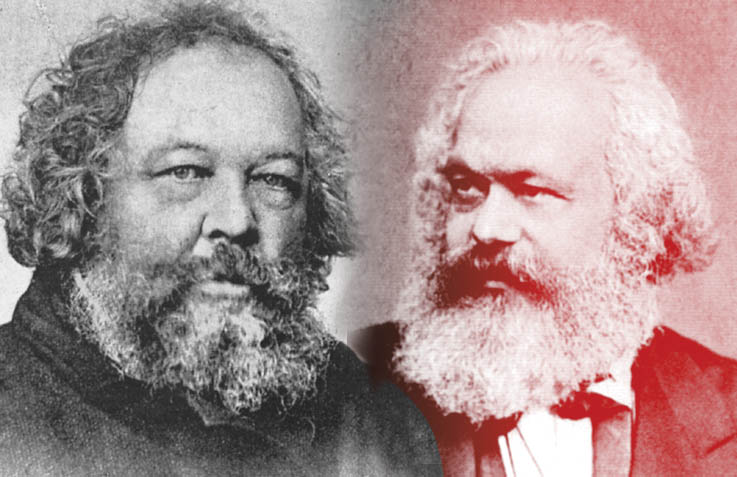
In the persons of these two revolutionaries, two distinct projects clashed within the First International
There are more elements of commonality between Bakunin and Marx than might appear. It was hardly a coincidence that both sought the shelter of the International and that, despite their disagreements, they shared space within that organisation. Aside from this, it is evident that both Bakunin and Marx wished to protect the International from external attacks. The boundless, perhaps excessive, admiration that Bakunin felt at all times for Marx’s theoretical work can never be overstated. The desire to leave behind an order, that of capital, was present in the reflections and actions of these two revolutionaries.
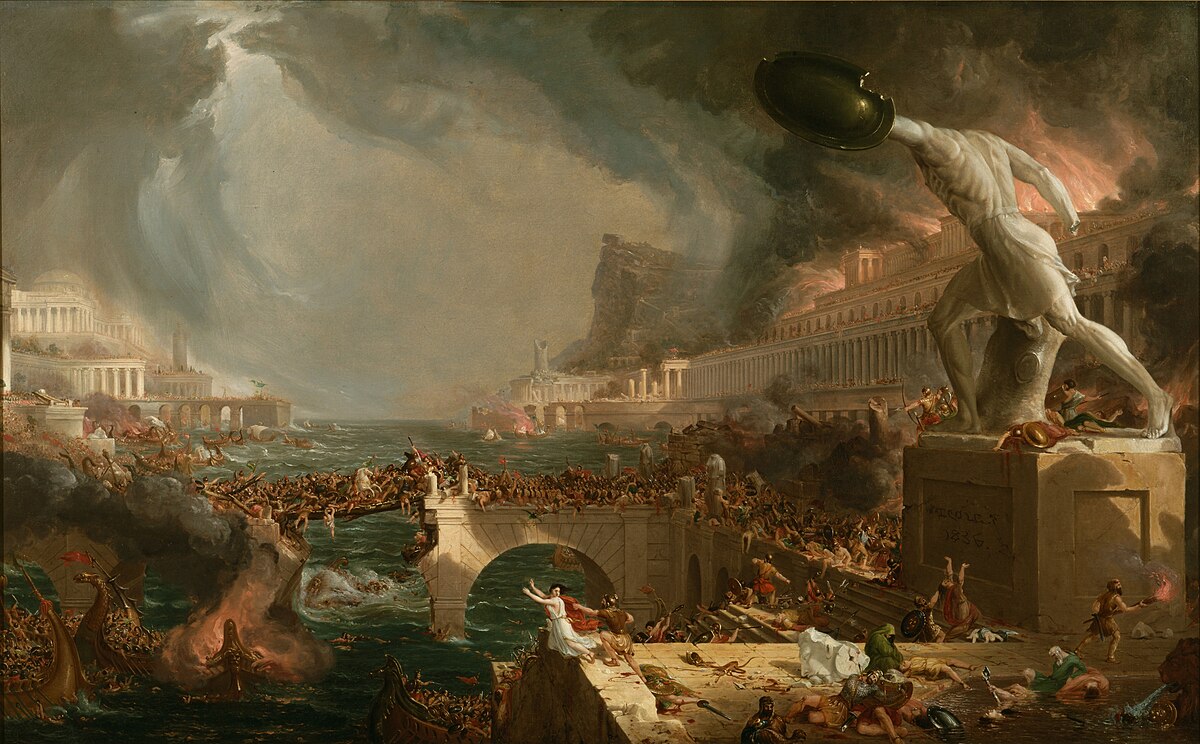
Thomas Cole, Destruction from The Course of Empire (1836)
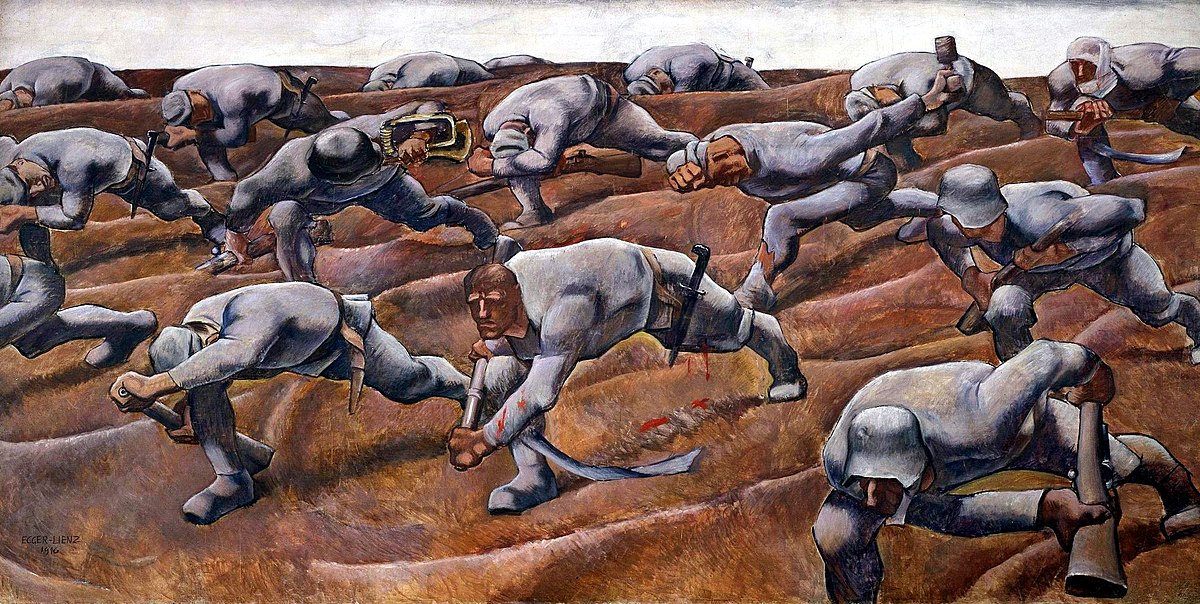
Many people nowadays, moved by the horrors of every kind that our time provides in a number overwhelming for anyone the least bit sensitive, think that, as a result of an excessively great technical power, or a kind of moral decadence, or for any other reason, we are entering a period of greater barbarity than the centuries humanity has already gone through. That is far from being the case. All one need do to be convinced is open any ancient text, the Bible, Homer, Caesar, Plutarch. In the Bible, the victims of a massacre number generally in the tens of thousands. Total extermination, in one day, with no exceptions made for sex or age, is not, in Caesar’s accounts, anything extraordinary. According to Plutarch, Marius used to walk in the streets of Rome followed by a troop of slaves who would immediately fall upon anyone greeting him if Marius didn’t return the greeting. Sulla, who was begged on the Senate floor at least to declare whom he intended to have killed, said that he couldn’t recall all the names at that moment, but that he would publish them day by day as they occurred to him. None of the past centuries known to history is poor in atrocious events. The power of weaponry is unimportant in this regard. For large-scale massacres, the simple sword, even of bronze, is a more effective instrument than the airplane.
In every sphere, we seem to have lost the very elements of intelligence: the ideas of limit, measure, degree, proportion, relation, comparison, contingency, interdependence, interrelation of means and ends. To keep to the social level, our political universe is peopled exclusively by myths and monsters; all it contains is absolutes and abstract entities.
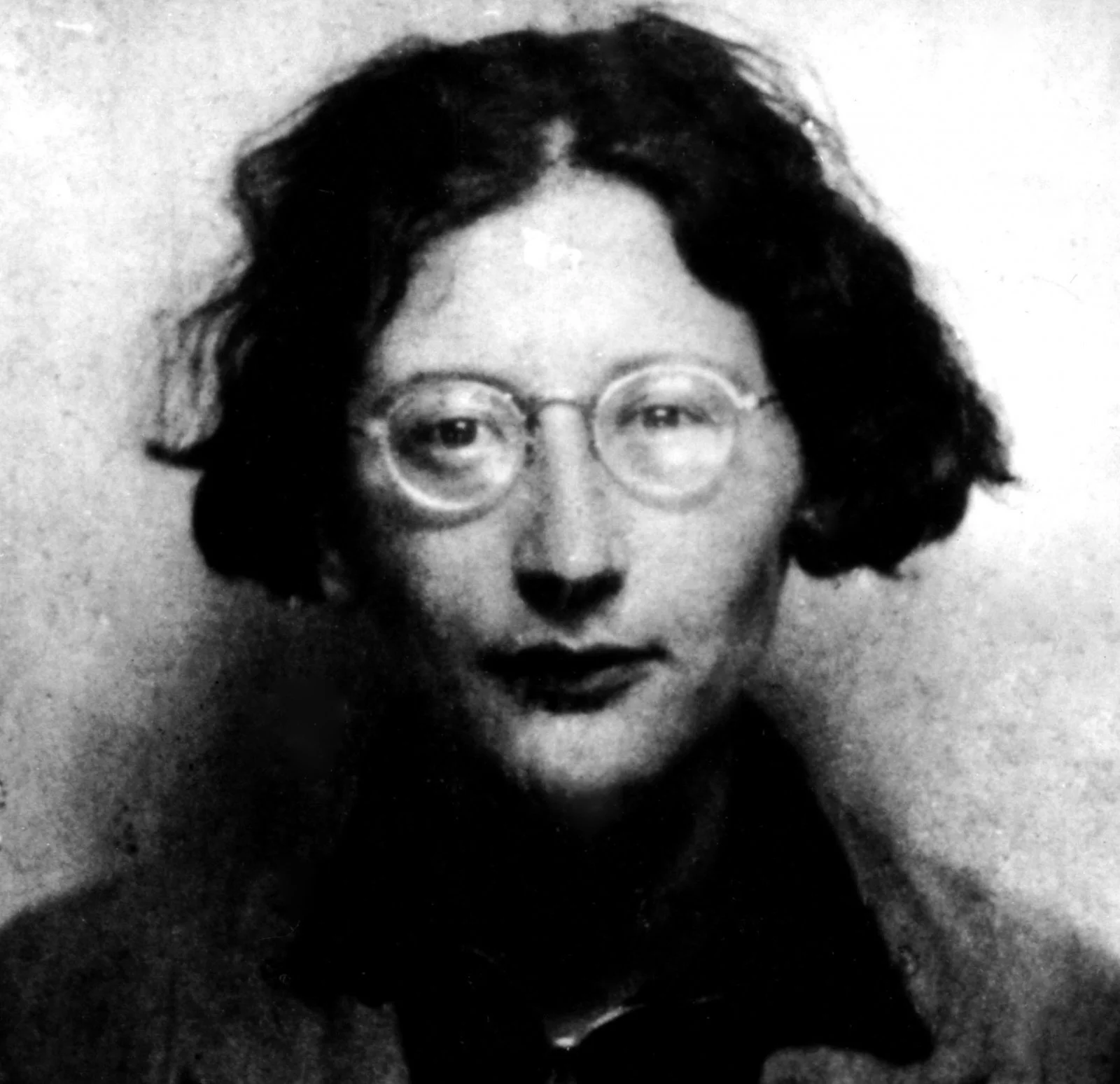
Simone Weil
We shed blood for high-sounding words spelled out in capital letters. We seek to impart content to them by destroying other men who believe in enemy-words, also in capital letters. … The nothingness of national, class, or racial myth must receive an apparent substance, not from intelligible content but from the will to destroy and be destroyed.
The relative security we enjoy in this age, thanks to a technology which gives us a measure of control over nature, is more than cancelled out by the dangers of destruction and massacre in conflicts between groups of men.[1] If the danger is grave it is no doubt partly because of the power of the destructive weapons supplied by our techniques; but these weapons do not fire themselves, and it is dishonest to blame inert matter for a situation in which the entire responsibility is our own. Common to all our most threatening troubles is one characteristic which might appear reassuring to a superficial eye, but which is in reality the great danger: they are conflicts with no definable objective. The whole of history bears witness that it is precisely such conflicts that are the most bitter. It may be that a clear recognition of this paradox is one of the keys to history; that it is the key to our own period there is no doubt.
The perspectives of a revolution seem therefore quite restricted. For can a revolution avoid war? It is, however, on this feeble chance that we must stake everything or abandon all hope.
Simone Weil
The masks have fallen away, or they have been torn away, as too restraining. Over a century of struggles over the many powers of states are now being won by tyrants and new fascists. And we are called upon not only to think the new, but the old; to think anew of political violence, war and revolution. And we turn to Simone Weil.
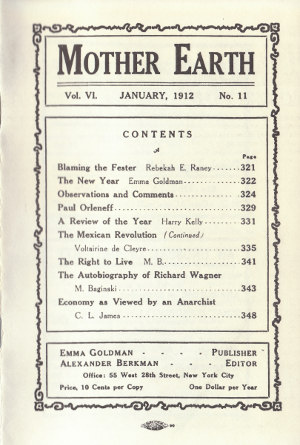
The business Christians have just celebrated Christmas. To increase their profits and heighten the glory of God, they have exploited the Savior to good purpose. Splendid success of redemption! Christ gave his blood to enable the churches and department stores to do better business. If, on the right hand of the Heavenly Father, he does not swear and curse over this success to shock the very angels, his heart is a lamb’s indeed.
Fortunately, we are atheists, not Christians, and in no wise responsible for the bitter disappointment of the Savior.
However, the hopes of Mother Earth for the new year depend neither on religious nor political calculations. They rest on the awakened consciousness of the people, upon whom depends the great and glorious future,—a new social structure built on freedom and well-being for all.
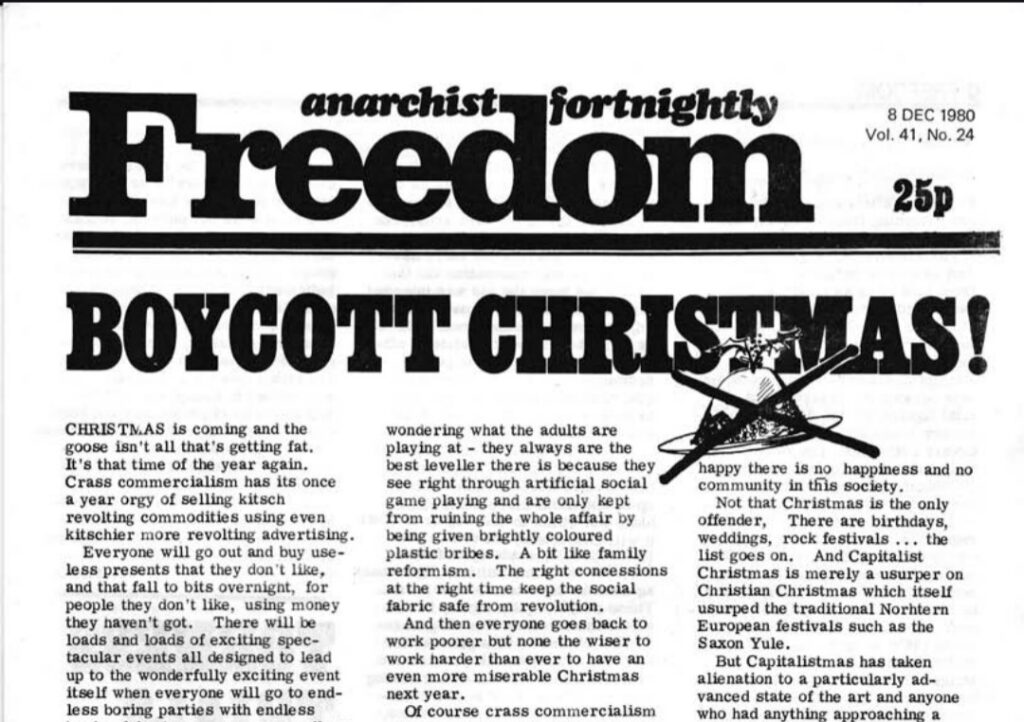
A curmudgeonly anarchist Christmas rejoinder is in some ways truer now than it was forty-five years ago
punkacademic
The 8 December 1980 edition of Freedom led with a bold call to action—BOYCOTT CHRISTMAS! A wonderfully curmudgeonly rant at ‘Capitalist Christmas’ penned by one of our predecessors, the piece veers between all-out assault on the hypocrisies of Christmas celebrations under capitalism and more poignant reflections on loneliness and mental health.
In 1973, writing Tools for Conviviality, Ivan Illich predicted that the catastrophe of the industrial system would become a crisis that would usher in a new era. “The total collapse of the industrial monopoly on production will be the result of synergy in the failure of the multiple systems that fed its expansion. … Almost overnight people will lose confidence not only in the major institutions but also in the miracle prescriptions of the would-be crisis managers. The ability of present institutions to define values such as education, health, welfare, transportation, or news will suddenly be extinguished because it will be recognized as an illusion. This crisis may be triggered by an unforeseen event, as the Great Depression … . People will suddenly find obvious what is now evident to only a few: that the organization of the entire economy toward the “better” life has become the major enemy of the good life. Like other widely shared insights, this one will have the potential of turning public imagination inside out. Large institutions can quite suddenly lose their respectability, their legitimacy, and their reputation for serving the public good.”
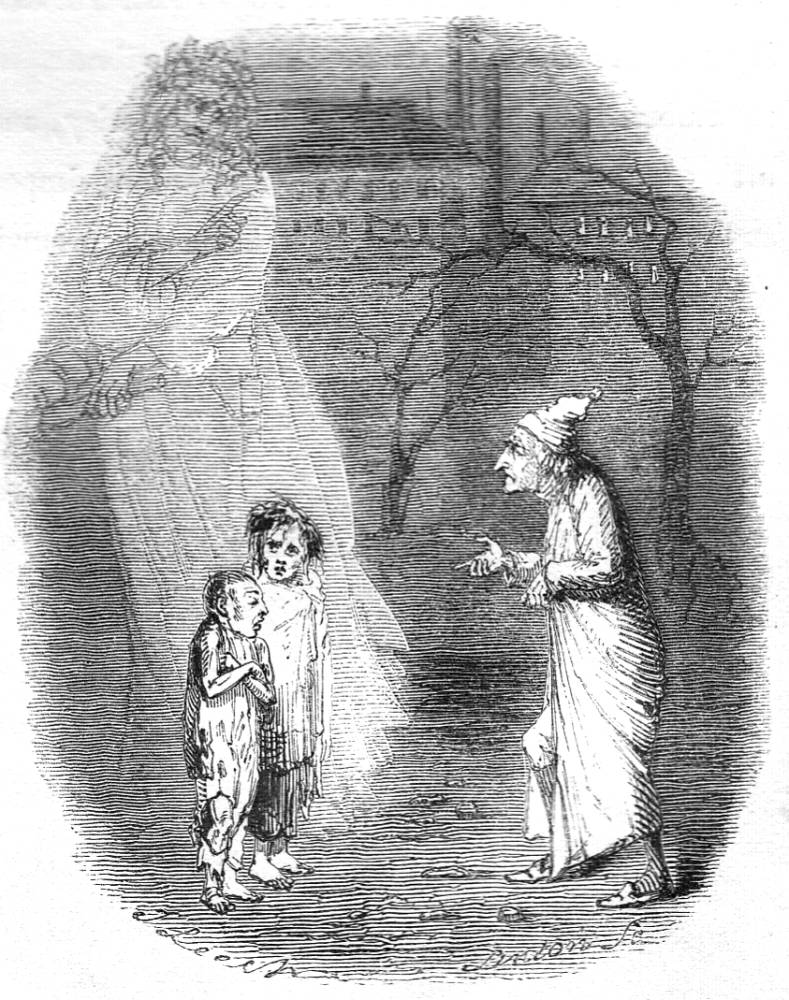
“Ignorance and Want”, by John Leech, from Charles Dickens’ A Christmas Carol (1842)
“Forgive me if I am not justified in what I ask,” said Scrooge, looking intently at the Spirit’s robe, “but I see something strange, and not belonging to yourself, protruding from your skirts. Is it a foot or a claw?”
“It might be a claw, for the flesh there is upon it,” was the Spirit’s sorrowful reply. “Look here.”
From the foldings of its robe, it brought two children; wretched, abject, frightful, hideous, miserable. They knelt down at its feet, and clung upon the outside of its garment.
“Oh, Man! look here. Look, look, down here!” exclaimed the Ghost.
They were a boy and girl. Yellow, meagre, ragged, scowling, wolfish; but prostrate, too, in their humility. Where graceful youth should have filled their features out, and touched them with its freshest tints, a stale and shrivelled hand, like that of age, had pinched, and twisted them, and pulled them into shreds. Where angels might have sat enthroned, devils lurked, and glared out menacing. No change, no degradation, no perversion of humanity, in any grade, through all the mysteries of wonderful creation, has monsters half so horrible and dread.
Scrooge started back, appalled. Having them shown to him in this way, he tried to say they were fine children, but the words choked themselves, rather than be parties to a lie of such enormous magnitude.
“Spirit! are they yours?” Scrooge could say no more.
“They are Man’s,” said the Spirit, looking down upon them. “And they cling to me, appealing from their fathers. This boy is Ignorance. This girl is Want. Beware them both, and all of their degree, but most of all beware this boy, for on his brow I see that written which is Doom, unless the writing be erased. Deny it!” cried the Spirit, stretching out its hand towards the city. “Slander those who tell it ye! Admit it for your factious purposes, and make it worse. And bide the end!”
Charles Dickens, A Christmas Carol
A Christmas Story
Lucy E. Parsons, The Alarm, December 26, 1885
And here is my mail with a letter from Santa Claus who has not even forgotten me, although the halcyon days of childhood’s sweet delusion have long since vanished from me. And the precious missive which the venerable old sire in his rambles through foreign lands has found and brought to me, becomes so interesting as I peruse its contents that I have determined to let the readers of The Alarm have the benefit of it.
Everyone agrees that the current political landscape in France is frankly depressing. On the one hand, there is an obvious fascistisation of stupidity, and on the other, a kitsch revival of Leninist leftism. It’s easy to forget that for almost 15 years, from the anti-CPE movement in 2006 to the Yellow Vests movement in 2019, there was a much more joyful and vibrant anarchist and destituting movement. The defeat of some is always the joy of others. In any case, the happy thing about history is that everything can always be rethought and restarted, which is what a new online magazine, À bas bruits, des paysages anarchiques [Quietly/ Discretely, Anarchic Landscapes], proposes. We are publishing one of its first articles here, written by Josep Rafanell i Orra, who is well known to readers of lundimatin. A launch party is planned for 24 January in Paris.
David Graeber: Revolution in reverse
David Graeber is an anthropologist at Goldsmiths College, University of London. In his previous books, particularly Towards An Anthropological Theory of Value and Fragments of An Anarchist Anthropology, he has spelt out his view of the need for a link between radical politics and anthropology. Here, building on his ethnographic work with direct action activists, he argues that although theories of revolution today seem unrealistic and old-hat, revolutionary practice is in good health. We need, therefore, new theoretical tools. Can anthropology point the way?
“Revolution in reverse” is a chapter from a collection of essays by Graeber entitled Revolutions in Reverse: Essays on Politics, Violence, Art, and Imagination (2009/2012). Both the essay and the collection are available at The Anarchist Library.
Continue reading →