Achille Mbembe’s Politiques de l’inimitié reads contemporary politics as a series of strategies and tactics of colonisation, thus grounded on the creation of fictional others (through hierarchising categories of race, sex, ethnicity and the like) and the desire for their complete control, exclusion and extermination, in conformity with the fulfillment of this desire.
If in the past, this politics of enmity was limited geographically by the extent of State power and their corresponding economies of and technologies of control, under contemporary capitalism, it is global and total, or aspires to be, both in extent and intensity.
This process can be read as the full realisation of the Carl Schmitt’s contention that the political is reducible to the existential distinction between friend and enemy, or that the sovereign is s/he who decides on the exception. The totalisation of the political thus translates into a universalisation of the distinction and/or the exception, both at the macro level between states and at the micro level in the construction of subjectivities and intersubjective relations.
The hatred of the other, and the exclusion or death of the other, are thus constitutive of social relations, in turn, sustained and produced by capitalism. Commodity production depends upon hierarchy no less than modern states.
What Mbembe modestly opposes to this is a democratic politics of recognition. It is however unclear what this actually might look like. And given the nature of contemporary politics, it seems completely utopian. And if we affirm, by contrast, that “revolutionary politics really begins with the realisation that everything is about everything. Because we recognize that incremental tinkering will never change the system, we demand a total revolution in all areas of social life”, the question immediately follows, “but what does that mean? How do we get a hold of the whole?” (Having Premonitions: an interview with AK Thompson, AK Press, 28/11/2018)
There are no simple answers to these questions, and perhaps they are unanswerable beyond the moments when they surge up in crises. Yet it seems equally defeatist to just sit about waiting for the collapse when far more violent actors feed and endeavour to respond to the desire for annihilation of the undesirable.
Neo-liberal forms of democracy capitalism and its more openly violent expressions in fascism function through seduction, the creation and taming of desires through fantasies and myths. Anti-authoritarian anti-capitalism must be capable of generating its own myths, its own forms of “spirituality” (c.f. Mario Tronti, Dello spirito libero), the distinguishing characteristic – from the neo-liberal, authoritarian – that these myths must be lived as myths, as exercises in myth-making, as playful storytelling (Walter Benjamin’s politicisation of aesthetics).
What is outlined upon our political-social horizon is a capitalist-eugenic feudalism of unprecedented violence. And there is no longer any escape to the wilds, to a “zomia” (James C. Scott). The battles, at whatever their scale, occur henceforth within the empire. But to speak with the guerilla is still to speak the language of friends and enemies. Is it possible to move beyond, to a myth and desire of redemption beyond the logic of sovereignty? Perhaps here: in the recognition not of the other, but in the recognition of our mutual fragility and thus the impossibility of raising ourselves above anyone or anything else.
From the CrimethInc. Collective, an interview with Joey Ayoub on the rebellion in lebanon (and a followup on an earlier text of his posted by the Collective and shared by Autonomies).
Lebanon: The Revolution Four Months in
An Interview
A massive uprising broke out in Lebanon on October 17, 2019, drawing people together across sectarian lines to reject the domination of warlord oligarchs. Four months later, the unrest continues—amid efforts to crush, tame, or redirect it. How can an understanding of Lebanese history help us understand the situation? What can we learn from the Lebanese uprising that could inform struggles against capitalism, sectarianism, and the state worldwide?
The Raccoon people live by simple rules: live life to its fullest, no concession to a world of misery, and run to fight another day.
I first met one of the Raccoon people when I was only a child. He was visiting my parents, dressed in the fashion of the time, and he treated himself to our food and our company. I had never met a happier person. I alternated between bouncing on his knee, wrestling with him over the last piece of bread, and racing around the jungle of our backyard with him, an adult unlike any I had ever met before, or since.
He left behind a little buckskin figurine to remember him by. “Rub this between your palms and say my name. I will not promise that I will come back to you but I promise that my memory will, and often times that will be enough.”
When he left our house my parents stopped speaking to each other. Something about his visit reminded them that they were not working out the way that they expected and each of them began to look for something else. Other people passed through, glass was broken, voices were raised not in song, and eventually feet walked in different directions.
Later in life I found more Raccoon people. They usually did not have time for me because I was looking and they had already found. They were a merry people, running in groups, speaking in code, dressing like explosions and carousels, Bottles in hand, holes in shoes, scabs on joints; these were a people worth knowing.
For me, the idea, the beautiful idea, is about—how do you connect ideas to living? It’s not about “the struggle.”
A Hell of a Mistress, the Beautiful Idea: An Interview with Aragorn! (CrimethInc. 19/02/2020)
We cannot speak of Aragorn! the person (for we did not know him), nor of his “activism”, or better, of his way of living anarchism (except indirectly, through what he and others have said of it). As for polemics about the person, we leave to others more finely practiced in such arts.
What we know of him and his anarchism we have learned above all through his writings, and it is with his written word that we share affinities.
If we speak of the passing of an “american” anarchist, it is not to identify his work as provincial, for it is only through being rooted in a time and place, in a story, in its passions and thoughts, in its spirit, that one can speak beyond one’s “self”. Aragorn! at times confessed embarrassment at “american” twists of “european” anarchism, but he also had little patience for what he viewed as often elitist and anachronistic visions of rebellion coming from europe. And, in the end, what mattered was how one lived anarchism, in both thought and action, and not the label; and real life must be grounded.
While of course I agree with and adhere to internationalist values that are sort of anarchist values, my interest has always been in doing what you’re going to do in the here and now. I’ve always distrusted people that proselytize across oceans.
A Hell of a Mistress, the Beautiful Idea: An Interview with Aragorn!(CrimethInc. 19/02/2020)
Aragorn! brought to anarchism a “post-leftism” or “post-workerism”, fed by the Situationists and Italian insurrectionism [ … the SI provide the best, most cruel, anarchist criticism of the first wave of anarchists. An anarchist who has not read chapter 4 of Society of the Spectacle (especially parts 90-94) and come away changed vis-à-vis the questions of revolution, timing, and politics is probably not capable of working with people in a contemporary context. I think these questions are central, even if they are not easily answered.Laughing at the Futility of it All: An interview with Aragorn! (Anarchist without content 13/10/2015)], along with a nihilist reading of anarchist politics, an effort to “decolonise” the tradition, and a turning to american indigenous ways of living for inspiration. For Aragorn!, anarchism is not an “activism”, a “theory” (though it includes these as well); it is rather an ethics, a way of being-in-the-world.
Aragorn! died this last February 13th. For him, for us, we share what follows.
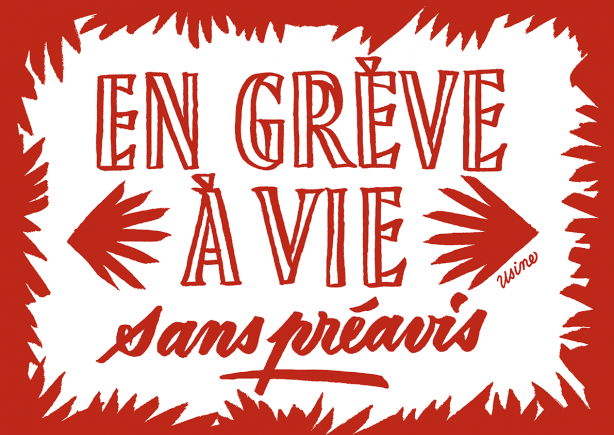
The strangely intermittent general strike in opposition to proposed pension reforms in france is neither “general”, nor truly a “strike”. If the movement is soon to enter its third month, with another day of protest scheduled for today (Paris-luttes.info), the strike has never succeeded in paralysing the country’s economy (indeed, it barely reaches past the more unionised public sector).
Where the movement will go from here, whether it will be able to break out of its formal “labour union” demands, whether it can overflow into other resentments and/or desires, is to be seen. Its limits however are evident; if it is to become more, then it must shed its role as a defender of past reforms.
We share below, in translation, a short critical essay from the Temps critiques collective that was generously forwarded to us, and which has also been published with lundi matin.
From the CrimethInc. Collective: A Call for Solidarity Actions February 22-29
In Russia, the Russian Federal Security Service—the FSB, which is descended from the KGB—has set a new precedent for extracting false confessions from arrestees by means of torture, threats, and blatantly planted evidence. This week, a Russian court found seven defendants guilty of terrorist conspiracy on the basis of evidence derived from these methods; they have been sentenced to up to 18 years in prison apiece. For years, governments all over the world have unsuccessfully attempted to make fabricated conspiracy charges stick. Now, utilizing this new model based in flagrant brutality and dishonesty, the Russian government has succeeded in setting a new precedent. Police exchange tactics and strategies on a global basis. As the world slides faster towards tyranny, we can be sure that we will see these tactics of repression spread outside Russia if we don’t mobilize effectively against them now.
Consequently, in concert with the Russian solidarity organization supporting these prisoners, we are calling for a week of solidarity actions February 22-29.
For more background on the case and the pattern of trumped up conspiracy cases throughout Europe and the US, read our earlier analysis, “Why the Torture Cases in Russia Matter.”
The yellow vests insurrection revealed the central role of the State in assuring the reproduction of capitalist social relations, a role which as central, is also fragile, sustained only by its increasing militarisation against those whom capital increasingly discards.
From the Temps critiques collective, a further reflection on the yellow vests movement.
On the one hand, then, there is antagonism, everything that contributes to our generalized dispossession, itself associated with pure and simple destruction; and on the other hand, everything that seeks to oppose it, in an ethical leap to save the possibility of a dignified life for all human and non-human inhabitants of the Earth.
With two recent posts in the background – The ethics of revolution and Vaneigen’s Everything Starts Here and Now – we return to a reflection on the gilets jaunes/yellow vests. And we do so because of our conviction that the movement inaugurates a series of tendencies that will very likely mark the rebellions of our time, rebellions without a guiding ideology, a central organisation or leadership, rebellions that aim to destitute power rather than create it, and grounded above all in the desire to live.
Below, we share an interview conducted on September 12, 2019 by ACTA with Jérôme Baschet, author of a new book on the Gilets Jaunes uprising, Une Juste colère. Interrompre la destruction du monde, and translated for and published with Mute (23/02/2019).
Anarchism means flying forever. Since the very moment we open our eyes to this world, from all sides, a net of religion, nationality, language, “race”, sexism is thrown over our intelligence, as an obstacle to flight. When you talk to me about religion, race, language and superstition, then I try to build wings out of these nets to fly towards the infinite freedom of thinking mind
Becoming an anarchist starts with breaking norm structures. This is hugely difficult and expensive. But more difficult than that is to remain an anarchist
In fact, all brave birds fly far away to distant places, but eventually halt somewhere their flight and are unable to continue more. Then they sit on the higher branch of a big tree or on a big rock
Who else can say then that there is no infinite freedom anymore? Who else can say that they have flown as far as they could handle? There are no birds capable of flying for endless eternity
Anarchism is a bird that moves against the definite characteristics called fate and laws, therefore it breaks the norm structure, goes against Power and thus conquers the world and creates the change
The Anarchist development is not created of any chance, but is produced by the difficult path of libertarian struggle
Until now, capitalism has only tottered due to the crises of its internal development, its fluxes of growth and decline. It has progressed from one bankruptcy to another. We have never succeeded at bringing it down, except on those very brief occasions when people have taken their destinies into their own hands.
To state the following isn’t to pretend to be a prophet: we have entered an era in which the historical circumstances are favorable for the rise of a human future, to the rebirth of a life that is intoxicated by freedom.




Achille Mbembe: The society of enmity
Achille Mbembe’s Politiques de l’inimitié reads contemporary politics as a series of strategies and tactics of colonisation, thus grounded on the creation of fictional others (through hierarchising categories of race, sex, ethnicity and the like) and the desire for their complete control, exclusion and extermination, in conformity with the fulfillment of this desire.
If in the past, this politics of enmity was limited geographically by the extent of State power and their corresponding economies of and technologies of control, under contemporary capitalism, it is global and total, or aspires to be, both in extent and intensity.
This process can be read as the full realisation of the Carl Schmitt’s contention that the political is reducible to the existential distinction between friend and enemy, or that the sovereign is s/he who decides on the exception. The totalisation of the political thus translates into a universalisation of the distinction and/or the exception, both at the macro level between states and at the micro level in the construction of subjectivities and intersubjective relations.
The hatred of the other, and the exclusion or death of the other, are thus constitutive of social relations, in turn, sustained and produced by capitalism. Commodity production depends upon hierarchy no less than modern states.
What Mbembe modestly opposes to this is a democratic politics of recognition. It is however unclear what this actually might look like. And given the nature of contemporary politics, it seems completely utopian. And if we affirm, by contrast, that “revolutionary politics really begins with the realisation that everything is about everything. Because we recognize that incremental tinkering will never change the system, we demand a total revolution in all areas of social life”, the question immediately follows, “but what does that mean? How do we get a hold of the whole?” (Having Premonitions: an interview with AK Thompson, AK Press, 28/11/2018)
There are no simple answers to these questions, and perhaps they are unanswerable beyond the moments when they surge up in crises. Yet it seems equally defeatist to just sit about waiting for the collapse when far more violent actors feed and endeavour to respond to the desire for annihilation of the undesirable.
Neo-liberal forms of democracy capitalism and its more openly violent expressions in fascism function through seduction, the creation and taming of desires through fantasies and myths. Anti-authoritarian anti-capitalism must be capable of generating its own myths, its own forms of “spirituality” (c.f. Mario Tronti, Dello spirito libero), the distinguishing characteristic – from the neo-liberal, authoritarian – that these myths must be lived as myths, as exercises in myth-making, as playful storytelling (Walter Benjamin’s politicisation of aesthetics).
What is outlined upon our political-social horizon is a capitalist-eugenic feudalism of unprecedented violence. And there is no longer any escape to the wilds, to a “zomia” (James C. Scott). The battles, at whatever their scale, occur henceforth within the empire. But to speak with the guerilla is still to speak the language of friends and enemies. Is it possible to move beyond, to a myth and desire of redemption beyond the logic of sovereignty? Perhaps here: in the recognition not of the other, but in the recognition of our mutual fragility and thus the impossibility of raising ourselves above anyone or anything else.
Continue reading →