Viruses and Separation: Frédéric Neyrat on political virality and competing separatisms
(15/03/2020)
Originally published in Terrestreson March 5, 2020
Translated from the French by an anonymous friend
“Our enemy is separatism,” President Macron recently declared. Hearing him define separatism as “the will to leave the Republic, to no longer respect its rules,” to “leave the republican field” in the name of certain “beliefs,” many of us thought that he was talking about himself and not about Muslims, according to the well-known mechanism of projection – a primitive psychological defense system that makes it possible to attribute to another what one seeks to deny in oneself. This is because La République en Marche clearly appears to be the party of those who have separated themselves from others: from the people, from refugees, from the reality of the climate, and who are more interested in the future privatization of the pension system than in the laws of the Republic. It should be added that putting demonstrators’ eyes out with Flash-Ball guns (LBDs), making highschoolers kneel with their hands on their heads in Mantes-la-Jolie, or arresting those who worry about their future and invade the headquarters of the multinational BlackRock, does not seem to be a matter of respect for the rules of the Republic, unless one understands it as being in the business of psychic and physical mutilation.
Crisis and Control: Resisting the end of the world by proliferating new worlds
COVID-19 is the culmination of a decade of contagion movies, the beginning of the worst. Every little anxiety baked into the liberal order is now being expressed with PSAs reminding us we are all vectors responsible for the spread of the economy’s epochal pandemic. Governments the world over scramble to impose restrictive measures, some ham-fisted, some half-baked, others just horrifying.
In James C. Scott’s telling of the rise of early Neolithic states, sedentism, farming, the domus, irrigation and urbanisation precede the creation of state power. “All of these human achievements of the Neolithic were in place well before we encounter anything like a state” in Mesopotamia or elsewhere. (Against the Grain, 116) Rather than embryonic states preceding the emergence of these institutions and practices, they arose by harnessing the new agricultural grains and concentrations of manpower as a basis of control and appropriation. There was no other possible foundation for the design of a state previously or at that time.
What might “collapse” mean, anyway—as in the phrases “the collapse of Ur III,” around 2,000 BCE; “the collapse of the Old Kingdom Egypt,” around 2,100 BCE; “the collapse of the Minoan Palatial Regime” on Crete, around 1,450 BCE? At the very least it means the abandonment and/or destruction of the monumental court center. This is usually interpreted not merely as a redistribution of population but as a substantial, not to say catastrophic, loss of social complexity. If the population remains, it is likely to have dispersed to smaller settlements and villages. Higher-order elites disappear; monumental building activity ceases; use of literacy for administrative and religious purposes is likely to evaporate; larger-scale trade and redistribution is sharply reduced; and specialist craft production for elite consumption and trade is diminished or absent. Taken together, such changes are often understood to be a deplorable regression away from a more civilized culture. In this respect, it is just as essential to emphasize what such events do not necessarily mean. They do not necessarily mean a decline in regional population. They do not necessarily mean a decline in human health, well-being, or nutrition, and, as we shall see, may represent an improvement. Finally, a “collapse” at the center is less likely to mean a dissolution of a culture than its reformulation and decentralization.
…
What I wish to challenge here is a rarely examined prejudice that sees population aggregation at the apex of state centers as triumphs of civilization on the one hand, and decentralization into smaller political units on the other, as a breakdown or failure of political order. We should, I believe, aim to “normalize” collapse and see it rather as often inaugurating a periodic and possibly even salutary reformulation of political order. In the case of more centralized command-and-rationing economies such as Ur III, Crete, and Qin China, the problems were further compounded, and cycles of centralization, decentralization, and reaggregation seem to have been common.
James C. Scott, Against the Grain
For something positive to emerge from moments of crisis, it is not enough to prophecise the end of the world and to simply witness the sunset from our ivory tower. From now on, the necessary scaffolding, networks and organisation must be created, in order to respond to the wreckage, so as not to start from scratch when society breaks down and the human species loses its compass. If we do nothing in that direction, in creating today the cooperative and solidarity structures that already serve to test economic self-management and political autonomy in our neighborhoods (and not in isolated communities for the convinced), the future will look much more like what culture Pop has taught us for decades on the big screen.
Collapse is an opportunity, but not necessarily an opportunity for improvement. That depends on us.
Beyond the quarantines, the expansion and intensification of State control, the states of emergency, justified in the name of “public health”, we share further sources for reflections on the politics of the coronavirus (COVID-19) …
Headline for an article from the NASA earth observatory (March 2, 2020): “Airborne Nitrogen Dioxide Plummets Over China“.
A commentary following on the headline …
Whoever believes that pollution, once produced and out of human control, is apolitical (being political only the options and decisions that increase or decrease the quantity and content of the pollution), is mistaken: pollution can also be an ideologically and politically constructed object. It is thanks to this construction that pollution does not officially produce deaths or sickness (except when there is an accident or a catastrophe like Chernobyl), while the victims of a virus are counted one by one and country by country. And what if the appearance of the virus, in China, was a conspiracy engendered in a laboratory by “green” terrorists to combat pollution? What if this viral remedy was relatively innocuous, from the perspective of public health, when compared with the tons of gases and polluting materials produced daily when a threatening virus does not circulate? Where in the end is the illness and where is the cure? We will never know. But the idea that the virus – this one or another to come – is not a catastrophe but a salvation is a source of great enthusiasm.
(“Livro de recitações”, in the portuguese newspaper Público – 06/03/2020)
The logic of the struggle is not the final victory, but permanent and tenacious sabotage.
María Galindo
For the 8th of March, in solidarity with the calls for a feminist strike, an interview with María Galindo, anarchist, feminist, psychologist, from bolivia, by Carolina Meloni González, for the spanish newspaper, el salto diario (25/01/2020).
Indian women, whores and lesbians: María Galindo and feminist disobedience
We spoke with María Galindo, one of the most subversive voices of Bolivian feminism. Founder of the Mujeres Creando collective, a movement that has been building a true rebellious, critical, disobedient and deeply poetic “feminist utopia” for more than 20 years, Galindo has made desire, graffiti, street action and performance true poetry and combative alchemy. We owe Galindo the lucid concept of “de-patriarchalisation”, a powerful tool of analysis and for dismantling the apparatuses patriarchal and colonial power that have historically served to subdue women. “Indians, whores and lesbians, together, revolted and in sisterhood”, such is the unexpected and forbidden political matrix of anti-colonial and anti-systemic feminism that Galindo defends, as a space of struggle for social and personal transformation.
March is Coming: The Next Phase of Revolt in Chile
The Lay of the Land Ahead of Round Two
Since October, the territory nominally controlled by the Chilean government has seen massive demonstrations against capitalism and the state that have opened up exciting new possibilities for social transformation. The movement has shown unprecedented longevity and resilience in the face of brutal repression and efforts at co-optation. With the summer vacations coming to a close, a new chapter of this story is about to begin. Our comrades in Chile present an overview of the situation along with translations of recent texts from anarchists on the ground in the movement—focusing on anarcha-feminism, the rejection of electoral politics, and strategies for toppling state power.
Power is domination: all it can do is prohibit, and all it can command is obedience.
Michel Foucault
Human societies have become like devouring and insatiable mono-cultures, and as such, the viruses multiply. Made therefore fragile, we turn to the State, we become States.
To those who claim, from the far right to the left, that our empires really care for their people – “this time they really want our good” -, in other words, that our empires have no interest in this health crisis, we allow ourselves to respond by adding a few features to the excellent description of Agamben published in Il Manifesto three days ago.
Before the frenzied, irrational and totally unjustified emergency measures taken for a supposed epidemic due to the coronavirus, it is necessary to start with the declarations of the CNR (Consiglio Nazionale delle Ricerche), according to which “there is no epidemic of Sars-CoV2 in Italy “.
From spain, from the 8M organising committee of the strike, from spain’s CNT anarcho-syndicalist labour union, from an anarcho-feminist collective in south america, and from an anarchist feminist collective in mexico …
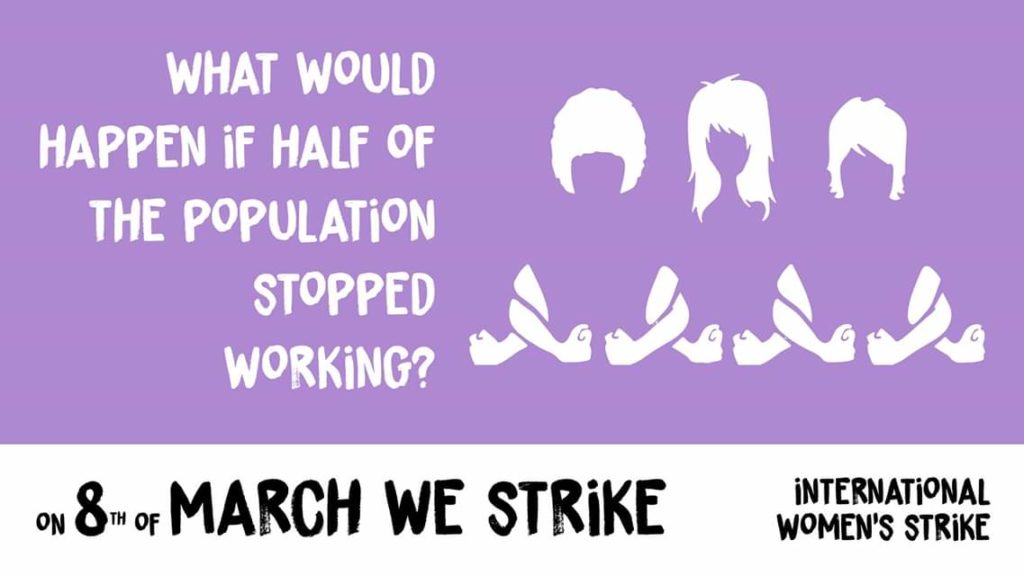
To share, the first of a series of reflections on contemporary feminism, in interviews, essays and so on, with the eighth of March, international women’s day as afeminist strike, in the foreground.
What follows is an interview with Silvia Federici, originally published with Lobo suelto (22/02/2020).
Feminism is the diamond tip of an international insurgency – Silvia Federici
Interview conducted by Victoria Furtado and Mariana Menéndez
While throughout the world the fourth feminist strike is being prepared in hundreds of meetings, activities and assemblies, listening to Silvia Federici is inspiring. In a stop in her travelling about the world, sharing keys of understanding and giving courage, Silvia met with us at her home in New York to discuss current feminist struggles, the popular revolts of recent months, the tensions of feminism with the left and the highlights of her latest book.




Viruses and Separation
From the journal Inhabit …
Viruses and Separation: Frédéric Neyrat on political virality and competing separatisms
(15/03/2020)
Originally published in Terrestres on March 5, 2020
Translated from the French by an anonymous friend
“Our enemy is separatism,” President Macron recently declared. Hearing him define separatism as “the will to leave the Republic, to no longer respect its rules,” to “leave the republican field” in the name of certain “beliefs,” many of us thought that he was talking about himself and not about Muslims, according to the well-known mechanism of projection – a primitive psychological defense system that makes it possible to attribute to another what one seeks to deny in oneself. This is because La République en Marche clearly appears to be the party of those who have separated themselves from others: from the people, from refugees, from the reality of the climate, and who are more interested in the future privatization of the pension system than in the laws of the Republic. It should be added that putting demonstrators’ eyes out with Flash-Ball guns (LBDs), making highschoolers kneel with their hands on their heads in Mantes-la-Jolie, or arresting those who worry about their future and invade the headquarters of the multinational BlackRock, does not seem to be a matter of respect for the rules of the Republic, unless one understands it as being in the business of psychic and physical mutilation.
Continue reading →