Let us therefore trust the eternal Spirit which destroys and annihilates only because it is the unfathomable and eternally creative source of all life. The passion for destruction is a creative passion, too.
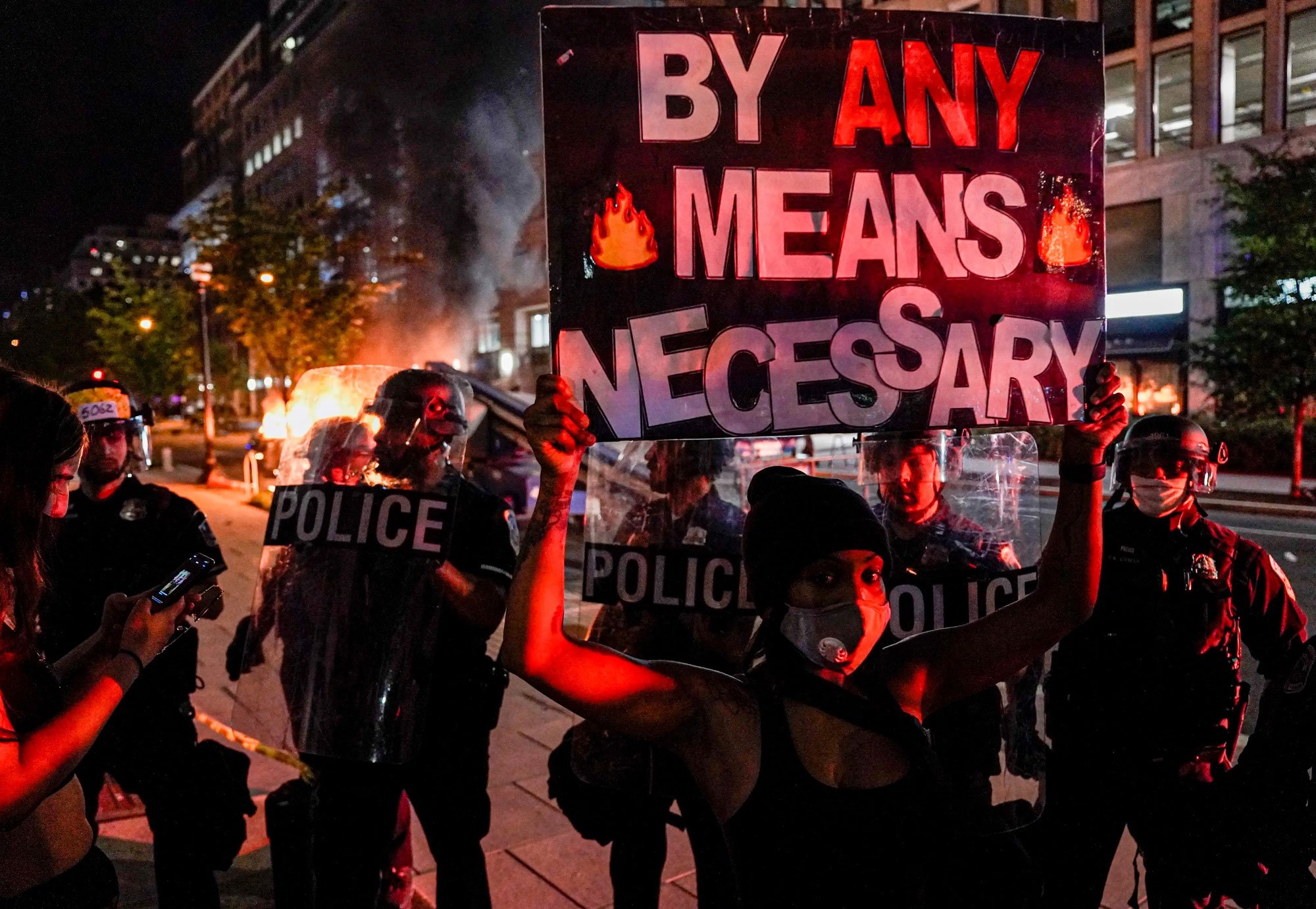
There is something which seems to echo as true for all manner of “leftists” in Badiou’s short reflection, “On the current conjuncture” (Verso 21/12/2021): that the wave of protest-insurrectionist movements of the last decade have been largely negative – reactive and opposed to what is -, without a positive conception or vision of what is to follow, without any affirmative demands and political-social goals to be struggled for.
… I believe that everything today turns around the need for negative slogans and defensive actions finally to be subordinated to a clear and synthetic vision of our own objectives. And I am convinced that in order to achieve this, we must in any case recall that which Marx declared to be the kernel of his thought. A kernel that is of course negative in its turn, but at a scale such that it can only be supported by a grandiose affirmation. I am referring to the slogan ‘the abolition of private property’.
If we share the initial observation, we are not entirely convinced by the “slogan” as sufficient for the creation of a “synthetic vision” of a politics-society beyond capitalism.
The fragility of the many movements that Badiou cites (and perhaps the fact that they are conceived of as “movements” impedes us from seeing their limitations or possibilities – Giorgio Agamben) would seem to defy any simple slogan, especially one that lends itself to narrow political-economic interpretations, and thus susceptible to alienating political appropriation.
We would suggest that a step further is necessary, a step that will appear to many as paradoxical, impossible even. What such movements call for are myths, myths which as “precious stones of memory” (Marcel Detienne, L’invention de la mythologie) weave a present to a past powerful enough to project a future, myths which fracture the eternal present of capitalist utility generating profaned spaces and times of collective play, of common joyful expenditure (Georges Bataille, The Absence of Myth: Writings on Surrealism), myths which bind us to our shared ancestors, to the telluric or chthonic dimension of our lives which are not reducible to the managed and cultivated topoi of Gaia. (Giorgio Agamben, Gaia e Ctonia)
Bataille was to describe fascism as an affectivepolitical movement, a movement of powerful emotions and passions sustained by myth. To then call for myth again would be to possibly repeat the risk of totalitarianism. And what myth could conceivably arise in the time of the “absence of myth”?
The fact that a universe without myth is the ruin of the universe — reduced to the nothingness of things — in the process of depriving us equates deprivation with the revelation of the universe. If by abolishing the mythic universe we have lost the universe, the action of a revealing loss is itself connected to the death of myth. And today, because a myth is dead or dying, we see through it more easily than if it were alive: it is the need that perfects the transparency, the suffering which makes the suffering become joyful. (Bataille)
Fascism and State driven communism sought to fill the void of the death of myth with new, foundational myths, an exercise condemned to terrifying violence by the madness of trying to liberate “humanity” (whose etymology takes us back to “earthly beings”) from its ancestors through technical-technological liberation; in both instances, excrescences of capitalist progress and its attendant rituals of accumulation (the highest expression of a passionless, demythologised religion – Walter Benjamin, “Capitalism as Religion”).
Our proposed myth is written in the plural – there have only ever been myths -, myths which reveal/create our ties to life, in all of its wildness. If we are condemned to give form to this life, to “teach” it, let it be with the passion and consciousness that all creation rests on destruction.
Why We Need Real Anarchy: Don’t Let Trump’s Minions Gentrify Revolt
Politicians have come together across the aisle to decry the storming of the Capitol on January 6 as “lawless,” “anti-democratic,” and “extremist,” going so far as to misrepresent the result as “anarchy.” But the problem with the invasion of the Capitol was not that it was unlawful, undemocratic, or extremist, per se, but that it was an effort to concentrate oppressive power in the hands of an autocrat—which is precisely the opposite of anarchy. Direct action, militant tactics, and a critique of electoral politics will remain essential to movements against fascism and state violence. We must not let the far right associate them with tyranny, nor permit centrists to muddy the waters.
State and corporate activism to repress those directly and indirectly involved in the assault on the U.S. Capitol building in Washington DC on the last 6th of January risks extending beyond the limits of the country’s “neo-fascist” and white supremacist Right, especially when carried out in the name of a war on “domestic terrorism”.
We share the first of a series of articles on the dangers and the responses that must be sought and struggled for if the security State is not to tightens its grips even further during the pandemic.
Meanwhile, as the Republicans Fracture, a New Political Center Emerges—Further to the Right
As a consequence of Donald Trump’s supporters occupying the Capitol building in Washington, DC after a rally promoting his baseless claims of election fraud, the Republican Party is fracturing, setting the stage for the consolidation of a new bipartisan political center—albeit much further to the right than before. Yet this also paves the way for massive sections of Trump’s base to break away from representative democracy altogether, embracing an explicitly fascist alternative. The events of January 6 offer them martyrs and a revanchist narrative that will serve them for years to come, providing an internal mythos for recruitment and a justification whenever they need to use force.
The poets (by which I mean all artists) are finally the only people who know the truth about us. Soldiers don’t. Statesmen don’t. Priests don’t. Union leaders don’t. Only poets.
James Baldwin
For those who lead a provincial life, life and happiness are always to be found elsewhere, in another city, in another country. But for us provincials, this other place is perpetually out of reach. Cavafy’s wisdom is in the dignity and introspective sensibility with which he approaches this sad truth. And finally, with the same linguistic restraint and philosophical simplicity, he concludes by revealing that we have wasted our lives in that city. We come to realize that we have all been wasting our lives, and that the problem lies not in being provincial, but in the very nature of life itself. Great poets can tell their own stories without once saying “I,” and in doing so, lend their voice to all of humanity.
Orhan Pamuk, “Other Countries, Other Shores”, (New York Times, 19/12/2013)
Why share poetry as well known as Cavafy’s on Autonomies? Because it is the poets who allow us to see, and above all, to see beyond a “provincialism” which blinds us to the violence and tragedy of pandemic politics.
The dead live on, and with them, the dreams they carried.
Gustav Landauer
We share below the announcement and obituary of the death of the anarchist militant and historian, Alexandre Skirda, originally published with Freedom News (30/12/2020). This is followed by a short article published in 1989 dedicated to Nestor Makhno.
The influential French historian and translator, best known for his research on revolutionary Ukraine in the early 20th century, died on Wednesday December 23rd.
Alongside his extensive series of works on Russian radicalism, the Makhnovtchina and Krondstadt, Skirda published Facing the Enemy: A History of Anarchist Organisation (Autonomie Individuelle et Force Collective: Les Anarchistes et l’Organisation de Proudhon a nos Jours), the as yet untranslated biography of Jan Vaclav MakhajskiLe Socialisme des Intellectuels and a number of highly critical works on Leninism, listed (in French) here.
He founded the Groupe d’Etudes et Action Anarchiste (Anarchist Studies and Action Group) with fellow anarchist historian Roland Biard when they were both 19, taking an active role in the wave of demonstration which took place against France’s war in Algeria. A number of his works are available at the Kate Sharpley Library.
It was in Spain that [my generation] learned that one can be right and yet be beaten, that force can vanquish spirit, that there are times when courage is not its own recompense. It is this, doubtless, which explains why so many, the world over, feel the Spanish drama as a personal tragedy.
Albert Camus
The political accountants – political scientists, sociologists, media commentators, politicians -submitted their balance sheets some years ago, so that by now, ten years on, it sounds like a tired refrain: the “Arab spring” ended in a tragic winter, a political Thermidor, a series of failed revolutions for which the people of the “Arab world” are only worse off today for their effort.
We would object to the use of the Lenin’s expression “dual power” to characterise the creation of autonomous, free spaces; an always relative autonomy and taking multiple forms. For Lenin, the expression captured a transitional moment in the Russian revolution between bourgeois parliamentary-dictatorship and worker-peasant soviet-dictatorship, the moment of uncertainty and struggle for hegemony between the two state forms, however “bottom-up” the latter was conceived to be. (Lenin, The Tasks of the Proletariat in Our Revolution)
In both forms, the goal is power, class based state power. “The basic question of every revolution is that of state power. Unless this question is understood, there can be no intelligent participation in the revolution, not to speak of guidance of the revolution.” (Lenin, The Dual Power)
The creation of “free spaces”, if however understood as the creation of forms of life that simultaneously withdraw or retreat from capitalist social relations, seek not to take power, hierarchical and authoritarian power, but to destroy it. Otherwise, “free spaces” become a means to something which they are not. In other words, it would be to destroy them.
A class based politics – if such a thing is even imaginable and/or feasible, today or yesterday – aspiring to social-political hegemony is not a vision of autonomy that we could embrace.
With this cautionary note, we share an article by Dennis Shep entitled “Freeing space: building worlds outside of state and capital”, published with Roarmag (23/12/2020).
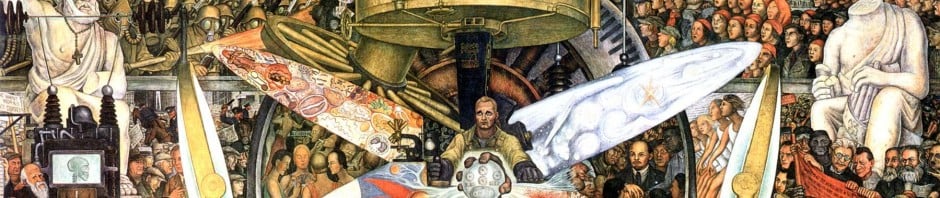


Reading the times with Alain Badiou
Let us therefore trust the eternal Spirit which destroys and annihilates only because it is the unfathomable and eternally creative source of all life. The passion for destruction is a creative passion, too.
Mikhail Bakunin, The Reaction in Germany (1842)
As long as there are no myths accepted by the masses, one may go on talking of revolts indefinitely without ever provoking any revolutionary movement.
Georges Sorel, Reflections on Violence (1908)
There is something which seems to echo as true for all manner of “leftists” in Badiou’s short reflection, “On the current conjuncture” (Verso 21/12/2021): that the wave of protest-insurrectionist movements of the last decade have been largely negative – reactive and opposed to what is -, without a positive conception or vision of what is to follow, without any affirmative demands and political-social goals to be struggled for.
If we share the initial observation, we are not entirely convinced by the “slogan” as sufficient for the creation of a “synthetic vision” of a politics-society beyond capitalism.
The fragility of the many movements that Badiou cites (and perhaps the fact that they are conceived of as “movements” impedes us from seeing their limitations or possibilities – Giorgio Agamben) would seem to defy any simple slogan, especially one that lends itself to narrow political-economic interpretations, and thus susceptible to alienating political appropriation.
We would suggest that a step further is necessary, a step that will appear to many as paradoxical, impossible even. What such movements call for are myths, myths which as “precious stones of memory” (Marcel Detienne, L’invention de la mythologie) weave a present to a past powerful enough to project a future, myths which fracture the eternal present of capitalist utility generating profaned spaces and times of collective play, of common joyful expenditure (Georges Bataille, The Absence of Myth: Writings on Surrealism), myths which bind us to our shared ancestors, to the telluric or chthonic dimension of our lives which are not reducible to the managed and cultivated topoi of Gaia. (Giorgio Agamben, Gaia e Ctonia)
Bataille was to describe fascism as an affective political movement, a movement of powerful emotions and passions sustained by myth. To then call for myth again would be to possibly repeat the risk of totalitarianism. And what myth could conceivably arise in the time of the “absence of myth”?
Fascism and State driven communism sought to fill the void of the death of myth with new, foundational myths, an exercise condemned to terrifying violence by the madness of trying to liberate “humanity” (whose etymology takes us back to “earthly beings”) from its ancestors through technical-technological liberation; in both instances, excrescences of capitalist progress and its attendant rituals of accumulation (the highest expression of a passionless, demythologised religion – Walter Benjamin, “Capitalism as Religion”).
Our proposed myth is written in the plural – there have only ever been myths -, myths which reveal/create our ties to life, in all of its wildness. If we are condemned to give form to this life, to “teach” it, let it be with the passion and consciousness that all creation rests on destruction.
Continue reading →