Political affinities very often transgress ideological borders; indeed, if they did not, politics would be far poorer, if not dead. Politics is the gathering together of singularities for collective life, in dissension.
This post is in memory of the intellectual and political work of Horacio González. While perhaps little known outside of south america or the hispanophone world, he was a central figure in his own country, argentina.
But why celebrate a “Peronist”, some may ask? A ready answer lies in the fact that “Peronism” was never homogenous, and González was among its most critical and heterodox “followers”. And more importantly, González and his work were never reducible to the ideology and/or the movement.
Below we share a text by González that takes us back to the argentinian uprising of 2001, an event which remains of enormous significance for the understanding of anti-capitalist politics in the present.
This is followed by a tribute to González, authored by Diego Sztulwark.
Through translated fragments, we share the work of a writer, some few words of Catherine Malabou.
We begin with a very brief summary of her essay, Le plaisir effacé: Clitoris et pensée [Pleasure erased: Clitoris and thought], followed by the transcript of a conversation (the original may be heard here) around the essay. And we close with two video-conferences.
At what point is destituent communism? Its theory? It continues apace. From itsItalian sources, it has provoked fruitful debates, even across the Atlantic.
Let us bring to the subject a little more material, with these 13+1 theses signed (collectively), Grisha.
Every Flag Is Black in a Fire: The Black Flag—Emblem of Rebellion, Negation, and Hope
In the following selections, a range of authors and artists from across a century and a half reflect on the meaning of the black flag, the anarchist standard of rebellion and negation.
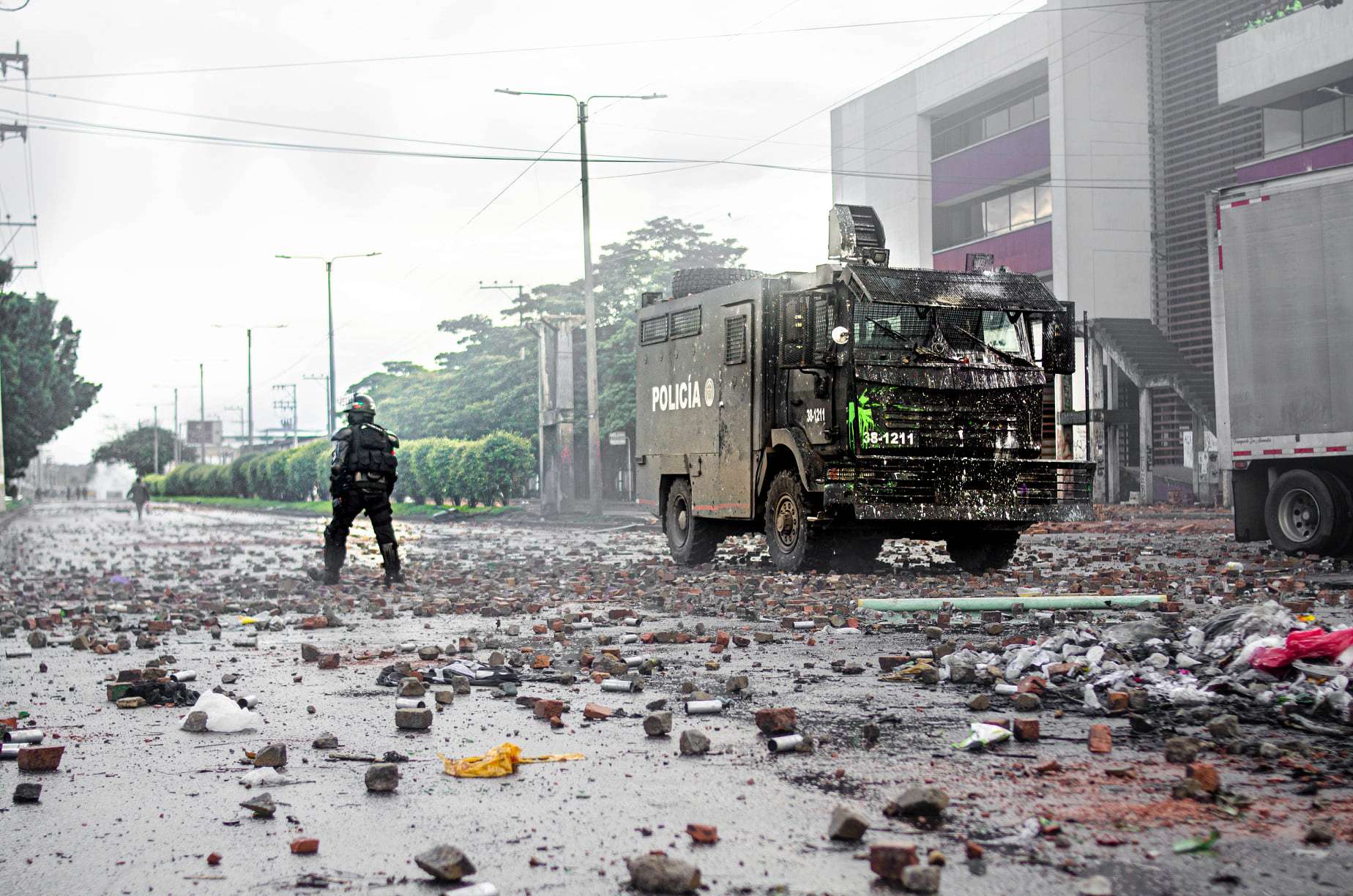
Police charges during the National Strike in Bogotá. Photo: Colombia Informa
Raúl Zibechi is perhaps one of the most significant and lucid writers today on “social movements” in latin america. Below, we share a recent text authored by him, in translation.
We also share a conference-conversation with Zibechi and Rita Segato (in spanish). We close the post with websites/news sources where Zibechi publishes regularly.
Protests in Colombia that began in late April over a proposed tax hike have morphed into a generational outcry over the country’s deep-rooted inequalities.
Fifty-eight people have died in six weeks of unrest – at least 45 of them killed by police – and dozens of people have gone missing. Protesters have set up more than 2,000 roadblocks around the South American country, hitting businesses and the government, as well as slowing down humanitarian access. Police stations and civic buildings have been torched, and the images of smoke-filled streets and skirmishes between frontline protesters and riot police have become a daily reality.
Corrupt politicians want to keep us poor so they can stay rich. They want us to go home, but after a month we’re still here. Older generations never made Colombia a better place, but young people have the balls to change this country. The government complains about the roadblocks we’ve set up, but they steal from the people every day. We’re showing them what that feels like. Maybe when they stop we can talk about how our roadblocks are hurting their pockets. This is a revolution, and we won’t go away until Duque is gone.
‘This is a revolution’: the faces of Colombia’s protests, The Guardian, 09/06/2021
In Cali, the epicenter of the protest against Iván Duque’s right-wing government and the Uribist narco-state, the authority of the State is being questioned, while a collective conscience and real popular power are built. Indigenous peasants converge at places or points of resistance in the neighborhoods and the oppressed multitude appears, reclaims its territory. The foundations of a revolution are laid. Young people neglected by the State find recognition on the front lines. They are stepping up and risking their lives to defend the dreams of a more just Colombia, while the repression of State and parastatal forces intensifies. Every night, new cases of assassinations are reported and several NGOs have denounced the discovery of mass graves.
There are those whose lives are testimonies to anarchism. Marc Tomsin’s was one such life. We share below a translation of an entry in the Dictionnaire des anarchistes dedicated to him, a letter of remembrance by Raoul Vaneigem, and links to two interviews with him, in french.
We want to thank the not bored collective for sharing their translations with us.
(Since the original post, the not bored collective passed on to us a translation of an interview with Marc Tomsin, which we have added below).
What exactly is the “system” that we are fighting?
Eric Laursen
The system is the state, a complex mechanism that includes government, capitalism, patriarchy and imperialism. It will not go away until we force it to.
“The system” is back. And it is high time we talk about it again.
Fifty years ago, in the days of the Vietnam War, the counterculture and widespread questioning of government, a lot of prominent writers, not to mention day-to-day activists, used this bit of shorthand to describe the power they were fighting against. Today, in the era of dark money, neoliberal capitalism, police impunity and US American forever wars, we still need a way to think coherently about these problems, about the forces that produce them and we need to figure out how to fight back — without lapsing into some left version of QAnon.
“News” from the Notre-Dames-des-Landes ZAD (zad for ever blog, 14/05/2021) …
A lighthouse to cancel the end of the world
In the fields of Notre Dame des Landes, in western France, stands a disobedient lighthouse. It was built far from the sea, exactly where the control tower of a new international airport was supposed to be built. This short 17 minute film documents its construction by a ragged crew – including deserting architects, an ex-homeless kid, art activists, a ceramicist, a few farmers and a genius welder whose day job was building the world’s biggest cruise-liners in France’s largest shipyard.
We post a reflection on binary-gender oppression and the grounds for strategically contesting it, ‘in commemoration of “pride,” an introduction to the production of subjectivities’, originally published on dehiscence (01/06/2021). We want to thank Robin Peignot for sharing this with Autonomies.




For Horacio González (1944-2021)
Political affinities very often transgress ideological borders; indeed, if they did not, politics would be far poorer, if not dead. Politics is the gathering together of singularities for collective life, in dissension.
This post is in memory of the intellectual and political work of Horacio González. While perhaps little known outside of south america or the hispanophone world, he was a central figure in his own country, argentina.
But why celebrate a “Peronist”, some may ask? A ready answer lies in the fact that “Peronism” was never homogenous, and González was among its most critical and heterodox “followers”. And more importantly, González and his work were never reducible to the ideology and/or the movement.
Below we share a text by González that takes us back to the argentinian uprising of 2001, an event which remains of enormous significance for the understanding of anti-capitalist politics in the present.
This is followed by a tribute to González, authored by Diego Sztulwark.
Continue reading →