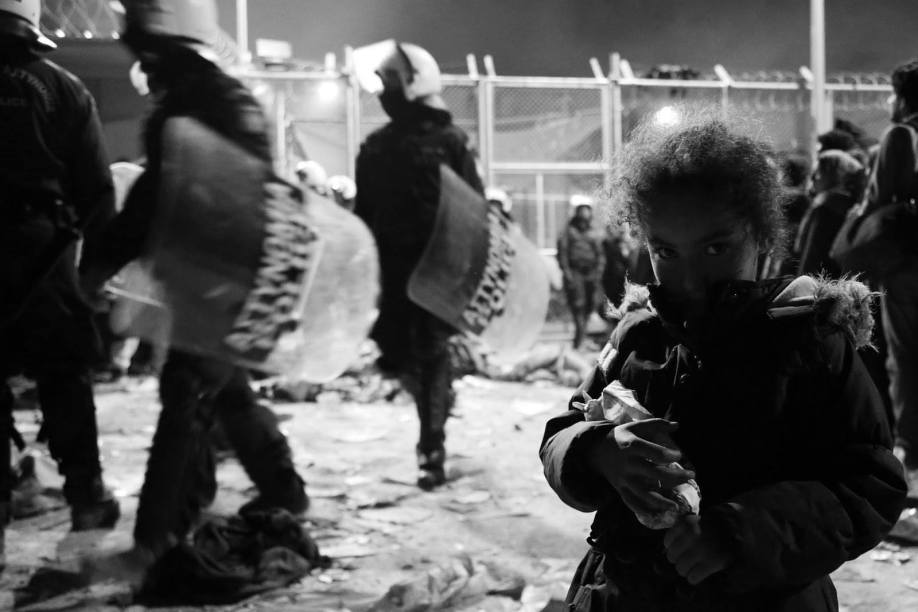
The Democratic Party has led Black America down a dead end. The sooner we begin to understand that, the more realistically we will be able to organize against fascism.
by William C. Anderson and Zoé Samudzi
from Roar Magazine #5

The Democratic Party has led Black America down a dead end. The sooner we begin to understand that, the more realistically we will be able to organize against fascism.
by William C. Anderson and Zoé Samudzi
from Roar Magazine #5

Remembering the Paris Commune (from CrimethInc.), followed by an interview with Kristen Ross, author of Communal Luxury: The Political Imaginary of the Paris Commune (Verso, 2015), with Roarmag‘s Jerome Roos …
What idea does the Paris Commune represent? And why is this idea so attractive to the workers of every land, of every nationality?
The answer is easy. The revolution of 1871 was above all a popular one. It was made by the people themselves, it sprang spontaneously from within the masses, and it was among the great mass of the people that it found its defenders, its heroes, its martyrs–and it is exactly for this ‘mob’ character that the bourgeoisie will never forgive it. And at the same time the moving idea of this revolution–vague, it is true, unconscious perhaps, but nevertheless pronounced and running through all its actions–is the idea of the social revolution, trying at last to establish after so many centuries of struggle real liberty and real equality for all.
It was the revolution of ‘the mob’ marching forward to conquer its rights.
Peter Kropotkin, The Paris Commune
From paris-luttes.info …
The Makhnovist movement was one of the rare anarchist-communist insurrections in history, if not the only one, capable of holding a territory for a number of years (from 1917 to 1921). The film that follows returns to the traces of these revolutionary workers and peasants almost eighty years after their defeat.

Tomás Ibáñez is arguably one of the most important voices of spanish anarchism, and the resonance of his work extends beyond his country of origin. Infrequently translated into english, we have tried in earlier posts to modestly fill that gap.
We share below a recent and perhaps polemical essay of his, an essay that was originally published in Libre Pensamiento nº 88, of the spanish CGT, and in electronic format at alasbarricadas, acracia and el libertario.

In our series dedicated to anarcho-syndicalism, we share Murray Bookchin’s critical reflections on this tradition within anarchism, in the excellent essay, “The Ghost of Anarcho-Syndicalism”. Whatever reservations we have regarding the direction of Bookchin’s anarchism towards a radically democratic municipalism, his emphasis on the communalist traditions of anarchism is of great importance, not only in reading the history of the anarchist movement, but also for critically engaging with the more recent “occupy movements” and the “anarchist” response to them. …

Our recent series of testimonial posts in memory of the centenary of the russian february revolution of 1917, posts that we shared from (and by which we were inspired) Robert Graham’s Anarchist Weblog, with additional writings by the same authors, raise numerous questions, both historical and political. Among the many is whether or not anarcho-syndicalism, one of the forms that russian anarchism took at the time, remains a a relevant or desirable means for radical anti-capitalist and anti-authoritarian politics.
On the 30th of April 2015, in Santa María de Guía, Grand Canary, the anarchist activist Ruymán Rodríguez, member of the Federación de Anarquistas de Gran Canaria (FAGC)/Anarchist Federation of the Grand Canary, member of the recently created Sindicato de Inquilinos de Gran Canaria/Tenants Union of the Grand Canary, was arrested by the Guardia Civil, without any motive given, taken to the police station and subjected to torture (beatings and strangling).
We continue to share testimonials/reflections on the russian revolution, shared from and inspired by Robert Graham’s Anarchist Weblog …
Gregory (“Grigori”) Maksimov (often written as “Maximov” and “Maximoff” in English language material) was one of the leading exponents of anarcho-syndicalism in Russia during the 1917 Revolution. He was in St. Petersburg when the February 1917 Revolution broke out, participating in the strike wave that helped provoke the Revolution. He became active in the factory committee movement which sought to bring about genuine workers’ control in Russia. After he was forced into exile in 1921, he wrote an exposé of the Bolshevik tyranny in Russia, The Guillotine at Work, and edited the first major English language selection of Bakunin’s writings, The Political Philosophy of Bakunin (published from Maksimov’s manuscripts after his death in 1950). The following is Maksimov’s pamphlet, Syndicalists in the Russian Revolution, in which he describes the beginning of the Russian Revolution, before the return of the many political exiles who were to play such a fateful role in the Revolution’s ultimate outcome (including Bolsheviks like Lenin and Trotsky, and anarchists like Boris Yelensky), the role of revolutionary anarcho-syndicalists in the events and their subsequent repression by Bolshevik authority.
We also share below a second short text by Maximov, entitled My Social Credo.

From the Its Going Down media collective, an essay by Peter Gelderloos (20/02/2017) …
Long Term Resistance: Fighting Trump and Liberal Co-option
So far, the only thing that has mitigated the horrifying opening salvos of Trump’s presidency—of course the first president to follow through on his campaign promises had to be this one—has been the widespread popular resistance against his deportation orders, Muslim bans, pipeline projects, and misinformation campaigns. Resistance in and of itself is a beautiful thing because it shows that people are still alive, they still consider themselves a part of their environment; on the other hand, resistance is by no means a synonym for change. The State has long known how to manage resistance, and how to factor it in as one more cost of its policies. For that reason, rather than being self-congratulatory when we resist, we should encourage one another to understand just what it is we are fighting back against, what it would take to defeat it, and how our actions measure up to the requirements of the situation.
Continue reading
Armand Gatti and the wandering words of rebellion
Poetry is a dissociating and anarchic force which through analogy, associations and imagery, thrives on the destruction of known relationships.
Antonin Artaud
I always believed that by the beauty of words, one could change the world.
Armand Gatti
His weapon was the word, and his horizon utopia. Armand Gatti, who died on Thursday, the 6th of April at the age of 94, lived his life fighting with words made weapons, first as a journalist, then writer, poet, film director (in 1960, he films L’Enclos, a drama set in the world of the concentration camp and in 1963, El Otro Cristobal, a reflection on the Cuban revolution), then in theatre, where, with those without name, those at the margins, the forgotten, those without voice and the excluded, collective stories were forged, stories that created new worlds. His passion and energy made him nomadic, multiform, prolific, but always engaged in resistance against the arbitrariness and violence of power.
Continue reading →