Okupation, between the city and the metropolis; sharing a short reflection (generation online) by Giorgio Agamben on the politics of the metropolis against the city …
Okupation, between the city and the metropolis; sharing a short reflection (generation online) by Giorgio Agamben on the politics of the metropolis against the city …

Ongoing reflections on an okupation in Lisbon (continuing a discussion) …
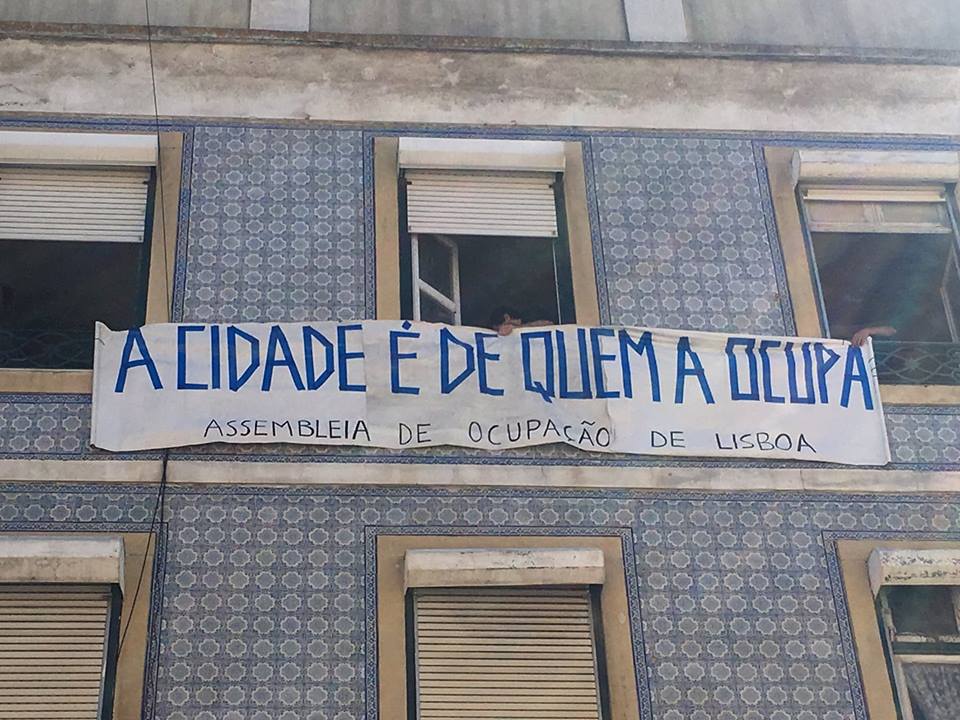
The essay below, which we share in translation, is by Tiago F. Duarte, a member of the Assembleia de occupação de Lisboa, a collective responsible for the recent occupation of a residential building in Lisbon’s centre. We share the essay not because we agree with everything that is stated therein – for example, its overly marxist reading of history, of the opposition of the city and the countryside, of class conflict, and its reduction of occupation to a means or tactic of anti-capitalism when it is as much an end and a strategy (that is, these distinctions are in the end not only meaningless, but problematic) – but because of its insistence in reading “okupation” as a radical politics.
Reflections after an assembly of a new okupation in Lisbon …
Any new occupation is invariably accompanied by uncertainty, an uncertainty only intensified by a lack of clarity over means and goals, organisation and methods of functioning, and the physical and human needs for the sustainability of the space taken, over time. The task of setting these out, even minimally, is difficult, but fundamental.

On the 30th of June, the state owned land estate of Somonte, occupied in 2012 by landless, agricultural day labourers of the Sindicato Andaluz de Trabajadores/as (SAT), were evicted by a large police (Guardia Civil) intervention, for a fifth time. The eight persons present were charged with usurpation of “public” property. (SAT 30/06/2017))
Twenty-four hours later, the finca was retaken; lands that were once common lands, then appropriated by the State, have now been re-appropriated by those who work it. Those accused have had the charges against them dropped. (SAT 10/07/2017) The struggle for land in Andalucía, an exemplary struggle, continues …

What is important right now is to twirl in a cheerful danse macabre on the grave of bourgeois enjoyment.
Eukariot
A speculative, provocative and experimental intervention, from Eukariot (Issue 1) …
Firm Statements (Soon To Be Proven Wrong)
I.
– There are, perhaps, two initial challenges that an anti-bourgeois experiment faces: first, the participants need to learn how to enjoy failing in the bourgeois Olympics and to stop running after the tin medals that, once pinned into our flesh by various authorities, promise us their eternal respect and love. This failure involves learning how to enjoy the discomfort of being a disappointment to mom and dad, teachers, sergeants and bosses, to God, the superego, the prime minister, to “people” and the laws of Nature. The bourgeois world makes a lot of seductive offers – protection, recognition, tenderness, copulation, uniqueness, the status of rebel, a pat on the back, a diploma to hang around our necks or therapy. But bourgeois comfort comes at a price too high to pay; we need to cut its throat.
– Second, and potentially harder, is acknowledging that our great political aims, our fantasies of truth, fullness, peace and harmony, of the revolution that will purify and perfect us, of the harmonious collective, will fail. These fantasies are as impossible to fulfill as they are to abandon. As modern Western subjects we have limited resources, abilities and potentialities. We are a checker board of anxiety nodes; our lifelines are attached to a complex of governing apparatuses that we are unprepared and reluctant to disturb. Consequently, we accept that we might need a political fantasy that verges on the metaphysical in order to engage in risky activities. This fantasy functions as a shining light that might be a lure, but still gives us some direction. Or as an amulet, offering us the illusion of protection while we de-occupy spaces, build collectives and stick pieces of scrap iron in the mechanisms that provide us with being, comfort and enjoyment.
– Currently most of our political inventions follow rules laid down by a few European men and women from past centuries; the only thing that these tired rules can stimulate is the compulsive pleasure of the political ritual. Following these rituals makes easy our attentive policing by a bourgeois order that has long ago learned how to re-signify our games, how to make them irrelevant or impracticable. We might still be ahead of our adversary at the level of structural analysis (are we?), but the bourgeois order, despite its rudimentary logic, prevails at the level of tactical and strategic struggle.
– Alarmingly, it seems that today the survival of many of our groups and practices depends on the enemy’s ability – what we generically call the State, capitalism, bourgeois order, colonialism, patriarchy, heterosexism, fascism and so on – to keep up its brutal practices. By this I mean that most of our resistances come from a reactionary position, reacting to the events created by liberal-capitalism. We engage in struggles that have already been lost several times in the past so that we can shout truths from the cross to an absent public. And we ignore that stubbornly repeating these customary practices makes us points of support and vessels of power, a part of the system of pipes through which bourgeois enjoyment circulates.
– We have stopped experimenting with assembling and disassembling different life-forms and economies of enjoyment, away from the lurid semantics of bourgeois pleasure. We do not work towards inventing and building our own fantasies and worlds. We sit tight in the lairs that we’ve dug for ourselves within the bourgeois world, scavenging leftovers from the libidinal forage they feed their flock with: a concentrated spec(tac)ular mix of submission to authority, (self) humiliation, terror, war, revenge, jealousy, camps, murder, torture and death, packaged in the multi-coloured tin foil of “entertainment”, “education”, “success” or “progress”. At the light of organic wax candles we obsessively scan the news, gorging on the latest disaster, commenting, critiquing, shouting outrage, calling for justice, organising protests or aid missions. It is this placidity that we nowadays call “activism”. I have come to the strange conclusion that I am really bored with critique. Wow, what a devastating point for a “radical”, isn’t it, since what we enjoy most is critiquing, assiduously looking for the next disaster so that we can indulge in this sado-narcissistic pleasure? But critiquing is now irrelevant: we have all the critiques we need. Critique keeps us attached to the world of the enemy, glued to the window of fantasy through which we watch its exploits, seduced by the governing dispositifs we so carefully survey from behind our twitchy curtains; it keeps us in a libidinal relationship with the bourgeois world, often one where our spite hides desire and admiration. We need to start something else, start demolishing, start building, in all registers of reality. A much more daunting and serious matter, one that will get our hands dirty with the contradictions and compromises of each other’s enjoyment; one that can aspire to no purity or resolution, no bird’s eye view; and all this without guaranteeing the enjoyment that critique provides.
-The pleasure that we take in these reactionary politics signals our dependence on the recognition of bourgeois authorities: we still place ourselves on a stage for the gaze of the Father, we still enjoy transgressing his prohibitions so as to get a reaction from him, so that he notices us. How many of us would lose their reason to be if these prohibitions were lifted? But the point is not simply to transgress or to critique; the point is not simply to lift the prohibition. The point is to stop enjoying that which the prohibition prohibits, since the purpose of prohibition is just that: to stimulate our desire for the bourgeois law, even if it is the desire to break it. As long as we critique the bourgeois world rather than inventing our own we are still in love with it.

Un grand sommeil noir
Tombe sur ma vie :
Dormez, tout espoir,
Dormez, toute envie !
Je ne vois plus rien,
Je perds la mémoire
Du mal et du bien…
O la triste histoire !
Je suis un berceau
Qu’une main balance
Au creux d’un caveau :
Silence, silence !
Paul Verlaine
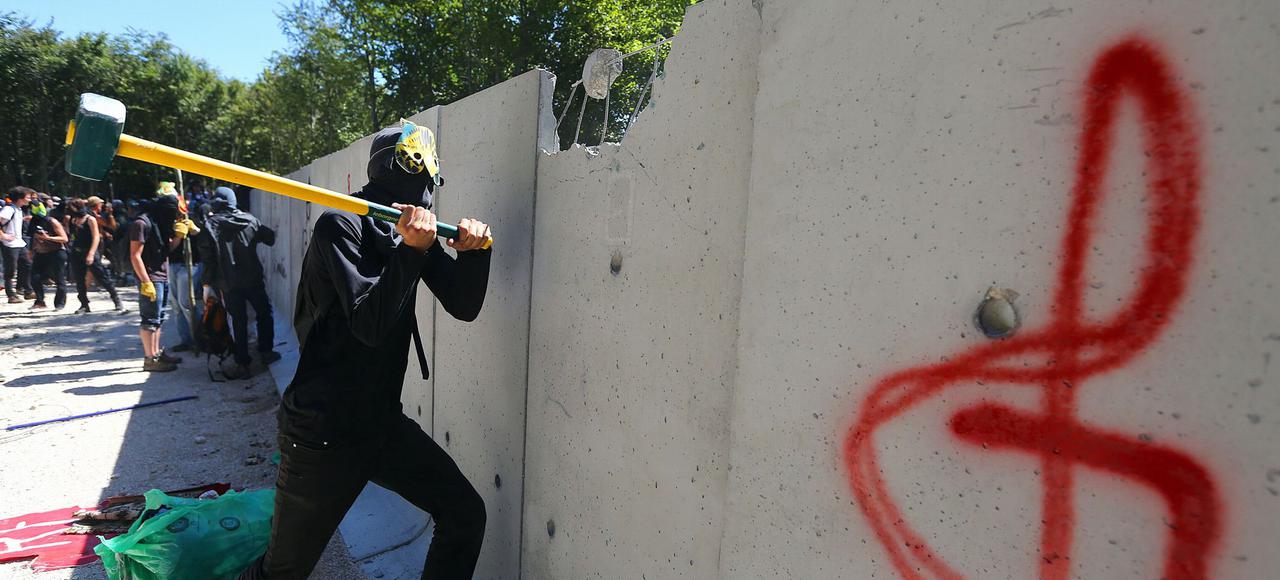
The ZADs of france (Zone à défendre), at Notre-dame-des-landes, Testet, Roybon and the many others elsewhere (click here for ZAD map: le monde 21/12/2015) have emerged originally as moments of contestation against major infrastructure developments, public and private, typically outside of large urbanised spaces. The protests have then, in some cases, been followed by occupations of the contested territories with the aim of literally physically impeding the development projects. It is then bodies against machines, the war machine of the State, with all of its apparatuses of control and repression, and the physical machines that re-make space and life, to serve the movement of capital-commodities.
A convivial society should be designed to allow all its members the most autonomous action by means of tools least controlled by others. People feel joy, as opposed to mere pleasure, to the extent that their activities are creative; while the growth of tools beyond a certain point increases regimentation, dependence, exploitation, and impotence.
Ivan Illich, Tools for Conviviality
The distinction between city and countryside under contemporary capitalism fades under flows of commodities that know no borders except those of obstacles to be overcome.
Born from the concentration of resources in urban centres, under capitalist commodification and spectacle, the rural is but a corrupted term for primitive accumulation and colonisation; the space through which the conditions for the reproduction of capitalist social relations are secured.
For this, the spaces beyond the city must be invested, invaded, captured and used; transformed in this way into extensions of “urban” social life.
The spread of urban infrastructure into rural spaces (i.e., not yet commodified spaces) is thus fundamental to the expansion of a social system that rests upon permanent growth.
The ZADs (“Zone à défendre”) of france are a politics of resistance-creation that oppose to the world of capital spaces of collective autonomy that both refuse capitalism and prefigure different ways of life beyond it.
The struggle against a nuclear waste storage site in the commune of Bure, in the department of Meuse in north-eastern france, is only the latest example of such resistance-creation. And if we can speak of “neighbourhood anarchism“, the ZAD’s then perhaps exemplify the extension of the “neighbourhood” beyond any human-urban population to living nature.
From Alternative Libertaire, the translation of an article on the Bure ZAD …

The 12th of September marks the beginning of protests against the new (yet again!) french government’s proposed labour law reforms. Exit the socialists François Hollande and Manuel Valls, enter the golden boy, “I belong to no political party!”, politician as pure spectacle, Emmanuel Macron and the “I join whatever political party brings me to power!”, Edouard Philippe, and the political script … remains unchanged: weaken collective bargaining and collective labour contracts, weaken labour unions, weaken protection against firings, expand temporary contracts, in sum, intensify and expand labour exploitation in the name of competition and national well-being. (the guardian 31/08/2017)
With no illusions regarding the radicalness or militancy of labour unions (even the french “communist” CGT), the call for a day of strikes and protests led to over four thousand work stoppages and brought forth some four hundred thousand people into the streets across the country. (le monde 13/09/2017)
To strike and protest for a day is little, against the oppressive political and economic order of our time. But in every protest there is the unpredictable, the unmanageable … the eruption of the ungovernable that for however brief a time allows one to breath freely and opens a door on another imaginary. Those who Macron had earlier called the lazy, the cynical, belonging to the extremes, that is, all of those who refuse the sovereign’s light, on this day, reveled amid dark autumn leaves. The response of the State: the only one that increasingly it seems to know: physical violence.
Paris, September 12 (from Taranis news) …

The catalan referendum: anarchy and/or self-determination?
Sunday, October 1st, was the day in which the residents of catalonia were asked to vote on the region’s independence. The referendum, having earlier been declared unconstitutional by the spanish courts, became then the object of an active judicially driven prohibition with police seizures of voting bulletins, ballot boxes, the closure and barring from probable voting spaces, the shutting down of websites supportive of the referendum, arrests or threats of arrest against local civil servants and politicians involved in the organisation of the vote (for the crime of sedition which carries a maximum penalty of 10 years), debates on the referendum within public spaces were prohibited, and the like. With the Rajoy government hiding behind the law, it did what it does best in the face of opposition: send in the police. Over 10,000 Guardia Civil and national police agents were sent to the region from the across the country, along with hundreds of special mobile units of the national police, for the October 1st date. And the result was inevitable mass police violence, with over 800 people hurt and wounded, some seriously. In most instances, the violence was against those trying to protect voting stations, election material and ballots cast.
The “law” showed its face in spain: a constitutional order before peaceful dissidence, rebellion, depends ultimately upon the threat and/or use of violence, even when that rebellion wishes to express itself through the ballot box.
Continue reading →