

Numerous calls have been made in france not to celebrate May 68, but to have it burn again in 2018. These calls have in turn been circulated beyond france.
From lespaves.net, an invitation for a beautiful May in Paris …
Numerous calls have been made in france not to celebrate May 68, but to have it burn again in 2018. These calls have in turn been circulated beyond france.
From lespaves.net, an invitation for a beautiful May in Paris …

An often forgotten or ignored dimension of May 68 were france’s peasant movements, which preceded 1968 and would continue after the student movement and general strike came to an end.
The Larzac protest and land occupation against government plans to expand a territory for military training were emblematic in this regard. And as the LIP factory occupation quickly overflowed the walls of the factory, so too would Larzac echo throughout the country, redefining anti-capitalist action.
The latter could no longer be imagined as concentrated exclusively in industrial spaces, nor submissive to political parties and ideological preconceptions of what the revolutionary subject must be. Larzac generated a movement of combative solidarity that violated older schemes of rebellion and revolution, and placed at the centre concerns for the land, ecology, peasant forms of life and self-management that resonate still, with indigenous and peasant movements, and the more recent ZADs.
We share two texts below, one a brief introduction to the Larzac movement, a reflection by Joseph Bové, a participant in the movement, and a film record of the events. We close with a recent documentary-road trip through various ZADs in europe, contemporary and past, beginning and ending with Larzac.
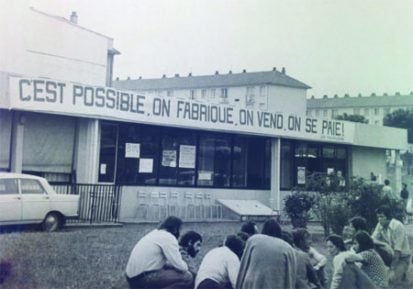
France’s May of 1968 brought on the largest industrial strike in the history of modern capitalism. What began as a student movement quickly overflowed the walls of the universities to spread throughout french society, with hundreds of factories not only being shut down, but occupied. What did not emerge during the strike however was the re-opening of the factories under workers’ control. Production was brought to a standstill, but no real step was taken to create a workers’ self-managed economy.
The example would be given five years later, with the Lip watch factory occupation; an occupation that would resonate throughout the country, mobilising thousands in acts of solidarity and serving as a model for new forms of anti-capitalist protest and rebellion.
We share two extraordinary film testimonials of the Lip occupation, films that record not only a history, but seek to intervene in the present.
For many of those who participated or witnessed the Lip movement, there was a “before Lip” and an “after Lip”.

A March 2018 interview in which Miguel Amorós discusses his anti-development concepts, the global trend towards mega-urbanization, the destructive tendencies of capitalist development, Latin American populist governments and their social basis, the civil society movement, and perspectives for a movement to create a better world. (Libcom.org 17/04/2018)
If Amorós does not speak directly to the ZAD in the interview, his radical politics points to de-industrialisation, de-urbanisation, de-centralisation … what could be taken as the proliferation of ZADs.
An earlier text by Amorós however does, written after the french government’s decision to abandon the airport project for the ZAD; a text that retains all of its relevance. (Libcom.org 17/04/2018)
We close with a video-interview with Miguel Amorós, in spanish.

A day will come when all the imaginary lines will be blown away, and in the scattering dust of all the maps made meaningless, all things will be left equal once again.
Pray for calamity
We do not know if there is a wilderness that lies within us, or beyond us, that might serve as refuge from the onslaughts of commodification. Is not the wild but the mirror image of the civilised? Or can a deeper reality be revealed by this word, of wildness as the voice from the “underground”, from the “irrational” rituals of love, giving and festivity?
Religion once meant tying individuals together into collectives that by their shared ways, brought into being realities greater than themselves. Perhaps then the “wild” is this ancient religiosity, this capacity for joint, ungovernable, self-creation of spaces and times not beholden to any logic of hierarchy and subordination, and slavish, destructive instrumentalisation; and the determination to build and defend these ways, together, against those whose desires can only find fulfillment in the domination of others.
From the blog “Pray for calamity“, we share an essay entitled “A wilderness between us” and a film documentary-intervention on the ZAD of Notre-dame-des-Landes from the Cinema Committee …
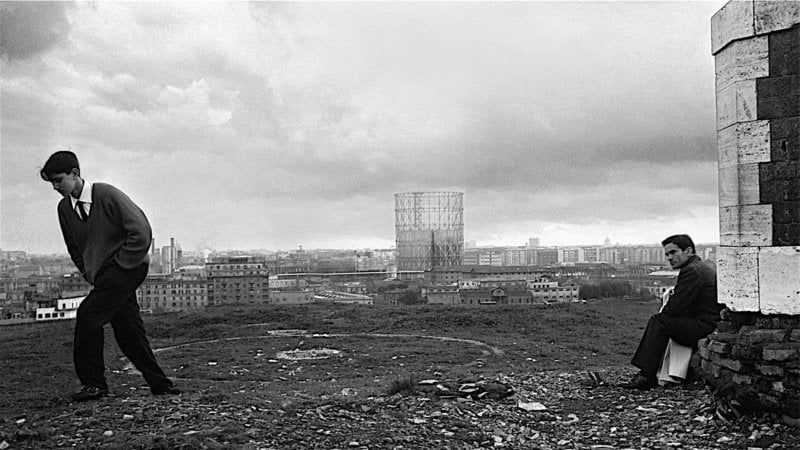
The magazine Ballast regularly gathers together citations of authors under the generic designation of an abécédaire. We share below, in translation, their most recent “alphabet text”, from the work of Pier Paolo Pasolini.

Antiterrorism, contrary to what the term would suggest, is not a means to fight against terrorism, it is the method by which the political enemy is positively produced as a terrorist. It is a matter, by a luxury of provocation, infiltration, surveillance, intimidation and propaganda, by a whole science of media manipulation, “psychological action”, the production of evidence and crimes, by the fusion also of the police and the judiciary, to annihilate the “subversive threat” by associating, within the population, the inner enemy, the political enemy, to the affect of terror.
What is essential, in modern warfare, is this “battle of hearts and minds”, where all blows are allowed. The elementary process here is invariable: to individuate the enemy in order to cut him off from the people and common reason, to expose as a monster, to defame him, to humiliate him publicly, to incite the vilest to cover him with their spit, to encourage them to hatred.
…
What is, before us, is a bifurcation, both historical and metaphysical: either we move from a paradigm of government to a paradigm of living at the price of a cruel but overwhelming revolt, or we allow to be establish, on a planetary scale, this air-conditioned disaster where there coexists, under the rule of an “uninhibited” management, an imperial elite of citizens and plebeian masses held to the margins of everything. So there is, indeed, a war, a war between the beneficiaries of the disaster and those who make of life something less skeletal. A ruling class has never been seen to heartily commit suicide.
Julien Coupat, Le Monde (18/12/2009)
The CrimethInc Collective offers a chronicle and an analysis of the significance of the french state’s effort to condemn the “Tarnac Group” for terrorism; an effort that concluded this last week in failure. Yet it is a failure from which lessons should be drawn.

As the resistance of the ZAD of Notre-Dames-des-Landes continues, so too we will continue to share news, communiqués, reflections, in solidarity with all of those who persevere in the struggle.

Peter Linebaugh: May Day from the “longue durée”
To read May Day historically is not only to take us back to the late 19th century working class struggles for a shorter workday, but also to see that this day was far more than a fight for better working conditions; that it always carried within it the seeds revolution and of an older form of life not yet radically alienated from “nature”.
We share below Peter Linebaugh’s essay on the long May Day, a day both painted in green and red.
Continue reading →