VI. To articulate what is past does not mean to recognize “how it really was.” It means to
take control of a memory, as it flashes in a moment of danger. For historical materialism
it is a question of holding fast to a picture of the past, just as if it had unexpectedly thrust
itself, in a moment of danger, on the historical subject. The danger threatens the stock of
tradition as much as its recipients. For both it is one and the same: handing itself over as
the tool of the ruling classes. In every epoch, the attempt must be made to deliver
tradition anew from the conformism which is on the point of overwhelming it. For the
Messiah arrives not merely as the Redeemer; he also arrives as the vanquisher of the
Anti-christ. The only writer of history with the gift of setting alight the sparks of hope in
the past, is the one who is convinced of this: that not even the dead will be safe from the
enemy, if he is victorious. And this enemy has not ceased to be victorious.
VII. Fustel de Coulanges recommended to the historian, that if he wished to reexperience an epoch, he should remove everything he knows about the later course of history from his
head. There is no better way of characterizing the method with which historical
materialism has broken. It is a procedure of empathy. Its origin is the heaviness at heart,
the acedia, which despairs of mastering the genuine historical picture, which so fleetingly
flashes by. The theologians of the Middle Ages considered it the primary cause of
melancholy. Flaubert, who was acquainted with it, wrote: “Peu de gens devineront
combien il a fallu être triste pour ressusciter Carthage.” [Few people can guess how
despondent one has to be in order to resuscitate Carthage.] The nature of this melancholy
becomes clearer, once one asks the question, with whom does the historical writer of
historicism actually empathize. The answer is irrefutably with the victor. Those who
currently rule are however the heirs of all those who have ever been victorious. Empathy
with the victors thus comes to benefit the current rulers every time. This says quite
enough to the historical materialist. Whoever until this day emerges victorious, marches
in the triumphal procession in which today’s rulers tread over those who are sprawled
underfoot. The spoils are, as was ever the case, carried along in the triumphal procession.
They are known as the cultural heritage. In the historical materialist they have to reckon
with a distanced observer. For what he surveys as the cultural heritage is part and parcel
of a lineage [Abkunft: descent] which he cannot contemplate without horror. It owes its
existence not only to the toil of the great geniuses, who created it, but also to the
nameless drudgery of its contemporaries. There has never been a document of culture,
which is not simultaneously one of barbarism. And just as it is itself not free from
barbarism, neither is it free from the process of transmission, in which it falls from one
set of hands into another. The historical materialist thus moves as far away from this as
measurably possible. He regards it as his task to brush history against the grain.
Walter Benjamin, On the concept of history
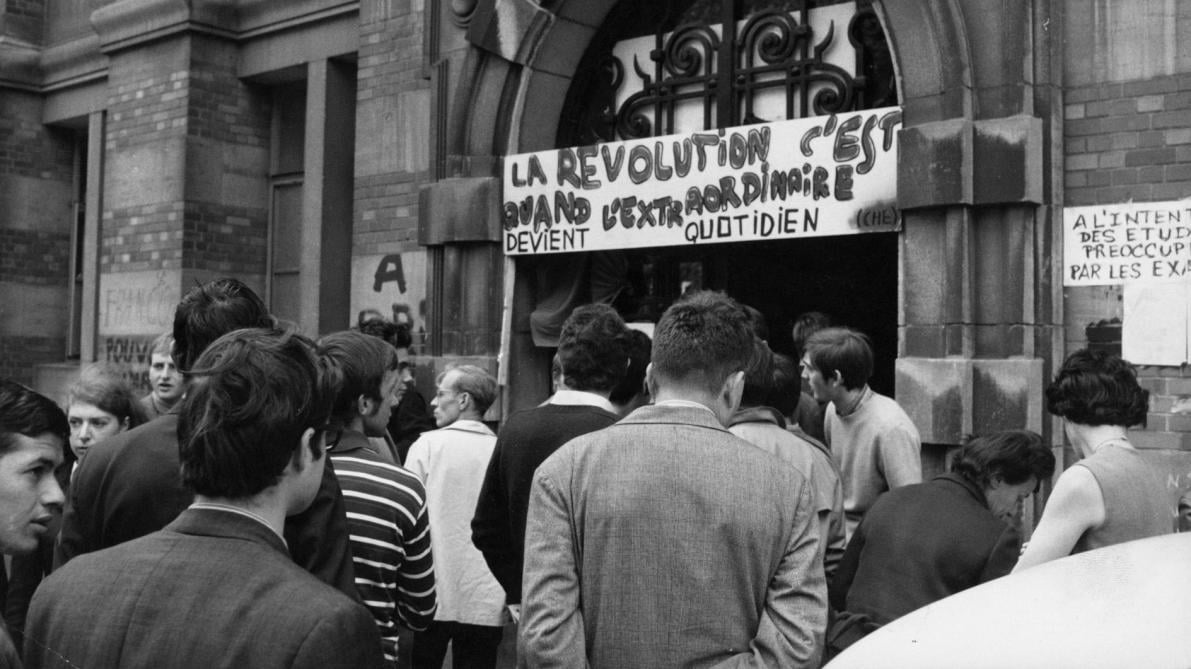
To speak of May 68 is not to merely mark an anniversary; it is to keep alive a memory of rebellion for the present, as present.
The politics of memory is often reduced to commemoration, when in fact it hides a politics of struggle over what remains possible still. And before the erasure of memory of dissidence and disobedience, we celebrate the occasion of the 50th anniversary of the french uprising, however modestly, to keep a past, present.
The effort to domesticate the events of May has been constant, above all in france. What was the largest general strike in the country’s history is reduced to a middle class student rebellion, what was a movement that echoed struggles elsewhere (above all, anti-colonial struggles in Algeria and Vietnam) is dismissed as idiosyncratically national, what spilled over any calendarisation of the events’ resonances is reduced to the months of May and June of 1968, what was an essentially anti-authoritarian political movement is caricaturised as concluding with philanthropic concerns for human rights, or worse, in hedonistic narcissism.
If we then engage in this exercise of celebration, it is because our political horizon (or the political horizon of those who stubbornly insist on imagining a world beyond capital) remains that of May 68, a political horizon far more vast than the caricatures.
The political lessons of May for the Left are far reaching: the illusions of an intrinsically revolutionary subject (of class, race, ethnicity, colonisation), the vanguard role of a revolutionary organisation (party or labour union), the primacy of the factory space as the location of revolutionary struggle and the secondariness of all other spaces of oppression, revolution as the seizure of central power, all of them die. And if this death is not yet recognised, fifty years on (as it was not at the time, by many), then “ideology” is indeed stronger than “reality”, or, to put matters differently, the Left is more comatose than those it supposedly struggles against.
We share below, in translation, a testimonial and an analysis of the events of May-June of 1968 by Tomás Ibáñez (a las barricadas 26/02/2018).
Continue reading →
The long and winding May of 1968 (1): The Prague spring
May 1968 was not a franco-french, hexagonal affair. It was a global event. One would speak of it very differently if it had not resonated with, not only the occupied factories decked with red flags, but also with the Tet offensive of February 1968 in Vietnam, the Prague Spring, the student agitation in Poland, the rebellion of Pakistani youth, the anti-war movement in the United States, the last embers of the cultural revolution in China, the massacre of Tlatelolco, to the raised black gloved fists on the Olympic podium of Mexico. 1968 is thus a symbolic date for a propitious instant, when the despotic edifice of Stalinism revealed its cracks, or the anti-bureaucratic struggles of the East, the colonial revolutions in Algeria, Indochina, Palestine, in the Portuguese colonies, seemed to be able to associate with the mobilisation of workers in France and Italy. The reflux of the 1960s opened the path to the counter-attack of the Thatcher-Reagan years. The spectre of the social and profane revolution receded. The time of velvet and sacred revolutions had arrived.
Daniel Bensaïd and Alain Krivine, 1968: Fins et suites
1968 was a year a of uprisings, to borrow Alain Badiou’s expression. To suggest however that all of the protests, social movements, wars of national liberation, revolutions, shared the same aims, methods, context, or that they were somehow all coordinated, would be absurd. But something was in the air, in the background, that served as an agent of resonance and contagion. Struggles of national liberation and “third worldism” were at their height (animated by the Tricontinental movement or OSPAAAL), and the outcry against the US war in Vietnam knew no borders. In North American, insitutional politics was strained to contain radical political challenges, while blacks fought to radicalise the older civil rights movements (and with Martin Luther King’s assassination in early April of 1968, would rise up across the country). South America was seemingly overwhelmed with Castroist guerrilla movements and in 1970, the Socialist Party would win Chile’s elections, apparently offering up the possibility of a social-democratic path to social change. The “developed” world was for its part not immune to the contamination, with France, Czechoslovakia, Poland, Germany, Holland, Italy, Spain, Portugal and Greece all experiencing major radical social and political contestation throughout the 1960s and 1970s.
Continue reading →