Follow the link below to an excellent discussion around Peter Gelderloos’ essay, The Solutions are Already Here.
Peter Gelderloos joins us again to discuss his recent book “The Solutions are Already Here: Strategies for Ecological Revolution from Below”. The conversation is framed around ecological collapse, the complexity of tackling these issues, and detangling climate change from the conversations around the carbon footprint. How does capitalism utilize climate change to continue its path to exploit the resources on the planet through tools like the green new deal, and how do we respond to this greenwashing?
We explore the concept of community-building, the power of utopia, and what kind of tools are at our disposal to find ways to gum up the system destroying the ecosystem.
You can get Peter’s book from Pluto Press: https://www.plutobooks.com/
When the Russian military invaded Ukraine at the end of February 2022, anarchists and other anti-war demonstrators defied draconian anti-protest measures to take the streets to express opposition. Over the months since those protests were crushed, resistance to the invasion has assumed new forms. Clandestine attacks across Russia have targeted railroads, military recruiting centers, vehicles belonging to pro-war zealots, and Russian state propaganda messaging in favor of the war.
One of the groups promoting these attacks is known as the Anarcho-Communist Combat Organization. In the following interview, they speak about how they see their predecessors in the regional history of anarchist movements, how the political situation in Russia deteriorated to such an extent that it was possible to suppress social movements and invade Ukraine, and what kind of organizing is possible under the prevailing conditions. We also asked them to go into detail about some of their operational protocol, in case this is ever useful for anarchists elsewhere who may be compelled to adopt similar strategies as state repression intensifies around the world.
Let us rather observe this lad of ten, clad in an ancient cap, his father’s probably, shoes worn on bare feet, and nankeen breeches, held up by a single suspender, who had climbed over the wall at the very beginning of the truce, and has been roaming about the ravine, staring with dull curiosity at the French, and at the bodies which are lying on the earth, and plucking the blue wild-flowers with which the valley is studded. On his way home with a large bouquet, he held his nose because of the odor which the wind wafted to him, and paused beside a pile of corpses, which had been carried off the field, and stared long at one terrible headless body, which chanced to be the nearest to him. After standing there for a long while, he stepped[Pg 120] up closer, and touched with his foot the stiffened arm of the corpse which protruded. The arm swayed a little. He touched it again, and with more vigor. The arm swung back, and then fell into place again. And at once the boy uttered a shriek, hid his face in the flowers, and ran off to the fortifications as fast as he could go.
Yes, white flags are hung out from the bastion and the trenches, the flowery vale is filled with dead bodies, the splendid sun sinks into the blue sea, and the blue sea undulates and glitters in the golden rays of the sun. Thousands of people congregate, gaze, talk, and smile at each other. And why do not Christian people, who profess the one great law of love and self-sacrifice, when they behold what they have wrought, fall in repentance upon their knees before Him who, when he gave them life, implanted in the soul of each of them, together with a fear of death, a love of the good and the beautiful, and, with tears of joy and happiness, embrace each other like brothers? No! But it is a comfort to think that it was not we who began this war, that we are only defending our own country, our father-land. The white flags have been hauled in, and again the weapons of death and suffering are shrieking; again innocent blood is shed, and groans and curses are audible.
Leo Tolstoy, The Sebastopol Sketches
History does not repeat itself and analogies between past and present events are only certain when the events are treated as static and closed, and therefore susceptible to unthinking identification. Yet if we take the word in its original Greek sense, then analogy is a form of thinking, of reasoning, based on significantsimilarities between things and events across space and time; similarities which do not erase differences.
It is with this in mind that we share a selection of articles for the New York Tribune written by Karl Marx and Frederick Engels on the Crimean War of October 1853 – February 1856, with Russia’s current war in the Ukraine before us.
Historian Enzo Traverso on his latest book, Revolution: An Intellectual History. The interview originally appeared in the Alias section of il manifesto, 9 July 2022 and was published in the Verso books blog, 01/08/2022, translated by David Broder.
“Revolution — without icons and without capital letters — remains a necessity, as an indeterminate idea of change and as the compass for human will. Not as a model, not as a prefabricated schema, but as a strategic hypothesis and a regulating horizon.” These words by the philosopher Daniel Bensaïd begin Enzo Traverso’s new book, soberly entitled Revolution: An Intellectual History. Traverso, one of Italy’s foremost historians of ideas, now teaches at Cornell University. Il manifesto met up with him in Rome during a recent visit in which he presented his book.
My viewpoint, in telling the history of the United States, is different: that we must not accept the memory of states as our own. Nations are not communities and never have been. The history of any country, presented as the history of a family, conceals fierce conflicts of interest (sometimes exploding, most often repressed) between conquerors and conquered, masters and slaves, capitalists and workers, dominators and dominated in race and sex. And in such a world of conflict, a world of victims and executioners, it is the job of thinking people, as Albert Camus suggested, not to be on the side of the executioners.
Howard Zinn, A People’s History of the United States (1980)
To be hopeful in bad times is not just foolishly romantic. It is based on the fact that human history is a history not only of cruelty but also of compassion, sacrifice, courage, kindness. What we choose to emphasize in this complex history will determine our lives. If we see only the worst, it destroys our capacity to do something. If we remember those times and places–and there are so many–where people have behaved magnificently, this gives us the energy to act, and at least the possibility of sending this spinning top of a world in a different direction. And if we do act, in however small a way, we don’t have to wait for some grand utopian future. The future is an infinite succession of presents, and to live now as we think human beings should live, in defiance of all that is bad around us, is itself a marvelous victory.
Howard Zinn, “The Optimism of Uncertainty,” The Nation (2004)
Howard Zinn would be a hundred years old this year, and to celebrate this remarkable historian, academic, playwright, political activist, we share a number of texts, interviews and videos below.
Zinn looked at and wrote of history with what the anthropologist James C. Scott called an “anarchist squint”. And Scott’s “two cheers for anarchism” could very well be Zinn’s. Their apology for anarchism is not that of the ideologist or of the sectarian militant. It is born rather of an “anarchist squint”,(xii) a way of looking “at the history of popular movements, revolutions, ordinary politics, and the state” from “below”, from a perspective freed from the State. What is then revealed (and Zinn’s histories and Scott’s anthropological work bear testimony to this) is “that anarchist principles are active in the aspirations and political action of people who have never heard of anarchism and anarchist philosophy.”(xii) (James C. Scott’s Two Cheers for Anarchism, Princeton University Press, 2012)
To brandish Karl Kraus’ 1914 essay “In these great times” against our own may seem out of place. And in some sense it is, for the First World War is not ours. Yet Kraus condemns not only the war, but the media and commercial culture that contributed to its advent and which fed it daily with a profitable and malignant patriotism. In this, our times have only degenerated further. The printed press has been supplanted by the radio, television and, of course, more recently, by the virtual diarrhea of hate and fear that floods daily the internet.
Kraus painfully witnessed the debasement of language and of sound judgment brought on by the press, something that could only culminate in a culture of stupidity. But equally, and no less significant, he saw how the expansion of “newspapers” transformed the relation between the events reported and the reports, between reality and its representations, with the written medium now capable of generating its own reality, from which actions follow. “Today the connections between catastrophes and editorial offices are far more profound and hence less clear. For in the age of those who live through it, deeds are stronger than words, but the echo is stronger than the deed. We live on the echo, and in this topsy-turvy world the echo arouses the call.” Or, as he states it more bluntly: “Wire dispatches are instruments of war.” (Karl Kraus, “In these great times”)
In such times as these, those “who now have nothing to say because actions are speaking continue to talk.” Then let “him who has something to say come forward and be silent!”, a silence from which great “and elemental forces must have the strength to cope with evils by themselves”, without “the stimulation and need of a writer.” (Karl Kraus, “In these great times”)
Walter Benjamin would say of Kraus: “To the ever-repeated sensations with which the daily press serves its public he opposes the eternally “news” of the history of creation: the eternally renewed, the uninterrupted lament.” (Walter Benjamin, “Karl Kraus”).
We share below Karl Kraus’ essay, “In these great times”, as it appears in english translation in the volume In These Great Times: A Karl Kraus Reader, Harry Zohn ed., Manchester, U.K., Carcanet Press, 1984.
It would be almost impossible to describe any of the regular participants or contributors to Autonomies as catholic, or christian, or even religious, in any traditional or institutional sense of the latter. And yet we are equally aware of the enormous contribution, past and present, of religious thought and practice to anarchism, taking this last as broadly as possible.
The death of Tom Cornell, long time member of the Catholic Worker, on the first of August (1934-2022), is the occasion to modestly remember his work and that of the movement to which he gave much. We do not agree with all that the Catholic Worker movement has done or the way it has done things, but there is much that we can embrace and to dismiss it merely because of its christianity would be absurd. As Dorothy Day asked in the first issue of the Catholic Worker newspaper, “Is it not possible to be radical without being atheistic? Is it not possible to protest, to expose, to complain, to point out abuses and demand reforms without desiring the overthrow of religion?” And we may ask, today, whether it is possible and/or desirable to imagine any radical political-social change premised on the overthrow of religion? If the answer is yes, then we may rest assured that religion will outlive any revolutionary desire.
We share below an interview with Tom Cornell, short writings by him in defense of Catholic Worker anarchism and a brief introduction to the Catholic Worker Movement. (For obituaries dedicated to Cornell, see America: The Jesuit Review and the National Catholic Reporter).
Stepping back a little, we share written and video material by and on Peter Maurin, Dorothy Day and Ammon Hennacy. And we close with a lecture by the north american philosopher-activist, Cornel West, dedicated to Dorothy Day.
In my forties, I chose to take my pain and turn it into compassion, and not hate. Whenever I experienced pain of any origin I always made a promise to myself never to do anything that would cause someone else to suffer the pain I was feeling in that moment. I still had moments of bitterness and anger. But by then I had the wisdom to know that bitterness and anger are destructive. I was dedicated to building things, not tearing them down.
Albert Woodfox,Solitary: Unbroken by Four Decades in Solitary Confinement
Despite the important of antiracist social movements over the last half century, racism hides from view within institutional structures, and its most reliable refuge is the prison system.
Angela Y. Davis,Are Prisons Obsolete?
There is a power in the words of Albert Woodfox, when he speaks of his 44 years of solitary confinement at the Angola State Penitentiary of Louisiana, a power that is borne by the simplicity of his words, of a witness who presents not the facts as a third party to an event, but as someone who lived it, who is the event in the flesh. His every word, in his every thoughtful hesitation, his every gesture, speaks of his memories and of his faith that what he experienced need not be repeated. He requires no grand eloquence or baroque extravagance to speak, for his subject is injustice, the injustice of a criminal system that can falsely accuse a man of a crime because of his racial identity and political commitments, and condemn him to physical isolation for almost half a century.
Albert Woodfox’s crime was to have been an african american and a member of the Black Panther Party, and together with Robert King and Herman Wallace, they would become known as the “Angola 3”, and again, together, they would spend over 100 years in solitary.
On his release from prison in 2016, Woodfox dedicated himself to “standing as a witness”, to giving voice to those with whom he shared the nightmare of solitary confinement, and to those who still suffer it. (Robert King would do the same, while Herman Wallace died three days after his release from prison, in 2013).
Albert Woodfox died this last August 4th. In memory of this “elder”, we share below an interview with him for Scalawag Magazine (19/08/2019) and a video recorded interview at the Public Library of Toronto (02/04/2019). And we close with a documentary, Angola 3: Black Panthers and the Last Slave Plantation of 2006.
“To destitute is not primarily to attack the institution, but to attack the need we have of it.” This statement, from the Invisible Committee’s text Now (2016), is at the heart of an essay by Spencer Beswick that we share below.
Reflecting on what he calls “living communism”, and working through the Invisible Committee’s reading of the german Autonomen of the 1980s as a revolutionary experiment in creating an “archipelago of communes”, a question does arise, however, from Beswick’s own conclusion, as we consider this experience, and other more recent experiences: if the Autonomen failed in creating sufficiently robust autonomous spaces, robust enough that is to keep the state’s policing forces at bay (and one could say the same of the current examples that he cites, for instance, the French ZADs), is it correct to see such spaces as instruments of resistance, of conflict, of war, against capitalism? The question may seem misplaced, but what it points to is an important distinction that can be made between being ungovernable and non-governable.
If cooperatives can be criticised for ultimately compromising with capitalist social relations, so too may squats and/or ZADS lose their “revolutionary” lustre (and we have examples of such throughout Europe and elsewhere). “Before the ungovernable, revolts, protests, civil disobedience, a government can respond in one of two ways. It may negotiate and perhaps consent to a change in politics. Or it may repress. In this sense, the ungovernable is what can be either understood or dominated.” The non-governable can, on the other hand, only be dominated, and not governed. As to what in practice distinguishes the two is not a given. “There is no clear frontier between disobedience and what is foreign to obedience.” The distinction is a moving and fragile one, for the non-governable exists only at the limit of the ungovernable. (Catherine Malabou, Au Voleur! Anarchisme et philosophie, 52-3) But that being so, it is equally very difficult, if not impossible, to identify movements and/or political practices that in fact block, secede from and destitute capitalist social relations.
What we do know, and this from experience, is the enormous importance that such “autonomous” spaces or communes can have in transmitting the “tradition of the oppressed”, of securing a minimal infrastructure for the reproduction of potentially anti-capitalist social relations, and of serving as fundamental points of passage in moments of (always unplanned) insurrection. They are, or at least can be, with no guarantee of permanence, means by which to transform our needs (we are tempted to say, spaces for the education of our desires) and thus, examples of destituent politics.
Destituent modes of life, however, are not the same as what Beswick calls, following the Invisible Committee, “bases of liberated territory from which to attack the state and capitalism”. As it is not clear to what extent we are dealing with “liberated” territory, so it is unclear what is to be attacked. If there is no more Bastille or Winter Palace to storm, are the targets so obvious? And if not, to strike out blindly at the enemy is politically ridiculous, if not simply mad. The repertoires of “violent” protest or insurrection may be exhausted, but are continually replayed because of motives that have little to do with any “revolution”.
This is not say that everything will move along peacefully, or that “self-defence” is to be excluded, but that it is impossible to predict or to plan for a general class war, whatever that may mean.
We may close with a sentence from Deleuze that Beswick also quotes: “Escape, but while escaping look for a weapon.”
tradition is not to preserve the ashes but to pass on the flame
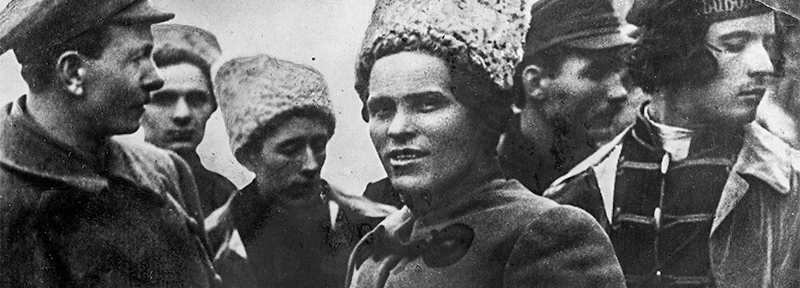
For our times of war, we share a portrait of the anarchist Nestor Makhno, by Alexander Berkman.
Nestor Makhno, The Man Who Saved the Bolsheviki: Personal Recollections
In the Tenon hospital at Paris there recently died a man poor and forsaken by almost every one of the millions that had once hailed him as liberator and hero. His name was Nestor Makhno. Great personalities are the cameos of life, standing out in bold relief on its canvas and giving us a clearer understanding of the social background. History itself often sculptures such significant figures that even the passage of time cannot obliterate. They personify the genius of their people, and their lives and deeds illuminate the past and cast a prophetic light on the future. Such a figure was Nestor Makhno. True child of a revolutionary epoch, his life and activities were imbued with the spirit of a dominating purpose, and it is more than probable that but for him and his insurgent army of Ukrainian peasants Soviet Russia might now be only a memory.




The solutions are already here with Peter Gelderloos: A podcast
Follow the link below to an excellent discussion around Peter Gelderloos’ essay, The Solutions are Already Here.
Peter Gelderloos joins us again to discuss his recent book “The Solutions are Already Here: Strategies for Ecological Revolution from Below”. The conversation is framed around ecological collapse, the complexity of tackling these issues, and detangling climate change from the conversations around the carbon footprint. How does capitalism utilize climate change to continue its path to exploit the resources on the planet through tools like the green new deal, and how do we respond to this greenwashing?
We explore the concept of community-building, the power of utopia, and what kind of tools are at our disposal to find ways to gum up the system destroying the ecosystem.
You can get Peter’s book from Pluto Press: https://www.plutobooks.com/
Find Peter on Twitter @PeterGelderloos
https://www.podbean.com/ew/pb-tu89s-12a241d