For Martin Luther King Jr. (January 15, 1929 – April 4, 1968) …
Reflection On Doctor King
Lorenzo Kom’boa Ervin
I am not one of a number of persons and commentators who come merely to hypocritically give salutations to Dr. King, when in their own times, they betray his entire history of activism. In fact, the political establishment present us with a Martin Luther King, who never really existed. A saint, instead of an activist, a dream instead of a man, and a pacifist, instead of a man who would fight back if you personally tested him.
The King we are being presented is the corporate King, the creature of the white government who used this pacifist myth to beat down the Black freedom movement of the 1960’s with blood, and of which he was one of the major casualties, along with Malcolm X, the other major leader of that period. We are fed this garbage every year at this time, which totally circumvents logic and perverts history about Martin Luther King jr. and the civil rights movement itself.
It is done to really remove him from his people, and put him in the hands of the White political establishment, and in that respect that is what has been done. They also want to give us a man they claim who was a sheer pacifist, and could not support the liberation movements which existed all during the revolutionary 1960’s. That also was false since we know that Dr. King was opposed to the Vietnam war and reached a pointed where he began to criticize the political institutions of the capitalist government and economy itself. That is why they killed him.
By no stretch of the imagination are we free in 2001. We have over one million Black prison inmates in the US prison system, each year 500-1,000 Black and poor persons are killed by the police in this country; over three million homeless persons walk or sleep on our streets; millions are locked out of the capitalist economy and into poverty of the worst sort, and we have just seen in the past election the revival of some of the worst Southern racist impediments to block our right to vote in the last Presidential election.
Along with the rise of a news super-poor, a new Black middle class surfaced in the wake of Dr. King’s sacrifice, but even that is being crushed by the most reactionary elements of the Republican party. We have serious challenges, but very little leadership, what we do have like Sharpton, Farrakhan, Jessie Jackson and others are flawed, weak, and compromised by money and privilege. To them, organizing is about frightening the political establishment and major corporations to give money to their organizations, in other words, a shakedown.
King was a good man, and even those his politics of moderation were superseded by the Black Power movement of the last 60’s, it could be said he was no crook. What we have got to do now is build a mass revolutionary movement, led by the poor (not preachers, politicians, or academics) which can totally dismantle the political, social and economic system of the United States. In other words, a Black revolution as the first stage of a social revolution.
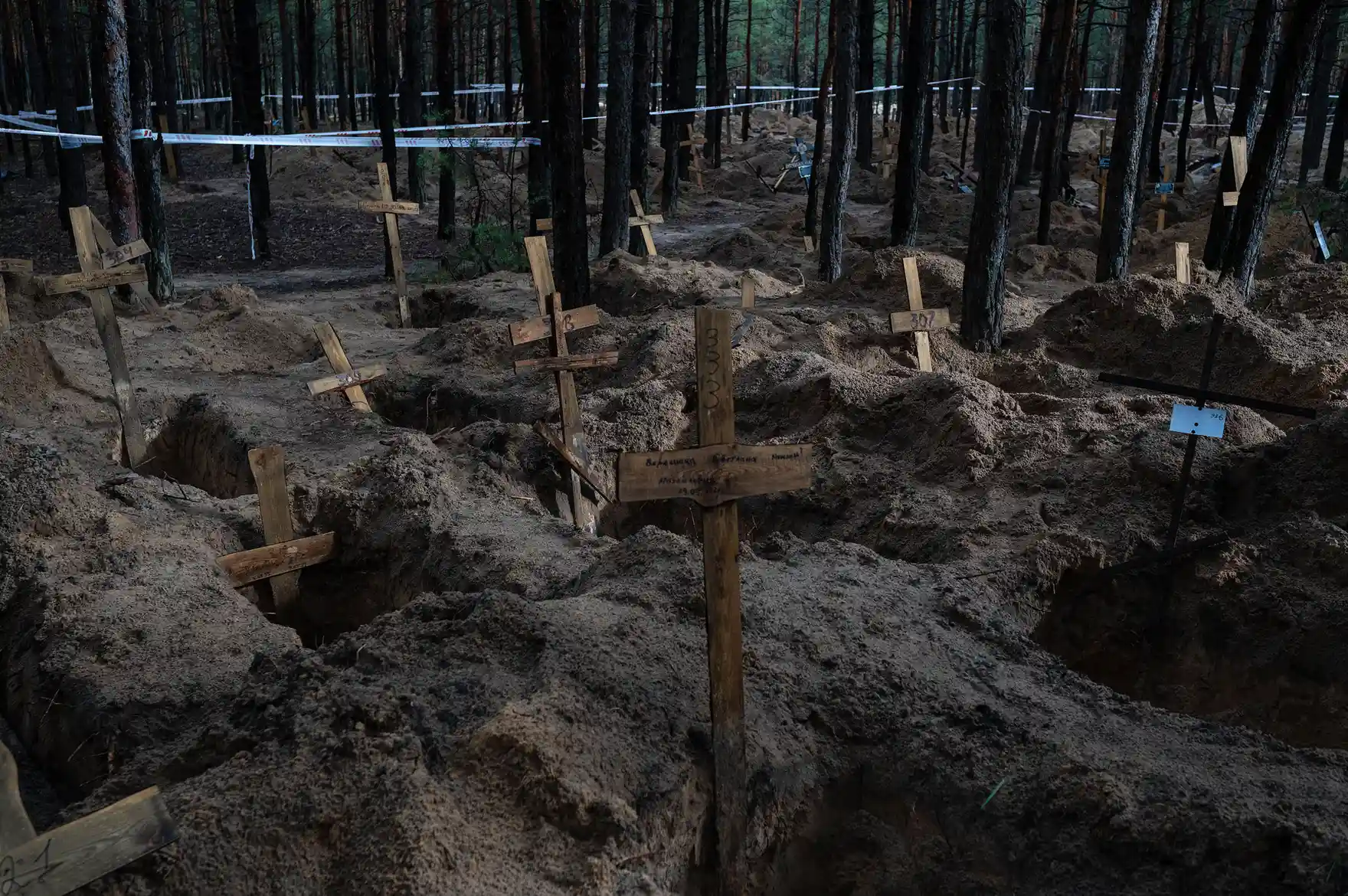
Wooden crosses at a mass burial site in the forest near the town of Izium. A total of 436 bodies were exhumed after liberation from Russian occupation. Most of them have signs of violent death Photograph: Viacheslav Ratynskyi
A Moscow court on Thursday sentenced two men to years in prison for taking part in the recital of verses against the Ukraine campaign during an anti-mobilisation protest last year.
Artyom Kamardin, 33, received a seven-year sentence for reciting a poem, and Yegor Shtovba, 23, was sentenced to five and a half years for attending the protest.
War in the 21st century imitates the 20th century, wants to return to an age of wholesale massacre and monstrous historical experiments. Now it is inseparable from a fashionable dependence on the image — but on our screens all we see are the deep tombs of the past. Resisting today means freeing ourselves from the dictatorship of another’s imagination, from a picture of the world that grasps us from inside and takes hold of our dreams, our days, our timelines, whether we want it or not.
Maria Stepanova, “The War of Putin’s Imagination”, The Financial Times, 18/03/2022
As parallel and overlapping crises persist and multiply – ecological, economic and political, social and existential -, the horror of contemporary war both steals our attention and blinds us to the many “wars” that are the common thread of the crises: wars on nature and life, civil-national-colonial wars, wars on populations, classes, kinds of subjectivities, and the like.
Let us us force a thesis: war is theform of state power, or state power finds its quintessential expression in war. The claim is not that all power is identical to state power, but that the unwanted power over others finds its paradigm in the state, while the state models and informs all other forms of power. And thus war is omnipresent.
To resist war then “means freeing ourselves from the dictatorship of another’s imagination“, from the imagination of the state, from the violence of sovereignty.
We want to tell you about our comrade, Marcy, who was killed in action on 11 November, near Avdiivka. (The family has asked for no media coverage, so we will not disclose his real name).
Do not believe that man grows up. No: he is born suddenly – a word, in an instant, penetrates his heart with a new pulse. It takes but one scene to make him fall from the threshold of childhood to the harshness of the road.
Ghassan Kanafani, writer and resistance fighter
How many generations will it take for us to begin to see them other than as the permanent enemy, since their cursed Zionist project was put into place, even before the construction of their colonial state, to see them other than as the most heinous and most hateful enemy ever? How many generations before they finally manage to see what is really happening every day, every night, every moment, on the other side of their mirror and their fables, to see us, us, who and what we are, in all of our bloody paradoxes? How many more among us, how many homes destroyed? How many towns, villages erased, eradicated or replaced? How many olive trees uprooted? Have you noticed the contempt they have for this sacred tree, whose origins date back to the dawn of time, long before these bloody monotheisms? These people are Mediterraneans?! How many generations will it take before they understand that it is not enough to occupy it, to be a part of this land? How many generations for them to understand that Nakba means catastrophe, disaster, in Arabic, or Shoah in Hebrew? Yes, it is as tragic and pathetic as that! How many generations for them to understand the why and the very nature of our resistance? Even Vladimir Jabotinsky, that bloody quasi far-right Zionist, whose private secretary was Netanyahu’s father, was aware of this… see if there is a single case of colonisation carried out with the consent of the indigenous population. There is no such precedent. You once read me this sentence from his book, The Iron Wall, written in Russian, in 1923. How many more bloody generations! He ended up getting angry. Frankly, do you, you, believe in a possible coexistence?! He was yelling at me. Nothing is stopping them, neither this bloody Christmas, nor this bloody year’s end! I still hadn’t said anything. The line crackled, like a landline. We could still hear one of the thousands of drones hovering above our heads. At home, near Nablus, and here, near Nabatieh, his north, my south. How many generations, Ghassan? Answer me! I love your bloody name! Ghassan Kanafani obviously, exiled at the age of twelve, assassinated in Beirut by Mossad, the Israeli intelligence service, more than fifty years ago, at the same time as his niece, Lamis, who was seventeen. He was thirty-six and he had never returned home to Acre. Thirty six! In less than a decade, we will have double that. Double, Ghassan! The line had suddenly stopped crackling. The buzzing of drones continued. How many more bloody generations for our eyes to no longer see only blood red? How many more funeral marches, how many mass graves? He continued to yell at me. The children of the children of the children of the children of our sisters, of our brothers? Neither he nor I had any offspring. How many more generations before this utopia penetrates hearts and minds? And what will they call it? Palesrael? Israeline? He burst out laughing. One more bloody state in this world, bi-national or con-federal, whatever its colours, its allegiances, we who dream of undoing (ourselves from) all these nation-states, of shitting on all these terrestrial borders, maritime and celestial! Can you believe it?! His mad laughter carried me away. It must have been two or three in the morning, the rain had invited itself, but winter had not yet set in. We probably won’t see any of this, Ghassan. Neither in your bloody life, nor in mine. I don’t remember how many times he used that word, bloody. The word is much more corrosive in Arabic.
The next morning, I sent him these few lines:
look, for what this verb could still mean look with what remains obscure to you with what shoulders you have left of nerves, of rage to lose sight voice
I translated them for him into our common language:
Ghassan Salhab is a filmmaker. From Beirut, he writes about the situation in Lebanon and beyond.
A modest reflection born in a fleeting moment of Yuletide …
When the world comes to us, instead of our going to it, we are no longer “in the world”, but only its consumers …
Günther Anders, The Obsolescence of Man
A scene at a restaurant: a family of brothers and sisters and in-laws, with their respective children, and an older woman in a beret, sit at a popular local restaurant of a European capital city. Around them, the space is decorated with large, flat screen televisions, all tuned into the same channel: the midday news service.
The family’s chosen table is perpendicular to the wall. They order an abundant meal comprised of starters, main courses, deserts, coffees, and bread and wine – we are in southern Europe.
In the intermissions of the meal, family members pull out their portable telephones, including the children, to check on the latest …, for fear of missing … what?
Throughout this Christmas family lunch, images of the war on the people of Gaza flow past in an unrelenting stream. And because of the size of the television, the images somehow serve to frame the meal, without ever bringing the eating and drinking to a halt, or interrupting what seems to pass as a conversation.
And as we also eat – for we too are part of this screen-illuminated “cave” –, we watch the family meal, watching the family not watching the war.
And as we watch and are watched, we have become as phantoms, feeling our flesh only in the isolated extremes of pleasure and pain.
And this brings us to the heart of our subject, since the fact that events—the events themselves, not reports about them—that football games, church services, atomic explosions, visit us at home; the fact that … the world comes to man, and not the reverse, is, along with the mass production of hermits and the transformation of the family into a miniature audience, the essentially revolutionary achievement that radio and television has brought.
The government of man by man (under whatever name it be disguised) is oppression. Society finds its highest perfection in the union of order with anarchy.
Pierre-Joseph Proudhon, What is Property? (1840)
The question I have raised is the following: if the anarchist problem since Proudhon is precisely to think about politics without the aid of hegemony, in any form whatsoever, it is also now a question of doing so when a certain anarchism has itself become hegemonic.
Catherine Malabou
“Being an Anarchist” is the concluding chapter of Catherine Malabou’s Stop Thief! Anarchism and Philosophy, now available in English. In it, the French philosopher argues that a “reckoning” is needed between philosophy and anarchism. Interrogating the gap between the conceptual embrace of the “anarchic” and the pompous disregard for historically-existent anarchism, Malabou seeks to redress an “anarchist failure of philosophical concepts of anarchism.” While thinkers such as Schürmann, Levinas, Derrida, Foucault, Agamben, and Rancière all elaborate concepts of anarchy, the anarchic, and the ungovernable, they also insist on the irreducibility of their concepts to political anarchism, distancing themselves from it while mining it for resources. By exploring the peculiar disposition that leads philosophers at once to plunder and disavow anarchism, Malabou’s broader aim is to disentangle the anarchic currents of our present, which assume both subversive and oppressive forms. While polarizations such as the Yellow Vests, the ZAD, or the decentralized movement to Defend the Atlanta Forest attest to new forms of mass organization and decision-making based on “self-generated, collective care for an environment, a territory,” these subversive currents are emerging alongside what Malabou terms an “anarchist turn in capitalism itself,” a shift from neoliberalism to “ultraliberalism.” How, she asks, “can the horizontality of alternative formations be distinguished from the veinstone of anarcho-capitalism?” For this, a clarification of the philosophical stakes of both anarchy and anarchism today is necessary.
I was a communist throughout. Justly though, the other communists looked askance at me. I was a communist despite their certainties, despite my doubts. Justly they did not see themselves in me. They would not admit my discipline. My centralism seemed anarchy to them. My self-criticisms contradicted theirs. Special communists cannot be: to think so is not to be so. Justly they did not see themselves in me, my comrades. Like them, I too was enslaved. Even more so: I tended to forget it. They did their work, I followed my inclination. Exactly that: I was a communist throughout. Despite their certainties, despite my doubts I always wanted this world ended. Myself ended too. And it was that exactly which estranged us. My hopes had no point for them. My centralism seemed anarchy to them. As if I wanted more, more truth, more for me to give them, more for them to give me. Thus living, dying thus. I was a communist throughout. I always wanted this world ended. I have survived enough to see comrades who bruised me broken by intolerable truths. Now tell me: you knew very well I was with you? Was that why you hated me? My truth is truly needed, breathed in through space and time, heard patiently.
Remembering/celebrating Toni Negri, with Alberto Toscano (Side Car/New Left Review, 21/12/2023) …
‘The free person thinks least of all of death, and his wisdom is a meditation not on death but on life.’ Toni Negri, who died in Paris at the age of 90 on 16 December, turned this dictum of Spinoza into an ethical and political lodestar. The conclusion of the third and final instalment of his intellectual autobiography, Storia di un comunista, features a moving reflection on aging as a rejoicing in life and a paring down of action. Negri offers the overcoming of death – a resolutely atheist and collective idea of eternity – as the substance of his thought, politics, and life. He writes: ‘And yet the possibility of overcoming the presence of death is not a dream of youth, but a practice of old age; always keeping in mind that organising life to overcome the presence of death is a duty of humanity, a duty as important as that of eliminating the exploitation and disease that are death’s cause.’
We share below texts by Giorgio Agamben, Alex Foti and by Antonio Negri.
In memory of Toni Negri
Giorgio Agamben
Two nights before I received the news of Antonio, – of Toni Negri’s – death, I dreamed about him for a long time and his presence was so vivid that when I woke up I felt the need to write to him. My message to the old email that he had not used for years could not reach him. When I spoke of the dream, a friend told me: “he wanted to say goodbye to you before she left.” Even in the divergences of our thoughts, which became more and more clear over time, something stubbornly united us, something that had to do above all with his generous, restless and punctilious vitality, which I felt immediately when I met him for the first time in Paris in 1987.
With Toni’s death, I feel like something is missing, inside me, under my feet, perhaps especially behind me, as if a part of my past suddenly became present and challenged me when it was missing. And this lack not only concerns me, but our entire country and its history, increasingly false, increasingly forgotten, as demonstrated by the hateful obituaries, which only remember the bad teacher and not the evil and atrocious country in which he had to live and that he tried, perhaps mistakenly, to improve. Because Toni, starting from the Marxist tradition to which he belonged and which perhaps conditioned and betrayed him, certainly tried to measure himself with the destiny of Italy and the world in the extreme phase of capitalism that we are currently going through towards who knows what unfortunate destiny. And this is what those who continue to insult his memory do not dare and will never be able to do.
Tati is a gentleman that I have a great deal of respect for. I believe that he did his work observing a world that, at the time, was going mad. He is not however a model for me; it was another time and a different look on the world. René Clair and Marcel Carné did not anticipate the beginning of the disaster, the beginning of this typhoon of madness that invades us today; Tati, he sensed it a little, while remaining sweet, tender and fairly “familial”. He showed the exaggeration of petit-bourgeois bad taste in Mon oncle; in Trafic, he saw the arrival of a new time but still in the tradition of Chaplin’s Modern Times, that is, in insisting on the comic side of things, by observing human behaviour as a child’s game.
Chaplin’s and Tati’s method is the old method of the clown. It is a matter of a single character standing against the world, in the footsteps of Don Quixote and Voltaire’s Candide. The character, in its relation to the world, is like corn husk paper that a chemist plunges into an acid solution. It is through the character that the acidity of the world is revealed. My method borrows more from the paintings of Breugel. It is the sum of a puzzle, the intersection of different characters blinded by the impossibility of continuing to live in tranquillity, according to their desires and what they understand about life. The drama of the world is that of the intersection of desires: the increase of the desire to have and the disappearance of the desire to give.
From: Marcel Jean and Micheline Dussault, “Entretien avec Otar Iosseliani : L’homme tranquille”, 24 images, Number 66, April–May 1993.



For a revolution of values
For Martin Luther King Jr. (January 15, 1929 – April 4, 1968) …
Reflection On Doctor King
Lorenzo Kom’boa Ervin
I am not one of a number of persons and commentators who come merely to hypocritically give salutations to Dr. King, when in their own times, they betray his entire history of activism. In fact, the political establishment present us with a Martin Luther King, who never really existed. A saint, instead of an activist, a dream instead of a man, and a pacifist, instead of a man who would fight back if you personally tested him.
The King we are being presented is the corporate King, the creature of the white government who used this pacifist myth to beat down the Black freedom movement of the 1960’s with blood, and of which he was one of the major casualties, along with Malcolm X, the other major leader of that period. We are fed this garbage every year at this time, which totally circumvents logic and perverts history about Martin Luther King jr. and the civil rights movement itself.
It is done to really remove him from his people, and put him in the hands of the White political establishment, and in that respect that is what has been done. They also want to give us a man they claim who was a sheer pacifist, and could not support the liberation movements which existed all during the revolutionary 1960’s. That also was false since we know that Dr. King was opposed to the Vietnam war and reached a pointed where he began to criticize the political institutions of the capitalist government and economy itself. That is why they killed him.
By no stretch of the imagination are we free in 2001. We have over one million Black prison inmates in the US prison system, each year 500-1,000 Black and poor persons are killed by the police in this country; over three million homeless persons walk or sleep on our streets; millions are locked out of the capitalist economy and into poverty of the worst sort, and we have just seen in the past election the revival of some of the worst Southern racist impediments to block our right to vote in the last Presidential election.
Along with the rise of a news super-poor, a new Black middle class surfaced in the wake of Dr. King’s sacrifice, but even that is being crushed by the most reactionary elements of the Republican party. We have serious challenges, but very little leadership, what we do have like Sharpton, Farrakhan, Jessie Jackson and others are flawed, weak, and compromised by money and privilege. To them, organizing is about frightening the political establishment and major corporations to give money to their organizations, in other words, a shakedown.
King was a good man, and even those his politics of moderation were superseded by the Black Power movement of the last 60’s, it could be said he was no crook. What we have got to do now is build a mass revolutionary movement, led by the poor (not preachers, politicians, or academics) which can totally dismantle the political, social and economic system of the United States. In other words, a Black revolution as the first stage of a social revolution.
That’s what on the agenda. Let’s get to it.
(The Anarchist Library)
Continue reading →