

In the domain of our life excess manifests in itself in so far as violence wins over reason. Work demands the sort of conduct where effort is in a constant ration with productive efficiency. It demands rational behaviour where the wild impulses worked out on feast days and usually in games are frowned upon. If we were unable to repress these impulses we should not be able to work, but work introduces the very reason for repressing them. These impulses confer an immediate satisfaction on those who yield to them. Work, on the other hand, promises to those who overcome them a reward late on whose value cannot be disputed except from the point of view of the present moment. From the earliest times work has produced a relaxation of tension thanks to which men cease to respond to the immediate urge impelled by the violence of desire. No doubt it is arbitrary always to construct the detachment fundamental to work with tumultuous urges whose necessity is not constant. Once began, however, work does make it impossible to respond to these immediate solicitations which could make us indifferent to the promised desirable results. Most of the time, work is the concern of men acting collectively and during the time reserved for work the collective has to oppose those contagious impulses to excess in which nothing is left but the immediate surrender to excess, to violence, that is. Hence the human collective, partly dedicated to work, is defined by taboos without which it would not have become the world of work that it essentially is.
Georges Bataille, Erotism.
The critique of labour is not limited to marxist inspired theorising. If the Krisis Group has developed a conceptually sophisticated analysis of the oppression of abstract labour and commodity production, anarchist writers, if not uniformly and with one voice, have also not been sparing in their condemnation work. The conceptual framework varies though, opening up other possibilities of understanding and of radical anti-capitalist politics. There are tensions between these two traditions (to state matters very simply, the Krisis Group place abstract labour-commodity production at the centre of their analysis of capitalist society, with all contemporary social relations being read off this centre, while anarchists – and other critical theorists – have tended to understand commodity production as dependent on other “non-economic” relations of social reproduction) and within anarchism itself. But there are also commonalities.
We then begin, from within anarchism, with Bob Black’s the Abolition of Work, originally published in 1985, and revised in 1991. (From Bob Black’s website Inspiracy).

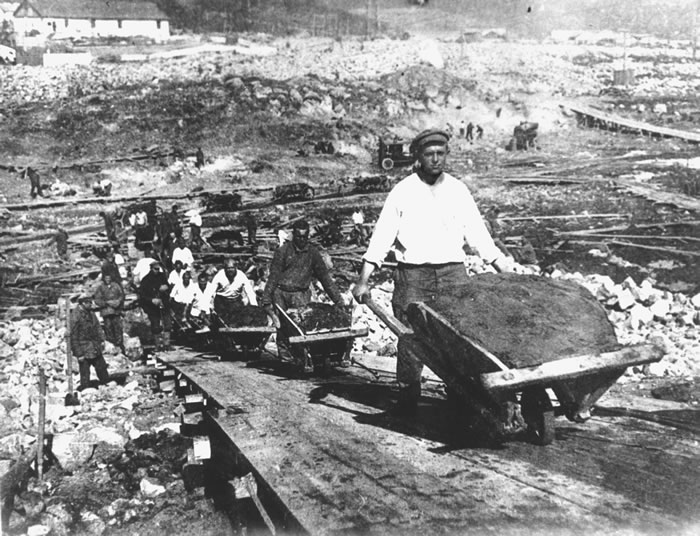


Against labour, against capital: Against the totalitarianism of capital, the destruction of work
Life unbridled, a venture into the absolute other, requires the total destruction not only of ‘my’ work, but of the very concept of work and economy as the basis of human relations.
Everything that led to the possibility of workers building a better world on and from the ruins of the old has now disappeared. It has all been ground down in the great race of accelerated procedures, the elimination of subject and object as distinct and opposing elements of a contradictory mechanism, which was nevertheless rich in prospects and vitality. In place of this mechanism we now have the domination of passage. The simple movement of something that reaches the receiver and the transmitter simultaneously, in real time, unifying them in the ongoing capacity to respond to simple, fast, coded impulses of communication.
It is not possible to speak of the ‘failure’ of the party or union as a function. In our opinion it is a question of a historical function reaching its natural conclusion. The end of an era. The end of a great illusion. Capital’s work is immense, it permeates school, the family, the church and everything else. It leaves no space unfilled, as it pushes back all initiatives in terms of struggle. Its repressive system welcomes disgusting practices such as grassing and repentance to get to the bottom of some of its contradictions which, although marginal, could still create a certain imbalance. Instead, in order to reduce the dissent of the most radical and least instrumentalisable to silence, it employs pure and simple repression, that of special prisons and police bullets. It has demonstrated once and for all that it is not true that revolt is more difficult in moments of material difficulty for the whole economic and social setup. And this was one of the canons of Marxism.
The era of opposing sides is over, we have now entered that of unification. We are all enlisted under the same flag. If once the world was orientated towards two opposing illusions, which on close inspection turned out to be anything but divergent, now everybody is being called to unite under the same common verb. Enough of the chatter! A few words, clear and unequivocal, will do. Everybody knows what they need to do and what they should be interested in.
Alfredo M. Bonanno
The tyranny of labour and the call for its destruction, from Alfredo M. Bonanno (The Anarchist Library) …
Continue reading →