The political soothsayers and diviners will cynically proclaim the yellow vests’ movement dead: Act XXI brought less than 25,000 people into the streets this last Saturday.
We however refuse to be political accountants. And rebellions and revolutions have never been about numbers, but about the intensity of the desires and creativity unleashed.
And we will continue to share the movement(s)’ voices.
Beginning as a protest against a fifth presidential term for the half dead, 82 year old Abdelaziz Bouteflika (in power since 1999) on the 22nd of February, the algerian protests have swelled into a mass rebellion against against an authoritarian, rentier capitalism that seemed to have been frozen in time. If Bouteflika seems to have been sidelined for now, the risk of an Egyptian or Tunisian style “transition” is on the horizon. The weekly protests however promise so much more.
We share below a testimonial from algeria published with lundi matin.
Robert Graham continues his notable and tireless effort to make known and share defining texts in the political tradition of anarchism for english language readers.
On this occasion, we post his most recent entry, a selection from Jean Grave’s essay, Society on the Morrow of the Revolution. The value of the text, as Graham himself states in his introductory note, lies in the clarity with which Grave endeavours to define “anarchist communism” as rooted in two fundamental concerns: the organisation of human social life without hierarchy and exploitation and the autonomy of those who take upon themselves to create such a society, without pre-given models or forms, or to withdraw from it.
We also share this post because it continues to provide a possible lens through which to read contemporary social-political movements, such as, for example, the gilets jaunes of france.
Our job is to see, to make things seen or to inform, but we never see enough. I knew around a dozen caryatides and then I discovered fifty of them.
I fought for a radical cinema, and I continued all my life.
Agnès Varda
There is no truth, Agnès Varda once said, in speaking of documentary film. It is always a matter of perspective, a perspective that must be shaped by a particular representation or artistic language, what Varda called cinécriture. Without the self-conscious elaboration of such formal mediation, film falls into the illusions of realism, the lie of wanting to “tell it like it is”, or to narrate a total story, thereby blinding us to what is not to be seen (and to the fact that the film maker does not see everything).
There are always lacuna in what we see, in what can be seen. To be aware of these absences humbles us, weakens the hold of our ego, and thereby opens us to realities that we can never exhaust, and allows those realities to speak. We learn to see beauty.
Varda’s cinema moves easily between fiction and documentary because for her, the distinction was of no importance. Like an artisan, she crafted images, moving images with care and respect for what she captured with the camera’s eye. Her’s was a cinema not of “vérités”, but of “souvenirs”; of image-memories from which we could find and create perspectives. And it was from this in-formed perspective that she herself would move through various personal and political issues in her films.
Agnès Varda’s cinema was – is – a cinema of liberation.
Agnès Varda died this last 29th of March at the age of 90.
The Temps critique collective (22/03/2019), in a finely developed analysis of the yellow vests movement(s) of france, elaborates three fundamental criticisms: the movement has hitherto been unable to define itself, it has equally failed to understand its “enemy”, and it risks political isolation. If the analysis is pertinent, it is also framed by time, that is, the yellow vests are a movement in movement and their ability to overcome their weakness will only be decided in the heat of events.
The yellow vests insurrection offers lessons beyond or in parallel to the often celebrated insurrections of the Zapatistas in Chiapas and of the Rojava “Revolution”. In no way dismissing these latter, the yellow vests speak more directly to those living in the “advanced” capitalist states, where indigenous populations, the peasantry, regional ethnic identities, industrial working classes have all waned or disappeared (never peacefully).
The yellow vests are a premonition of what insurrection, revolution, may be in the end times of ecological collapse and neo-liberal authoritarianism.
Rebellion will no longer be the act of a “people”, of a “class”, in any unified sense of these terms. It will be, as is the yellow vests’ insurrection, a plural and contradictory rebellion, created and defined in the movements of the movement. It will have no end beyond itself (none can be outlined); it will not be a means to an end, or an end justifying all means. It will be a permanent rebellion where social relations remain plastic, constantly changeable, fleeing from and struggling against those who would seek to harness the wild energy unleashed. In the midst of this an-archy, we catch a glimpse of autonomy.
From the CrimethInc. Collective, a further reflection on the yellow vests’ insurrection …
… to participate knowingly in a group, even if only temporarily, with a view to preparing, characterised by one or more material evidence, intentional violence against persons or the destruction or degradation of property is punishable by one year of imprisonment and a fine of 15,000 Euros.
Article 222-14-2 of the french penal code (introduced under the Nicolas Sarkozy presidency)
… when a demonstration is not declared, is prohibited, when it is organised to vandalise [casser/to break], all of those who participate, who in fact protect the vandals, who encourage them or glorify them on social networks, are complicit with them.
Eduoard Philippe, french prime minister interpreting the above cited article (Le Monde 20/043/2019)
We assume our crime.
We assume our solidarity with all of the “yellow vests” who for four months have imagined and acted to create a different world, freed from an untouchable and arrogant oligarchy, liberated from the reign of money; a world of solidarity experienced in occupations, assemblies, protests and self-defense.
We assume our solidarity with all of the “yellow vests” who have been the targets of State violence.
We assume our defense of rebellion against and escape from a social-political-economic system – capitalism – that rests upon the domination, exploitation and destruction of living nature.
Putting Ideas on Trial: The Greek State’s Laboratory of Repression – An Interview with Nikos Romanos, Imprisoned Anarchist
After several failed attempts across Europe to frame anarchists and other anti-authoritarians with conspiracy and terrorism charges, the Greek state is at the forefront of developing new legal strategies to attack social movements. Article 187A of the Greek legal penal code has existed since 2004, but last year, Greek officials used it in a new way against Nikos Romanos and several other anarchist prisoners, convicting and sentencing them to many years in prison based on a new interpretation of the article. Regardless of whether these verdicts are overturned in higher courts, the trials indicate a major strategic shift in the policing of social movements in Greece. They offer an important warning sign about the new forms that repression may assume around the world as social conflict intensifies.
Today we had people who tried by all of the means available … to injure the Republic, to damage, to destroy, at the risk of killing.
Emmanuel Macron (Le Monde 19/03/2019)
Saturday, we saw extreme violence in Paris. It was almost para-military groups, looters, zadists.
Government official (Le Monde 19/03/2019)
Before, the black blocks frightened everyone, now they are taken as a plus. It is they who make things move forward; we, we were too pacifist.
It’s great that things are vandalised because the bourgeoisie are so sheltered in their bubble that it is necessary that they feel fear physically, for their security, for them to give up.
Voices of Act XVIII yellow vest protesters in Paris (Le Monde 19/03/2019)
Le Monde‘s front page of Tuesday, March 19th, reads “L’Exécutif contraint de répondre aux violence [“The Executive is constrained/obliged to respond to the violence”]”. Yet as the yellow vests movement(s) enters its fourth month, after thousands have been gassed and beaten, after thousands have been arrested, after hundreds have been hurt and dozens crippled or blinded, it is difficult to know how to take the title.
Our own title then is meant to clarify matters.
Act XVIII of the yellow vests was concentrated in Paris, with a confluence with other protests in the city (most notably, against global warming). It brought part of the capital to halt, vandalised symbols and institutions of wealth, and in forcing once again that hand of the government (the president was forced to cut short his skiing vacation), the movement continues to radicalise in a seemingly endless and growing challenge to political and economic authority.
As Macron’s ministers throw responsibility for the violence on “organised radicals”, accuse each other of mismanagement, and then promise even more draconian security measures (with the famed national debate rapidly fading into the background), for those who continue to contest and create, the answer is increasingly to continue to rebel … for what is there to return to?
When we linger in the borderland on purpose, we become our own experiment.
Steve Paxton, Drafting Interior Techniques
How do you know you aren’t improvising?
Steve Paxton, Gravity
A reflection inspired by a performance of Steve Paxton’s Flat and Satisfyin Lover, and of the Goldberg Variations (after Steve Paxton), by Jurij Konjar, in Lisbon (09/03/2019).



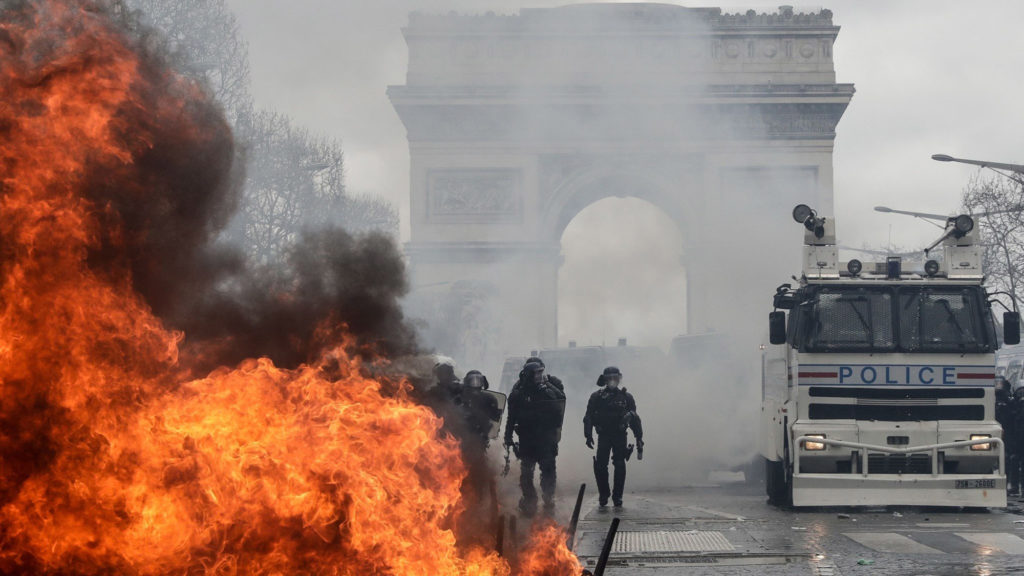


The gilets jaunes: Understanding the movement(s) beyond final defeat or victory
The political soothsayers and diviners will cynically proclaim the yellow vests’ movement dead: Act XXI brought less than 25,000 people into the streets this last Saturday.
We however refuse to be political accountants. And rebellions and revolutions have never been about numbers, but about the intensity of the desires and creativity unleashed.
And we will continue to share the movement(s)’ voices.
Continue reading →