
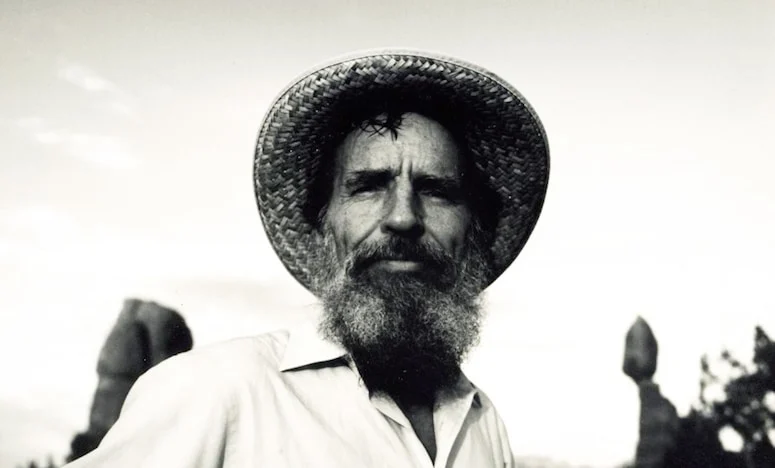
Anarchism is not a romantic fable but the hardheaded realization, based on five thousand years of experience, that we cannot entrust the management of our lives to kings, priests, politicians, generals, and county commissioners.
Edward Abbey, A Voice Crying in the Wilderness, (1989)
To write of Edward Abbey or to share his writing – as we do below -, invites criticism; the criticism that we are providing a forum to a writer, however influential and important, who openly expressed sexist and racist ideas.
And to this, we plead guilty, for Abbey did express such ideas. However, it would be equally important to try to see these ideas in a broader critical context, that is, to see them not just as a reflection of Abbey’s time, but as pointing to deeper issues around anarcho-primitivism, biocentrism and Malthusianism. To pursue these issues though would call for more than what we propose here.
We would suggest the same when addressing the antisemitism of two central figures in the history of anarchism: Pierre-Joseph Proudhon and Michael Bakunin.
It is not to diminish the significance of these intellectual and moral failings, but to understand them. And to understand them not only as a sign of their times, but as potentially symptomatic of more profound shortcomings in their thought and actions.
The persons from which we learn are not sacrosanct; they are as fragile and as susceptible to tragic error as we are.
For us then, Abbey’s work is also a tireless and serious – as well as eloquent and playful – defence of life lived on a “human” scale; on a scale that places us as equals with other species in the biosphere. Against this, stands property, wealth, power, unrestrained resource extraction for “economic growth”, the destruction of life.
All men are brothers, we like to say, half-wishing sometimes in secret it were not true. But perhaps it is true. And is the evolutionary line from protozoan to Spinoza any less certain? That also may be true. We are obliged, therefore, to spread the news, painful and bitter though it may be for some to hear, that all living things on earth are kindred.
Edward Abbey, Desert Solitaire (1968)
Theory of Anarchy
Edward Abbey
The bible says that the love of money is the root of all evil. But what is the essential meaning of money? Money attracts because it gives us the means to command the labor and service and finally the lives of others—human or otherwise. Money is power. I would expand the biblical aphorism, therefore, in this fashion: the root of all evil is the love of power.
And power attracts the worst and corrupts the best among men. It is no accident that police work, for example, appeals to those (if not only those) with the bully’s instinct. We know the type. Or put a captain’s bars on a perfectly ordinary, decent man, give him measure of arbitrary power over others and he tends to become–unless a man of unusual character–a martinet, another petty despot. Power corrupts; and as Lord Acton pointed out, absolute power corrupts absolutely. The problem of democracy is the problem of power–how to keep power decentralized, equally distributed, fairly shared. Anarchism means maximum democracy: the maximum possible dispersal of political power, economic power and force–military power. An anarchist society consists of a voluntary association of self-reliant, self-supporting, autonomous communities. The anarchist community would consist (as it did in preagricultural and preindustrial times) of a voluntary association of free and independent families, self-reliant and self-supporting but bound by kinship ties and a tradition of mutual aid.
Anarchy is democracy taken seriously, as in Switzerland, where issues of national importance are decided by direct vote of all citizens. Where each citizen, after his period of military training, takes his weapon home with him, to keep for life. Anarchy is democracy taken all the way, in every major sector of social life. For example, political democracy will not survive in a society which permits a few to accumulate economic power over the many. Or in a society which delegates police and military power to an elite corps of professionals. Sooner or later the professionals will take over. In my notion of an anarchist community every citizen–man or woman–would be armed, trained, capable when necessary of playing the part of policeman or soldier. A healthy community polices itself; a healthy society would do the same. Looters, thugs, criminals may appear anywhere, anytime, but in nature such types are mutants, anomalies, a minority; the members of a truly democratic, anarchistic community would not require outside assistance in dealing with them. Some might call this vigilante justice. I call it democratic justice. Better to have all citizens participate in the suppression and punishment of crime–and share in the moral responsibility–than turn the nasty job over to some quasi-criminal type (or hero) in a uniform with a tin badge on his shirt. Yes, we need heroes. We need heroines. But they should serve only as inspiration and examples, not as leaders.
No doubt the people of today’s Lebanon, for example, would settle gladly for an authoritarian government capable of suppressing the warring factions. But such an authoritarian government would provoke the return of the irrepressible human desire for freedom, leading in turn to rebellion, revolt and revolution. If Lebanon were not so badly overpopulated, the best solution there–as in South Africa–would be a partition of territory, a devolution into self-governing, independent regions and societies. This is the natural tendency of any population divided by religion, race or deep cultural differences, and it should not be restrained. The tendency runs counter, however, to the love of power, which is why centralized governments always attempt to crush separatist movements.
Government is a social machine whose function is coercion through monopoly of power. Any good Marxist understands this. Like a bulldozer, government serves the caprice of any man or group who succeeds in seizing the controls. The purpose of anarchism is to dismantle such institutions and to prevent their reconstruction. Ten thousand years of human history demonstrate that our freedoms cannot be entrusted to those ambitious few who are drawn to power; we must learn–again–to govern ourselves. Anarchism does not mean “no rule”; it means “no rulers”. Difficult, but not utopian, anarchy means and requires self-rule, self-discipline, probity, character.
At present, life in America is far better for the majority than in most (not all) other nations. But that fact does not excuse our failings. Judged by its resources, intentions and potential, the great American experiment appears to me a failure. We have not become the society of independent freeholders that Jefferson envisioned; nor have we evolved into a true democracy–government by the people–as Lincoln imagined.
Instead we see the realization of the scheme devised by Madison and Hamilton: a strong centralized state which promotes and protects the accumulation of private wealth on the part of the few, while reducing the majority to the role of dependent employees of state and industry. We are a nation of helots ruled by an oligarchy of techno-military-industrial administrators.
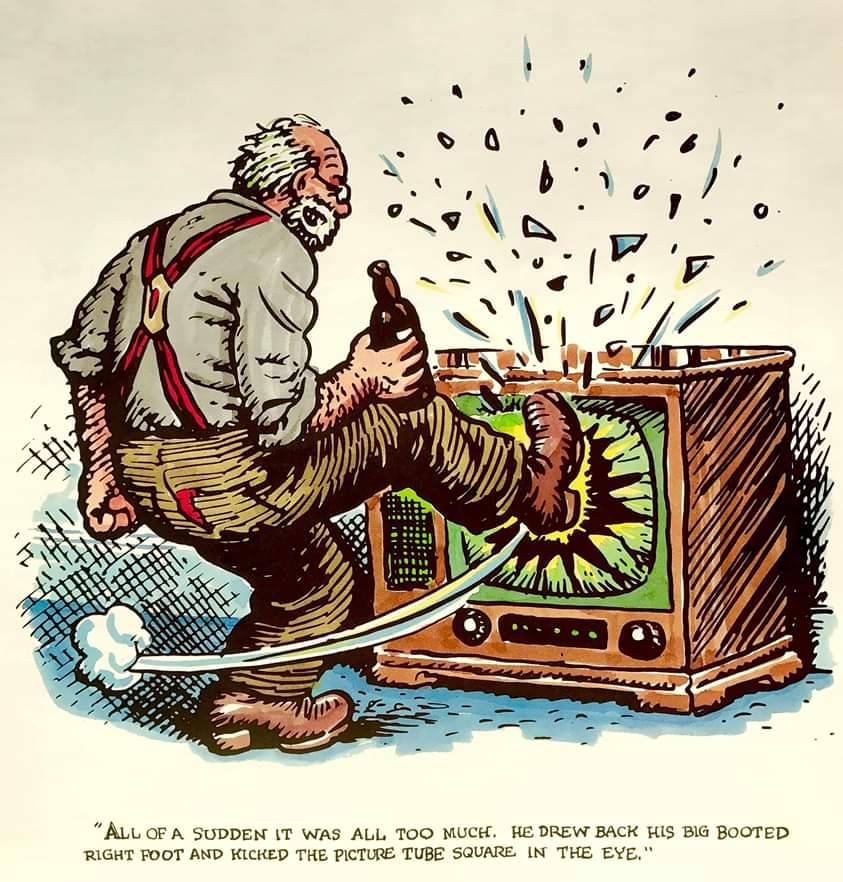
Never before in history have slaves been so well fed, thoroughly medicated, lavishly entertained–but we are slaves nonetheless. Our debased popular culture–television, rock music, home video, processed food, mechanical recreation, wallboard architecture–is the culture of slaves. Furthermore the whole grandiose structure is self-destructive: by enshrining the profit motive (power) as our guiding ideal, we encourage the intensive and accelerating consumption of land, air, water–the natural world–on which the structure depends for its continued existence. A house built on greed will not endure. Whether it’s called capitalism or socialism makes little difference; both of these oligarchic, militaristic, expansionist, acquisitive, industrializing and technocratic systems are driven by the same motives; both are self-destroying. Even without the accident of a nuclear war, I predict that the military-industrial state will disappear from the surface of the earth within a century. That belief is the basis of my inherent optimism, the source of my hope for the coming restoration of a higher civilization: scattered human populations modest in number that live by fishing, hunting, food gathering, small scale farming and ranching, that gather once a year in the ruins of abandoned cities for great festivals of moral, spiritual, artistic and intellectual renewal, a people for whom the wilderness is not a playground but their natural native home.
New dynasties will arise, new tyrants will appear–no doubt. But we must and we can resist such recurrent aberrations by keeping true to the earth and remaining loyal to our basic animal nature. Humans were free before the word freedom became necessary. Slavery is a cultural invention. Liberty is life: eros plus anarchos equals bios.
Long live democracy.
Two cheers for anarchy.
(Source: Edward Abbey, One Life at a Time, Please (1988), The Anarchist Library)
Suggested viewing: Edward Abbey: A Voice in the Wilderness (1993), Director: Eric Temple; Edward Abbey: Naturally Subversive, ARTE.tv Culture (Available at YouTube until 20/06/2026)
Pingback: Edward Abbey: Theory of Anarchy | Autonomies | word pond