“Anti-Sex” and the Real Sexual Politics of the Right

by Lee Shevek

(butchanarchy.medium.com/The Anarchist Library)

So common is the conceptualization of reactionaries as having “anti-sex” politics that it is hardly remarked upon. They hate sex workers, they hate it when women and other marginalized genders have a lot of sex, queer sex, or extramarital sex, they want to keep children from any form of sexual education, etc. What do these all have in common? Sex! So it really must be that the right-wing is anti-sex.

It is an easy conclusion, too easy, and so reductive as to render itself useless as a framework for political analysis. Reactionaries are not, nor have they ever been, anti-sex. Instead, what they really believe in is the politics of compulsory sexuality and patriarchal sexual control. Not only is reducing right wing ideology to being simply “anti-sex” inaccurate, it also positions those in opposition to reactionary politics as necessarily “pro-sex.” This frames sex as an inherent political “good” to be defended, when in reality what is in need of defending is bodily autonomy and consent.

Continue reading
Posted in Commentary | Tagged , , , , | Leave a comment

Remembering the Stonewall riots of 1969

… if there were only some way of contriving that a state or an army should be made up of lovers and their loves (compare Rep.), they would be the very best governors of their own city, abstaining from all dishonour, and emulating one another in honour; and when fighting at each other’s side, although a mere handful, they would overcome the world. For what lover would not choose rather to be seen by all mankind than by his beloved, either when abandoning his post or throwing away his arms? He would be ready to die a thousand deaths rather than endure this. Or who would desert his beloved or fail him in the hour of danger? The veriest coward would become an inspired hero, equal to the bravest, at such a time; Love would inspire him. That courage which, as Homer says, the god breathes into the souls of some heroes, Love of his own nature infuses into the lover.

Plato, The Symposium

“To remember” – to recall, to not forget, to bear in mind, to look back on, to cherish and to prize, to celebrate; it is this rich semantic field that we labour when we return to the past and extol riots and rebellions, not to confine the past to the past, but to give it life still, in the here and now. “All sensation is already memory”, wrote Henri Bergson. But should the memories die, our experience becomes the less for it.

To remember the Stonewall riots of 1969, we share two texts: a selection from the Queer Nation Manifesto of 1990 and (Verso Books blog) and a reflection on gender subversion from the CrimethInc. collective, and between them, a brief and immensely lucid discussion by Judith Butler on the politics of gender.

Continue reading
Posted in Commentary | Tagged , , , , , | Leave a comment

Ukraine: Voices of resistance

Step forward: we hear
That you are a good man.
You cannot be bought, but the lightning
Which strikes the house, also
Cannot be bought.
You hold to what you said.
But what did you say?
You are honest, you say your opinion.
Which opinion?
You are brave.
Against whom?
You are wise.
For whom?
You do not consider your personal advantages.
Whose advantages do you consider then?
You are a good friend.
Are you also a good friend of the good people?

Hear us then: we know.
You are our enemy. This is why we shall
Now put you in front of a wall. But in consideration of your merits and good qualities
We shall put you in front of a good wall and shoot you
With a good bullet from a good gun and bury you
With a good shovel in the good earth.

Bertolt Brecht, The Interrogation of the Good

The debate about the “correctness” of anarchists (and “leftists” more broadly) supporting and participating in the resistance to the Russian invasion of Ukraine – a debate that animates anarchists who are largely outside Ukraine – is overwhelmingly ideological, and perhaps nothing is more revealing of the “limits” of contemporary anarchism(s) than the fact that the controversy is largely ideological.

(This is not to say that all anarchists outside Ukraine fall into this category, as the many who have volunteered to resist the Russian invasion, in a variety of ways, both inside and outside Ukraine, testify to).   

“We” sit on the sidelines, judging, pontificating, excommunicating, with seemingly little awareness of the irrelevance of “our” judgements to what is at hand. “We” proclaim moral-political principles with a consoling, but also passive, “purity of heart”. “Anti-militarism”, “anti-nationalism”, “anti-statism”, are elevated to status of absolute principles, bloodless and empty; like flags hoisted high, they but flutter in the winds of events.

Events and acts however are not, and cannot be, distilled from principles. And as events and acts unfold over time, we can at best, in the effort to understand them, attempt to follow them as closely as possible.

And what concepts are thereby developed, created (e.g., “nation”, “nationalism”, “nation-state”, etc.), must be as sensitive and pliable as possible so as to render social-political reality legible.

With this aim, we share below a series of interviews conducted by members of the lundimatin collective with anti-authoritarian militants engaged, in different ways, in the Ukrainian resistance  (the subtitling is in French, but much of the interviews are conducted in English), followed by a fundamental anarchist reflection on “nationalism” by Fredy Perlman.

Continue reading
Posted in Commentary, Interview | Tagged , , , , , , | Leave a comment

Remembering the Gezi Park/Taksim Square uprising of 2013

They are the enemies of hope, my love, of flowing water and the fruitful tree, of life growing and unfolding. Death as branded them – Rotting teeth, decaying flesh – and soon they will be dead and gone for good. And yes, my love, freedom will walk around swinging its arms in its Sunday best – workers’ overalls! – yes, freedom in this beautiful country …

Nazim Hikmet

The creation of the modern Turkish nation-state is an expressive example of the violence of active and institutionalising nationalism. From the death-throws of the Ottoman Empire to the Turkish War of Independence after WWI, to the founding of the Republic in 1923, genocides, massacres and the ethnic cleansing of Armenians, Greeks, Assyrian and Syriac Christians, Alevis and Kurds (and accompanied by an almost permanent repression of political contestation and dissidence) would provide the socio-cultural, economic and political foundations of an ethnically and religiously homogeneous Turkish state. This was “nation” making on a grande scale, and the tragedies induced would be equal to the ambitions. And in this sense, there is no doubt some justification in describing Kemal Atatürk’s republican movement as revolutionary.

The Gezi Park/Taksim Square uprising of of 2013 involved, among other things – and herein lay its radicalness, above all perhaps in the Turkish context -, the scrambling or fracturing of identities, in a confluence generative of a new, yet to be defined, political community. The repression that the movement would suffer at the hands of the authorities is testimony to the political regime’s fear of something that began modestly enough as a protest to save a relatively small urban garden, but which then metamorphosised into an unheard of singular-plurality; a new “people” – short lived, yes, but a new people nonetheless. And the fear of this new “people” continues in the prohibition of any commemoration of the events of 2013 (Bianet 31/05/2023)

We return to these events with an article of 2014 from the former Roarmag magazine (with links to a collection of articles for a Roarmag symposium dedicated to the Gezi-Taksim uprising). This is preceded by news from Turkey surrounding the anniversary, and is followed by a background piece from the CrimethInc. collective entitled the “Roots of Turkish Fascism”. And we open with a video essay by Brandon Jourdan, the “Taksim Commune: Gezi Park And The Uprising In Turkey” and close with links to websites which offer collections of news and analyses of politics in Turkey.

Continue reading
Posted in Commentary, News blog | Tagged , | Leave a comment

War in Ukraine: An anarchist debate (continued)

As Wayne Price writes, the anarchist debate around the Russian invasion of Ukraine and the anarchist response to it continues; a debate that we continue to follow.

Retrieved from anarkismo.net/article/32774 (28/05/2023).

Anarchists Support Self-Determination for Ukraine: What Did Bakunin Say About National Self-Determination

This is a response to a challenge by Tridni Valka, a Czech anarchist group. They denounced an article of mine. I had defended anarchists who support the Ukrainian people in the Ukraine-Russian war. Bakunin and other anarchists have supported oppressed nations and national self-determination, as part of their revolutionary program, as I demonstrate.


Continue reading
Posted in Commentary | Tagged , , , , | Leave a comment

Kristin Ross: The commune as a form of life

Les Soulèvements de la Terre have succeeded in reorienting the gaze of city dwellers towards the countryside

In this in-depth interview, Kristin Ross discusses her recently published book, La forme-Commune, and the protests that have been erupting across France.

(This article was originally published by Mediapart on 23 April 2023; interview with Jade Lindgaard).


Mass disobedience against mega-reservoirs, ‘manif’actions’ against motorway projects, rallies against industrial farming: Les Soulèvements de la Terre are a form of contemporary Commune, according to historian Kristin Ross, who has just published an essay on ‘struggle as a way of inhabiting’.

Professor of comparative literature and a specialist on French history and culture, in her books Kristin Ross has revisited the history of the Commune. Rather than exploring a bygone past, she endeavours to bring into the present the revolutionary inventions and practices of the Communards and those who inherited from them. In her new book, La Forme-Commune. La lutte comme manière d’habiter, she goes in search of the way in which the commons are lived during moments when the state withdraws. She revisits some pioneering experiences of the late 20th century: the Nantes Commune of May 1968, the struggle against Narita airport in Japan in the 1970s, and the ZAD of Notre-Dame-des-Landes. She also talks about Les Soulèvements de la Terre, a movement she supports and with which she marched against the Sainte-Soline mega-reservoir in Deux-Sèvres on 25 March.

Continue reading
Posted in Interview | Tagged , , | Leave a comment

Gilles Dauvé: Peace is War

REUTERS/Serhii Nuzhnenko

Endeavouring to navigate the tempest of war in ukraine, with Gilles Dauvé …

(published at the PM Press website, The Anarchist Library, and originally in french at troploin).


“Small countries, such as Belgium, should be well-advised to rally to the side of the strong if they wished to retain their independence.” (Kaiser Wilhelm II to Belgian King Albert, November 1913)

“It may even be true that none of the States concerned ‘wanted’ war: it is certainly true that none of them wanted war if they could achieve their objects without. What is more important is that without exception they were pursuing policies of which war was the inevitable outcome.” (A.L. Morton, A People’s History of England, Lawrence & Wishart, 1979 [1938], chapter XVI, § 4, “The Road to Sarajevo”)

“A great war is inevitable in the first decades of the 21st century, but it will suppose a maturing economic crisis, massive overproduction, a sharp fall in profitability, exacerbated social conflicts and commercial antagonisms, resulting in a new division of the world.” (10 + 1 Questions sur la guerre au Kosovo, 1999)

“Don’t believe the propaganda, they’re lying to you here.” (Marina Ovsyannikova, interrupting a TV news programme on one of Russia’s main channels)

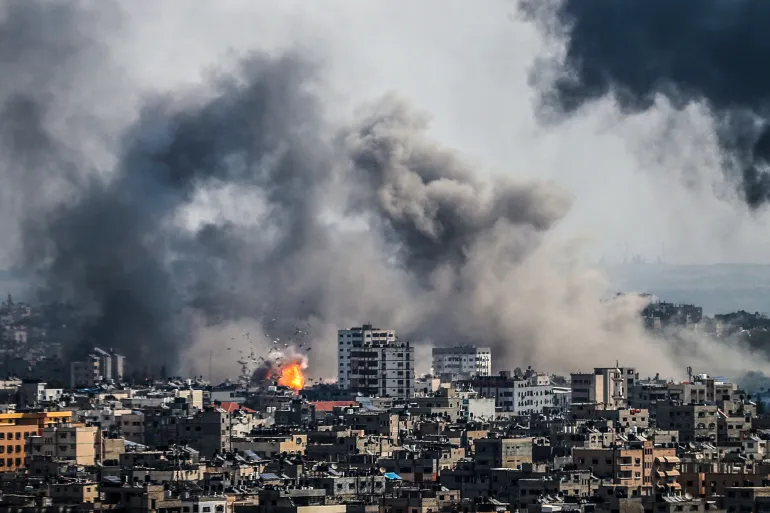
“War for peace”, “the cause of the weak against the strong”, “crimes against humanity perpetrated in the heart of Europe… a battle for civilisation”, “a genocide in progress in Ukraine”…

The first quote is from Droit du Peuple, a socialist paper, the second from the London Times, a bourgeois paper, both written in 1914; the third comes from the Prime Minister of France during the 1999 Kosovo war, and the last from the Ukrainian Prime Minister, March 9, 2022.

French media will never talk about the dictatorship in Chad (supported by France) as they do about the Belorussian dictatorship (supported by Russia). No more than Western media will invoke the millions of civilians killed by the French and American armies in the wars in Indochina in the same way as they comment on the massacre of Ukrainian civilians by the Russian army today. As for the 150,000 killed in Yemen, mainly by US, British and French weapons, they seldom make the BBC News at Ten.

Verbal inflation gnaws away at the meaning of words. In particular, genocide becomes a synonym for large scale massacre, whereas the word designates the extermination of a people as a people, which Hitler did to European Jews. But Stalin was not exterminating the Ukrainian people as such in the 1930’s, and Pol Pot was not trying to exterminate the Cambodian people. Nor is Putin now trying to annihilate the Ukrainian people.

Everything seems permitted in political mythology. Socialism having become openly national in 1914, the Nazis could claim the word: Nazi literally means “national socialist”. If ideologies are confused and confusing, if anyone can lay claim to socialism, to communism, to proletariat, even to revolution (such was the title of a book by the incumbent President of the French Republic), it is because up till now social movements have not made a radical break with the order of things.

It is when we are reduced to passivity by failed or deviated struggles that we receive information and images as spectators of a reality against which we cannot act. Only deeper struggles will give back meaning to words… revolution included.

Continue reading
Posted in Commentary | Tagged , , | 1 Comment

Sentence confirmed for the first arson attack on a Russian military enlistment office: 13 years imprisonment

From avtonom.org (21/05/2023) …

Kirill Butylin carried out the first known arson attack on a military enlistment office following the beginning of the full-scale Russian invasion of Ukraine. On 28th of  February 2022 the young man threw Molotov cocktails at the enlistment office in the town of Lukhovitsa in the Moscow region. Beforehand, he had painted the office gates with the colours of the Ukrainian flag and had written: “I won’t go to kill my brothers!” Kirill managed to upload the video of his action and his anti-war manifesto to the internet, but he was detained soon after.

On 15 March the Western Regional Military Court convicted Kirill Butylin for three offences: “vandalism” (Part 2, Article 214 of the Criminal Code of the Russian Federation), a “terrorist act” (Point “c”, Part 2, Article 205), and “terrorist propaganda” (Part 2, Article 205.2). Butylin was sentenced 13 years imprisonment: the first three years he should spend in a high-security prison, and the rest in a strict penal colony.

On 17 May the Military Appeal Court considered the defence’s appeal against the imposed sentence. As relayed on SOTAvision from the courtroom, during the hearing, Kirill himself spoke out against the war in Ukraine and also said that Russia was recognised as a terrorist state, and therefore he couldn’t care less about its laws. Butylin’s final words to the court ended with the phrase: “Glory to Ukraine!”

The Appeal Court left the original decision unchanged, and imposed the sentence in full.

It should be remembered that arson attacks on military enlistment offices do not constitute terrorism. Even under Russian laws. In this, and in other similarly politically motivated cases, the Russian authorities are attempting to justify their own criminal acts in Ukraine with the harsh sentences they are handing out to opponents of the war.

You can write to Kirill Butylin, although he has said it is currently hard for him to reply from the pre-trial detention centre where he is held. Nonetheless, he will be glad to receive letters and news.


Address for letters:

Russia, 107996, Moskva, ul. Matrosskaya Tishina, d. 18, SIZO-1,
Butylin Kirill Vladimirovich 2001 g.r.

It is possible to send via the electronic service “FSIN-pismo” (sending from anywhere in the world, subject to payment by a Russian card) and the volunteer resource “Rosuznik” (sending from anywhere in the world and the ability to remain anonymous).

How to write a letter to a prisoner if you are not in Russia?

Posted in News blog | Tagged , , | Leave a comment

In solidarity: The Libertarian Cultural Centre of Almada

For a new space for the Centro de Cultura Libertária/Libertarian Cultural Center!

The space that the Libertarian Cultural Centre (Almada, Portugal) has occupied and rented for almost 50 years is again in danger. The continued pressure exerted by gentrification and the real estate market that has evicted and forced out of city centres hits us once again. After years of threats and eviction processes that we resisted, in March 2024, the CCL will have to leave its historic headquarters in Cacilhas.

Over these nearly 50 years, several generations of anarchists have given voice to their hopes and struggles in this place through the most varied activities and means. Many collectives, publications, cultural and recreational activities have passed through here and inhabited it, which ‘carried a new world in their hearts’. The CCL is a unique space, with a history that insists on persisting, that resists and fights for its place in the minds and actions of those who dare to think and act without god or masters. The CCL also houses an archive of libertarian memory and a unique library in the Portuguese region. It is a space for the continuity of the anarchist struggle in this region, and that is why we intend to keep that flame burning for many more years.

We have therefore launched an appeal and a fundraising action with a view to acquiring a space for the Libertarian Culture Centre. A space that belongs to you and from which you cannot be evicted. A space that houses the CCL library, archive and bookshop. A space for the diffusion and protection of libertarian culture that has as its objective the recovery and protection of memory, the meeting and dynamism of anarchist ideas.

In the coming months, we will multiply fundraising initiatives and we call on all people and collectives, who are in solidarity with our goals, to contribute through donations, holding charitable events and publicising the campaign.


Saturday, May 20th at the CCL

18h-Presentation of the fundraising campaign for the Centre of Libertarian Culture

20h-Fundraising dinner


CCL bank account details for donations

Account Holder: LIBERTARIAN CULTURE CENTER
IBAN: PT50003501790000215493029
BIC: CGDIPTPL

CCL MBWAY for donations
913 125 532

(Centro de Cultura Libertária, 15/05/2023)

Posted in News blog | Tagged , | Leave a comment

Jacques Rancière: Emmanuel Macron’s republican order

While the French people strike, protest against, and decry Macron’s law raising the pension age, Macron remains unmoved, immune to the people’s demands. This, Jacques Rancière argues, inaugurates a new era for the French state: one of brutal police repression.

Jacques Rancière, 11 May 2023

(This piece was commissioned from Jacques Rancière by the French daily online AOC and published in its April 21st edition. It was translated by David Fernbach and published with the Verso Books’ Blog).

Continue reading
Posted in Commentary, News blog | Tagged , , , | Leave a comment