
In societies dominated by modern conditions of production, life is presented as an immense accumulation of spectacles. Everything that was directly lived has receded into a representation.
In a world that is really upside down, the true is a moment of the false.
When the real world is transformed into mere images, mere images become real beings — dynamic figments that provide the direct motivations for a hypnotic behavior.
Film by Guy Debord
Until now it has generally been assumed that film is a completely unsuitable medium for presenting revolutionary theory. This view was mistaken. The lack of any serious attempts in this direction stemmed simply from the historical lack of a modern revolutionary theory during virtually the entire period of the cinema’s development; as well as from the fact that the potentials of cinematic composition, despite so many declarations of intent on the part of filmmakers and so much feigned satisfaction on the part of a miserable public, have as yet scarcely been liberated.
Published in 1967, The Society of the Spectacle is a book whose theoretical insights have profoundly influenced the new current of social critique that is now more and more openly undermining the established world order. Its present cinematic adaptation, like the book itself, does not offer a few partial political critiques, but a total critique of the existing world; that is, a critique of all aspects of modern capitalism and of its general system of illusions.
The cinema is itself an integral part of this world, serving as one of the instruments of the separate representation that opposes and dominates the actual proletarianized society. As revolutionary critique engages in battle on the very terrain of the cinematic spectacle, it must thus turn the language of that medium against itself and give itself a form that is itself revolutionary.
The text and images of this film form a coherent whole; but the images are never mere direct illustrations of the text, much less demonstrations of it (cinematic “demonstrations” are in any case never reliable due to the unlimited possibilities of manipulation offered by the unilateral editing of the material). Instead, the film’s use of images (whether photographs, newsclips, or sequences from preexisting films) is governed by the principle of détournement, which the situationists have defined as “communication that includes a critique of itself.” The images through which spectacular society presents itself to itself are taken and turned against it: the spectacle’s means should be treated with insolence. As a result, in a certain sense this film, coming at the end of the cinema’s pseudo-autonomous history, incorporates all the memories of that history. It can thus be seen simultaneously as a historical film, a Western, a love story, a war movie, etc. Like the society it examines, it also presents a number of comical aspects. In talking about the spectacular order, and about the commodity domination that it serves, one is also talking about what this order hides: class struggles and strivings toward real historical life, revolution and its past failures, and the responsibilities for those failures. Nothing in this film is made to please the fashionable blockheads of leftist cinema: it has equal contempt for what they respect and for the style in which they express that respect. One who is capable of understanding and denouncing an entire socio-economic formation will denounce it even in a film. Objections to our “extremism” are meaningless, because current history is already on the verge of going beyond the most extreme possibilities imagined.
Theses that have never before been presented in the cinema will now appear there in a never before seen form, simply because for the first time a filmmaker has undertaken an uncompromising critique.
In the socio-economic context, the total freedom required to create such a film obviously means that the producer must renounce any claim to exert any preliminary control over the director, whether by insisting that he present a synopsis or by seeking to obtain from him any other sort of meaningless commitment. This has been recognized in the contract between the filmmaker and the producer, Simar Films: “It is understood that the filmmaker will carry out his work in complete freedom, without any control or supervision whatsoever, and without even being obliged to pay the slightest attention to any comment that the producer might make regarding any aspect of the content or of the cinematic form that the filmmaker feels appropriate for his film.”
Considering that this film itself expresses its meaning in a sufficiently comprehensible manner, the producer and the filmmaker believe that it is unnecessary to provide any further explanations.
Original Announcement of Guy Debord’s Film The Society of the Spectacle
[Source Bureau of Public Secrets: From a Simar Films brochure announcing the opening of Guy Debord’s film The Society of the Spectacle (Paris, April 1974). This translation is from Debord’s Complete Cinematic Works (AK Press, 2003, translated and edited by Ken Knabb), which includes the scripts of all six of Debord’s films along with illustrations, documents, and extensive annotations.]
The Society of the Spectacle
(film soundtrack)
In societies dominated by modern conditions of production, life is presented as an immense accumulation of spectacles. Everything that was directly lived has receded into a representation.
The images detached from every aspect of life merge into a common stream in which the unity of that life can no longer be recovered. Fragmented views of reality regroup themselves into a new unity as a separate pseudoworld that can only be looked at. The specialization of images of the world evolves into a world of autonomized images where even the deceivers are deceived. The spectacle is a concrete inversion of life, an autonomous movement of the nonliving.
The spectacle presents itself simultaneously as society itself, as a part of society, and as a means of unification. As a part of society, it is the focal point of all vision and all consciousness. But due to the very fact that this sector is separate, it is in reality the domain of delusion and false consciousness: the unification it achieves is nothing but an official language of universal separation.
The spectacle is not a collection of images; it is a social relation between people that is mediated by images.
Understood in its totality, the spectacle is both the result and the project of the dominant mode of production. It is not a mere decoration added to the real world. It is the very heart of this real society’s unreality. In all of its particular manifestations — news, propaganda, advertising, entertainment — the spectacle represents the dominant model of life. It is the omnipresent affirmation of the choices that have already been made in the sphere of production and in the consumption implied by that production.
Separation is itself an integral part of the unity of this world, of a global social practice split into reality and image. The social practice confronted by an autonomous spectacle is at the same time the real totality which contains that spectacle. But the split within this totality mutilates it to the point that the spectacle seems to be its goal.
In a world that is really upside down, the true is a moment of the false.
Considered in its own terms, the spectacle is an affirmation of appearances and an identification of all human social life with appearances. But a critique that grasps the spectacle’s essential character reveals it to be a visible negation of life — a negation that has taken on a visible form.
The spectacle presents itself as a vast inaccessible reality that can never be questioned. Its sole message is: “What appears is good; what is good appears.” The passive acceptance it demands is already effectively imposed by its monopoly of appearances, its manner of appearing without allowing any reply.
The spectacle is able to subject human beings to itself because the economy has already totally subjugated them. It is nothing other than the economy developing for itself. It is at once a faithful reflection of the production of things and a distorting objectification of the producers.
When the real world is transformed into mere images, mere images become real beings — dynamic figments that provide the direct motivations for a hypnotic behavior.
As long as necessity is socially dreamed, dreaming will remain a social necessity. The spectacle is the bad dream of a modern society in chains and ultimately expresses nothing more than its wish for sleep. The spectacle is the guardian of that sleep.
The fact that the practical power of modern society has detached itself from that society and established an independent realm in the spectacle can be explained only by the additional fact that that powerful practice continued to lack cohesion and had remained in contradiction with itself.
The root of the spectacle is that oldest of all social specializations, the specialization of power. The spectacle plays the specialized role of speaking in the name of all the other activities. It is hierarchical society’s ambassador to itself, delivering its official messages at a court where no one else is allowed to speak. The most modern aspect of the spectacle is thus also the most archaic.
The social separation reflected in the spectacle is inseparable from the modern state — the product of the social division of labor that is both the chief instrument of class rule and the concentrated expression of all social divisions.
In the spectacle, a part of the world represents itself to the world and is superior to it. The spectacle is simply the common language of this separation. Spectators are linked solely by their one-way relationship to the very center that keeps them isolated from each other. The spectacle thus reunites the separated, but it reunites them only in their separateness.
Workers do not produce themselves, they produce a power independent of themselves. The success of this production, the abundance it generates, is experienced by the producers as an abundance of dispossession. As their alienated products accumulate, all time and space become foreign to them. The forces that have escaped us display themselves to us in all their power.
Though separated from what they produce, people nevertheless produce every detail of their world with ever-increasing power. They thus also find themselves increasingly separated from that world. The closer their life comes to being their own creation, the more they are excluded from that life.
The spectacle is capital accumulated to the point that it becomes images.
Critical theory must communicate itself in its own language — the language of contradiction, which must be dialectical in both form and content. It must be an all-inclusive critique, and it must be grounded in history. It is not a “zero degree of writing,” but its reversal. It is not a negation of style, but the style of negation.
The very style of dialectical theory is a scandal and abomination to the prevailing standards of language and to the sensibilities molded by those standards, because while it makes concrete use of existing concepts it simultaneously recognizes their fluidity and their inevitable destruction.
This style, which includes a critique of itself, must express the domination of the present critique over its entire past. Dialectical theory’s mode of exposition reveals the negative spirit within it. “Truth is not like some finished product in which one can no longer find any trace of the tool that made it.” This theoretical consciousness of a movement whose traces must remain visible within it is manifested by the reversal of established relationships between concepts and by the détournement of all the achievements of earlier critical efforts.
Ideas improve. The meaning of words plays a role in that improvement. Plagiarism is necessary. Progress depends on it. It sticks close to an author’s phrasing, exploits his expressions, deletes a false idea, replaces it with the right one.
Détournement is the flexible language of anti-ideology. It appears in communication that knows it cannot claim to embody any definitive certainty. It is language that cannot and need not be confirmed by any previous or supracritical reference. On the contrary, its own internal coherence and practical effectiveness are what validate the previous kernels of truth it has brought back into play. Détournement has grounded its cause on nothing but its own truth as present critique.
The element of overt détournement in formulated theory refutes any notion that such theory is durably autonomous. By introducing into the theoretical domain the same type of violent subversion that disrupts and overthrows every existing order, détournement serves as a reminder that theory is nothing in itself, that it can realize itself only through historical action and through the historical correction that is its true allegiance.
The point is to actually participate in the community of dialogue and the game with time that up till now have merely been represented by poetic and artistic works.
When art becomes independent and paints its world in dazzling colors, a moment of life has grown old. Such a moment cannot be rejuvenated by dazzling colors, it can only be evoked in memory. The greatness of art only emerges at the dusk of life.
The official thought of the social organization of appearances is itself obscured by the generalized subcommunication that it has to defend. It cannot understand that conflict is at the origin of everything in its world. The specialists of spectacular power — a power that is absolute within its realm of one-way communication — are absolutely corrupted by their experience of contempt and by the success of that contempt, because they find their contempt confirmed by their awareness of how truly contemptible spectators really are.
In the spectacle’s basic practice of incorporating into itself all the fluid aspects of human activity so as to possess them in a congealed form, and of inverting living values into purely abstract values, we recognize our old enemy the commodity, which seems at first glance so trivial and obvious, yet which is actually so complex and full of metaphysical subtleties.
The fetishism of the commodity — the domination of society by “intangible as well as tangible things” — attains its ultimate fulfillment in the spectacle, where the real world is replaced by a selection of images which are projected above it, yet which at the same time succeed in making themselves regarded as the epitome of reality.
The world at once present and absent that the spectacle holds up to view is the world of the commodity dominating all living experience. The world of the commodity is thus shown for what it is, because its development is identical to people’s estrangement from each other and from everything they produce.
As long as the economy’s role as material basis of social life was neither noticed nor understood (remaining unknown precisely because it was so familiar), the commodity’s dominion over the economy was exerted in a covert manner. In societies where actual commodities were few and far between, money was the apparent master, serving as plenipotentiary representative of the greater power that remained unknown. With the Industrial Revolution’s manufactural division of labor and mass production for a global market, the commodity finally became fully visible as a power that was colonizing all social life. It was at that point that political economy established itself as the dominant science, and as the science of domination.
The spectacle is a permanent opium war designed to force people to equate goods with commodities and to equate satisfaction with a survival that expands according to its own laws. Consumable survival must constantly expand because it never ceases to include privation. If augmented survival never comes to a resolution, if there is no point where it might stop expanding, this is because it is itself stuck in the realm of privation. It may gild poverty, but it cannot transcend it.
Exchange value could arise only as a representative of use value, but the victory it eventually won with its own weapons created the conditions for its own autonomous power. By mobilizing all human use value and monopolizing its fulfillment, exchange value ultimately succeeded in controlling use. Usefulness has come to be seen purely in terms of exchange value, and is now completely at its mercy. Starting out like a condottiere in the service of use value, exchange value has ended up waging the war for its own sake.
Use value was formerly understood as an implicit aspect of exchange value. Now, however, within the upside-down world of the spectacle, it must be explicitly proclaimed, both because its actual reality has been eroded by the overdeveloped commodity economy and because it serves as a necessary pseudo-justification for a counterfeit life.
With the achievement of economic abundance, the concentrated result of social labor becomes visible, subjecting all reality to the appearances that are now that labor’s primary product. Capital is no longer the invisible center governing the production process; as it accumulates, it spreads to the ends of the earth in the form of tangible objects. The entire expanse of society is its portrait.
The spectacle, like modern society itself, is at once united and divided. The unity of each is based on violent divisions. But when this contradiction emerges in the spectacle, it is itself contradicted by a reversal of its meaning: the division it presents is unitary, while the unity it presents is divided.
Although the struggles between different powers for control of the same socio-economic system are officially presented as irreconcilable antagonisms, they actually reflect that system’s fundamental unity, both internationally and within each nation.
The sham spectacular struggles between rival forms of separate power are at the same time real, in that they express the system’s uneven and conflictual development and the more or less contradictory interests of the classes or sections of classes that accept that system and strive to carve out a role for themselves within it. By invoking any number of different criteria, the spectacle can present these oppositions as totally distinct social systems. But in reality they are nothing but particular sectors whose fundamental essence lies in the global system that contains them, the single movement that has turned the whole planet into its field of operation: capitalism.
Behind the glitter of spectacular distractions, a tendency toward banalization dominates modern society the world over, even where the more advanced forms of commodity consumption have seemingly multiplied the variety of roles and objects to choose from. The vestiges of religion and of the family (the latter is still the primary mechanism for transferring class power from one generation to the next), along with the vestiges of moral repression imposed by those two institutions, can be blended with ostentatious pretensions of worldly gratification precisely because life in this particular world remains repressive and offers nothing but pseudo-gratifications. Complacent acceptance of the status quo may also coexist with purely spectacular rebelliousness — dissatisfaction itself becomes a commodity as soon as the economy of abundance develops the capacity to process that particular raw material.
Stars — spectacular representations of living human beings — project this general banality into images of permitted roles. As specialists of apparent life, stars serve as superficial objects that people can identify with in order to compensate for the fragmented productive specializations that they actually live. The function of these celebrities is to act out various lifestyles or sociopolitical viewpoints in a full, totally free manner. They embody the inaccessible results of social labor by dramatizing the by-products of that labor which are magically projected above it as its ultimate goals: power and vacations — the decisionmaking and consumption that are at the beginning and the end of a process that is never questioned. On one hand, a governmental power may personalize itself as a pseudo-star; on the other, a star of consumption may campaign for recognition as a pseudo-power over life. But the activities of these stars are not really free, and they offer no real choices.
Spectacular oppositions conceal the unity of poverty. If different forms of the same alienation struggle against each other in the guise of irreconcilable antagonisms, this is because they are all based on real contradictions that are repressed. The spectacle exists in a concentrated form and a diffuse form, depending on the requirements of the particular stage of poverty it denies and supports. In both cases it is nothing more than an image of happy harmony surrounded by desolation and horror, at the calm center of misery.
The concentrated spectacle is primarily associated with bureaucratic capitalism, though it may also be imported as a technique for reinforcing state power in more backward mixed economies or even adopted by advanced capitalism during certain moments of crisis. Bureaucratic property is itself concentrated, in that the individual bureaucrat takes part in the ownership of the entire economy only through his membership in the community of bureaucrats. And since commodity production is less developed under bureaucratic capitalism, it too takes on a concentrated form: the commodity the bureaucracy appropriates is the total social labor, and what it sells back to the society is that society’s wholesale survival. The dictatorship of the bureaucratic economy cannot leave the exploited masses any significant margin of choice because it has had to make all the choices itself, and any choice made independently of it, whether regarding food or music or anything else, thus amounts to a declaration of war against it.
The diffuse spectacle is associated with commodity abundance, with the undisturbed development of modern capitalism. Here each individual commodity is justified in the name of the grandeur of the total commodity production, of which the spectacle is a laudatory catalog. Irreconcilable claims jockey for position on the stage of the affluent economy’s unified spectacle, and different star commodities simultaneously promote conflicting social policies. The automobile spectacle, for example, strives for a perfect traffic flow entailing the destruction of old urban districts, while the city spectacle needs to preserve those districts as tourist attractions. The already dubious satisfaction alleged to be obtained from the consumption of the whole is thus constantly being disappointed because the actual consumer can directly access only a succession of fragments of this commodity heaven, fragments which invariably lack the quality attributed to the whole.
Each individual commodity fights for itself. It avoids acknowledging the others and strives to impose itself everywhere as if it were the only one in existence. The spectacle is the epic poem of this struggle, a struggle that no fall of Troy can bring to an end. The spectacle does not sing of men and their arms, but of commodities and their passions. In this blind struggle each commodity, by pursuing its own passion, unconsciously generates something beyond itself: the globalization of the commodity (which also amounts to the commodification of the globe). Thus, as a result of the cunning of the commodity, while each particular manifestation of the commodity eventually falls in battle, the general commodity-form continues onward toward its absolute realization.
The image of blissful social unification through consumption merely postpones the consumer’s awareness of the actual divisions until his next disillusionment with some particular commodity. Each new product is ceremoniously acclaimed as a unique creation offering a dramatic shortcut to the promised land of total consummation. But as with the fashionable adoption of seemingly aristocratic first names which end up being given to virtually all individuals of the same age, the objects that promise uniqueness can be offered up for mass consumption only if they have been mass-produced. The prestigiousness of mediocre objects of this kind is solely due to the fact that they have been placed, however briefly, at the center of social life and hailed as a revelation of the unfathomable purposes of production. But the object that was prestigious in the spectacle becomes mundane as soon as it is taken home by its consumer — and by all its other consumers. Too late, it reveals its essential poverty, a poverty that inevitably reflects the poverty of its production. Meanwhile, some other object is already replacing it as representative of the system and demanding its own moment of acclaim.
The fraudulence of the satisfactions offered by the system is exposed by this continual replacement of products and of general conditions of production. In both the diffuse and the concentrated spectacle, entities that have brazenly asserted their definitive perfection nevertheless end up changing, and only the system endures. Stalin, like any other outmoded commodity, is denounced by the very forces that originally promoted him. Each new lie of the advertising industry is an admission of its previous lie. And with each downfall of a personification of totalitarian power, the illusory community that had unanimously approved him is exposed as a mere conglomeration of loners without illusions.
The things the spectacle presents as eternal are based on change, and must change as their foundations change. The spectacle is totally dogmatic, yet it is incapable of arriving at any really solid dogma. Nothing stands still for it. This instability is the spectacle’s natural condition, but it is completely contrary to its inclination.
The unreal unity proclaimed by the spectacle masks the class division underlying the real unity of the capitalist mode of production. What obliges the producers to participate in the construction of the world is also what excludes them from it. What brings people into relation with each other by liberating them from their local and national limitations is also what keeps them apart. What requires increased rationality is also what nourishes the irrationality of hierarchical exploitation and repression. What produces society’s abstract power also produces its concrete lack of freedom.
Capitalist production has unified space, breaking down the boundaries between one society and the next. This unification is at the same time an extensive and intensive process of banalization. Just as the accumulation of commodities mass-produced for the abstract space of the market shattered all regional and legal barriers and all the Medieval guild restrictions that maintained the quality of craft production, it also undermined the autonomy and quality of places. This homogenizing power is the heavy artillery that has battered down all the walls of China.
The free space of commodities is constantly being altered and redesigned in order to become ever more identical to itself, to get as close as possible to motionless monotony.
While eliminating geographical distance, this society produces a new internal distance in the form of spectacular separation.
Tourism — human circulation packaged for consumption, a by-product of the circulation of commodities — is the opportunity to go and see what has been banalized. The economic organization of travel to different places already guarantees their equivalence. The modernization that has eliminated the time involved in travel has simultaneously eliminated any real space from it.
The society that reshapes its entire surroundings has evolved its own special technique for molding its own territory, which constitutes the material underpinning for all the facets of this project. Urbanism — “city planning” — is capitalism’s method for taking over the natural and human environment. Following its logical development toward total domination, capitalism now can and must refashion the totality of space into its own particular decor.
While all the technical forces of capitalism contribute toward various forms of separation, urbanism provides the material foundation for those forces and prepares the ground for their deployment. It is the very technology of separation.
In all previous periods architectural innovations were designed exclusively for the ruling classes. Now for the first time a new architecture has been specifically designed for the poor. The aesthetic poverty and vast proliferation of this new experience in habitation stem from its mass character, which character in turn stems both from its function and from the modern conditions of construction. The obvious core of these conditions is the authoritarian decisionmaking which abstractly converts the environment into an environment of abstraction. Urbanism is one of the most glaring expressions of the contradiction between the growth of society’s material powers and the continued lack of progress toward any conscious control of those powers.
The history that threatens this twilight world could potentially subject space to a directly experienced time. Proletarian revolution is this critique of human geography through which individuals and communities could create places and events commensurate with the appropriation no longer just of their work, but of their entire history. The ever-changing playing field of this new world and the freely chosen variations in the rules of the game will regenerate a diversity of local scenes that are independent without being insular. And this diversity will in turn revive the possibility of authentic journeys — journeys within an authentic life that is itself understood as a journey containing its whole meaning within itself.
The time of production — commodified time — is an infinite accumulation of equivalent intervals. It is irreversible time made abstract, in which each segment need only demonstrate by the clock its purely quantitative equality with all the others. It has no reality apart from its exchangeability.
This general time of human nondevelopment also has a complementary aspect — a consumable form of time based on the present mode of production and presenting itself in everyday life as a pseudocyclical time.
Pseudocyclical time is associated with the consumption of modern economic survival — the augmented survival in which everyday experience is cut off from decisionmaking and subjected no longer to the natural order, but to the pseudo-nature created by alienated labor. It is thus quite natural that it echoes the old cyclical rhythm that governed survival in preindustrial societies, incorporating the natural vestiges of cyclical time while generating new variants: day and night, work and weekend, periodic vacations.
Consumable pseudocyclical time is spectacular time, both in the narrow sense as time spent consuming images and in the broader sense as image of the consumption of time. The time spent consuming images (images which in turn serve to publicize all the other commodities) is both the particular terrain where the spectacle’s mechanisms are most fully implemented and the general goal that those mechanisms present, the focus and epitome of all particular consumptions. As for the social image of the consumption of time, it is exclusively dominated by leisure time and vacations — moments portrayed, like all spectacular commodities, at a distance and as desirable by definition. These commodified moments are explicitly presented as moments of real life whose cyclical return we are supposed to look forward to. But all that is really happening is that the spectacle is displaying and reproducing itself at a higher level of intensity. What is presented as true life turns out to be merely a more truly spectacular life.
While the consumption of cyclical time in ancient societies was consistent with the real labor of those societies, the pseudocyclical consumption of developed economies contradicts the abstract irreversible time implicit in their system of production. Cyclical time was the really lived time of unchanging illusions. Spectacular time is the illusorily lived time of a constantly changing reality.
The production process’s constant innovations are not echoed in consumption, which presents nothing but an expanded repetition of the past. Because dead labor continues to dominate living labor, in spectacular time the past continues to dominate the present.
The lack of general historical life also means that individual life as yet has no history. The pseudo-events that vie for attention in spectacular dramatizations have not been lived by those who are informed about them; and in any case they are soon forgotten due to their increasingly frenetic replacement at every pulsation of the spectacular machinery. Conversely, what is really lived has no relation to the society’s official version of irreversible time, and conflicts with the pseudocyclical rhythm of that time’s consumable by-products. This individual experience of a disconnected everyday life remains without language, without concepts, and without critical access to its own past, which has nowhere been recorded. Uncommunicated, misunderstood and forgotten, it is smothered by the spectacle’s false memory of the unmemorable.
The spectacle, considered as the reigning society’s method for paralyzing history and memory and for suppressing any history based on historical time, represents a false consciousness of time.
Behind the fashions that come and go on the frivolous surface of the spectacle of pseudocyclical time, the grand style of an era can always be found in what is governed by the secret yet obvious necessity for revolution.
Examining history amounts to examining the nature of power. Greece was the moment when power and changes in power were first debated and understood. It was a democracy of the masters of society — a total contrast to the despotic state, where power settles accounts only with itself, within the impenetrable obscurity of its inner sanctum, by means of palace revolutions, which are beyond the pale of discussion whether they fail or succeed.
The dry, unexplained chronology that a deified authority offered to its subjects, who were supposed to accept it as the earthly fulfillment of mythic commandments, was destined to be transcended and transformed into conscious history. But for this to happen, sizable groups of people had to have experienced real participation in history. Out of this practical communication between those who have recognized each other as possessors of a unique present, who have experienced a qualitative richness of events in their own activity and who are at home in their own era, arises the general language of historical communication. Those for whom irreversible time truly exists discover in it both the memorable and the threat of oblivion: “Herodotus of Halicarnassus here presents the results of his researches, so that time will not abolish the deeds of men. . . .”
The victory of the bourgeoisie is the victory of a profoundly historical time, because it is the time corresponding to an economic production that continuously transforms society from top to bottom. So long as agrarian production remains the predominant form of labor, the cyclical time that remains at the base of society reinforces the joint forces of tradition, which tend to hold back any historical movement. But the irreversible time of the bourgeois economy eradicates those vestiges throughout the world. History, which until then had seemed to involve only the actions of individual members of the ruling class, and which had thus been recorded as a mere chronology of events, is now understood as a general movement — a relentless movement that crushes any individuals in its path. By discovering its basis in political economy, history becomes aware of what had previously been unconscious; but this basis remains unconscious because it cannot be brought to light. This blind prehistory, this new fate that no one controls, is the only thing that the commodity economy has democratized.
The bourgeoisie has thus made irreversible historical time known and has imposed it on society, but it has prevented society from using it. “Once there was history, but not any more,” because the class of owners of the economy, which is inextricably tied to economic history, must repress every other irreversible use of time because it is directly threatened by them all. The ruling class, made up of specialists in the possession of things who are themselves therefore possessed by things, is forced to link its fate with the preservation of this reified history, that is, with the preservation of a new immobility within history. Meanwhile the worker at the base of society is for the first time not materially estranged from history, because the irreversible movement is now generated from that base. By demanding to live the historical time that it produces, the proletariat discovers the simple, unforgettable core of its revolutionary project; and each previously defeated attempt to carry out this project represents a possible point of departure for a new historical life.
With the development of capitalism, irreversible time has become globally unified. Universal history becomes a reality because the entire world is brought under the sway of this time’s development. But this history that is everywhere simultaneously the same is as yet nothing but an intrahistorical rejection of history. What appears the world over as the same day is merely the time of economic production, time cut up into equal abstract fragments. This unified irreversible time belongs to the global market, and thus also to the global spectacle.
The irreversible time of production is first of all the measure of commodities. The time officially recognized throughout the world as the general time of society actually only reflects the specialized interests that constitute it, and thus is merely one particular type of time.
The class struggles of the long era of revolutions initiated by the rise of the bourgeoisie have developed in tandem with the dialectical “thought of history” — the thought which is no longer content to seek the meaning of what exists, but which strives to comprehend the dissolution of what exists, and in the process breaks down every separation.
This historical thought is still a consciousness that always arrives too late, a consciousness that can only formulate retrospective justifications of what has already happened. It has thus gone beyond separation only in thought. Hegel’s paradoxical stance — his subordination of the meaning of all reality to its historical culmination while at the same time proclaiming that his own system represents that culmination — flows from the simple fact that this thinker of the bourgeois revolutions of the seventeenth and eighteenth centuries sought in his philosophy only a reconciliation with the results of those revolutions.
When the proletariat demonstrates through its own actions that this historical thought has not been forgotten, its refutation of that thought’s conclusion is at the same time a confirmation of its method.
The weakness of Marx’s theory is naturally linked to the weakness of the revolutionary struggle of the proletariat of his time. The German working class failed to inaugurate a permanent revolution in 1848; the Paris Commune was defeated in isolation. As a result, revolutionary theory could not yet be fully realized.
The theoretical shortcomings of the scientific defense of proletarian revolution (both in its content and in its form of exposition) all ultimately result from identifying the proletariat with the bourgeoisie with respect to the revolutionary seizure of power.
The only two classes that really correspond to Marx’s theory, the two pure classes that the entire analysis of Capital brings to the fore, are the bourgeoisie and the proletariat. These are also the only two revolutionary classes in history, but operating under very different conditions. The bourgeois revolution is done. The proletarian revolution is a yet-unrealized project, born on the foundation of the earlier revolution but differing from it qualitatively. If one overlooks the originality of the historical role of the bourgeoisie, one also tends to overlook the specific originality of the proletarian project, which can achieve nothing unless it carries its own banners and recognizes the “immensity of its own tasks.” The bourgeoisie came to power because it was the class of the developing economy. The proletariat cannot create its own new form of power except by becoming the class of consciousness. The growth of productive forces will not in itself guarantee the emergence of such a power — not even indirectly by way of the increasing dispossession which that growth entails. Nor can a Jacobin-style seizure of the state be a means to this end. The proletariat cannot make use of any ideology designed to disguise its partial goals as general goals, because the proletariat cannot preserve any partial reality that is truly its own.
This ideologically alienated theory was then no longer able to recognize the practical verifications of the unitary historical thought it had betrayed when such verifications emerged in spontaneous working-class struggles; instead, it contributed toward repressing every manifestation and memory of them. Yet those historical forms that took shape in struggle were precisely the practical terrain that was needed in order to validate the theory. They were what the theory needed, yet that need had not been formulated theoretically. The soviet, for example, was not a theoretical discovery. And the most advanced theoretical truth of the International Workingmen’s Association was its own existence in practice.
The historical moment when Bolshevism triumphed for itself in Russia and social democracy fought victoriously for the old world marks the inauguration of the state of affairs that is at the heart of the modern spectacle’s domination: the representation of the working class has become an enemy of the working class.
The Stalin era revealed the bureaucracy’s ultimate function: continuing the reign of the economy by preserving the essence of market society: commodified labor. It also demonstrated the independence of the economy: the economy has come to dominate society so completely that it has proved capable of recreating the class domination it needs for its own continued operation; that is, the bourgeoisie has created an independent power that is capable of maintaining itself even without a bourgeoisie. The totalitarian bureaucracy was not “the last owning class in history” in Bruno Rizzi’s sense; it was merely a substitute ruling class for the commodity economy. A tottering capitalist property system was replaced by a cruder version of itself — simplified, less diversified, and concentrated as the collective property of the bureaucratic class. This underdeveloped type of ruling class is also a reflection of economic underdevelopment, and it has no agenda beyond overcoming this underdevelopment in certain regions of the world. The hierarchical and statist framework for this crude remake of the capitalist ruling class was provided by the working-class party, which was itself modeled on the hierarchical separations of bourgeois organizations.
The ruling totalitarian-ideological class is the ruler of a world turned upside down. The more powerful the class, the more it claims not to exist, and its power is employed above all to enforce this claim. It is modest only on this one point, however, because this officially nonexistent bureaucracy simultaneously attributes the crowning achievements of history to its own infallible leadership. Though its existence is everywhere in evidence, the bureaucracy must be invisible as a class. As a result, all social life becomes insane. The social organization of total falsehood stems from this fundamental contradiction.
Stalinism was also a reign of terror within the bureaucratic class. The terrorism on which this class’s power was based inevitably came to strike the class itself, because this class had no juridical legitimacy, no legally recognized status as an owning class that could be extended to each of its members. Its ownership had to be masked because it was based on false consciousness. This false consciousness can maintain its total power only by means of a total reign of terror in which all real motives are ultimately obscured. The members of the ruling bureaucratic class have the right of ownership over society only collectively, as participants in a fundamental lie: they have to play the role of the proletariat governing a socialist society; they have to be actors faithful to a script of ideological betrayal. Yet they cannot actually participate in this counterfeit entity unless their legitimacy is validated. No bureaucrat can individually assert his right to power, because to prove himself a socialist proletarian he would have to demonstrate that he was the opposite of a bureaucrat, while to prove himself a bureaucrat is impossible because the bureaucracy’s official line is that there is no bureaucracy. Each bureaucrat is thus totally dependent on the central seal of legitimacy provided by the ruling ideology, which validates the collective participation in its “socialist regime” of all the bureaucrats it does not liquidate. Although the bureaucrats are collectively empowered to make all social decisions, the cohesion of their own class can be ensured only by the concentration of their terrorist power in a single person. In this person resides the only practical truth of the ruling lie: the power to determine an unchallengeable boundary line which is nevertheless constantly being adjusted. Stalin decides without appeal who is and who is not a member of the ruling bureaucracy — who should be considered a “proletarian in power” and who branded “a traitor in the pay of Wall Street and the Mikado.” The atomized bureaucrats can find their collective legitimacy only in the person of Stalin — the lord of the world who thus comes to see himself as the absolute person, for whom no superior spirit exists. “The lord of the world recognizes his own nature — omnipresent power — through the destructive violence he exerts against the contrastingly powerless selfhood of his subjects.” He is the power that defines the terrain of domination, and he is also “the power that ravages that terrain.”
When the proletariat discovers that its own externalized power contributes to the constant reinforcement of capitalist society, no longer only in the form of its alienated labor but also in the form of the trade unions, political parties, and state powers that it had created in the effort to liberate itself, it also discovers through concrete historical experience that it is the class that must totally oppose all rigidified externalizations and all specializations of power. It bears a revolution that cannot leave anything outside itself, a revolution embodying the permanent domination of the present over the past and a total critique of separation; and it must discover the appropriate forms of action to carry out this revolution. No quantitative amelioration of its impoverishment, no illusory participation in a hierarchized system, can provide a lasting cure for its dissatisfaction, because the proletariat cannot truly recognize itself in any particular wrong it has suffered, nor in the righting of any particular wrong. It cannot recognize itself even in the righting of many such wrongs, but only in the righting of the absolute wrong of being excluded from any real life.
New signs of negation are proliferating in the most economically advanced countries. Although these signs are misunderstood and falsified by the spectacle, they are sufficient proof that a new period has begun. We have already seen the failure of the first proletarian assault against capitalism; now we are witnessing the failure of capitalist abundance. On one hand, anti-union struggles of Western workers are being repressed first of all by the unions; on the other, rebellious youth are raising new protests, protests which are still vague and confused but which clearly imply a rejection of art, of everyday life, and of the old specialized politics. These are two sides of a new spontaneous struggle that is at first taking on a criminal appearance. They foreshadow a second proletarian assault against class society.
As capitalism’s ever-intensifying imposition of alienation at all levels makes it increasingly hard for workers to recognize and name their own impoverishment, putting them in the position of having to reject that impoverishment in its totality or not at all, revolutionary organization has had to learn that it can no longer combat alienation by means of alienated forms of struggle.
The development of class society to the stage of the spectacular organization of nonlife is thus leading the revolutionary project to become visibly what it has always been in essence.
Revolutionary theory is now the enemy of all revolutionary ideology, and it knows it.
[Source Bureau of Public Secrets: New translation by Ken Knabb of the main voice-over soundtrack of Guy Debord’s fourth film, La Société du Spectacle (1973). The text of the soundtrack consists of excerpts from Debord’s book of the same name. The complete script of this film, with illustrations, detailed descriptions of the images, and extensive annotations, is included in Debord’s Complete Cinematic Works (AK Press, 2003).]
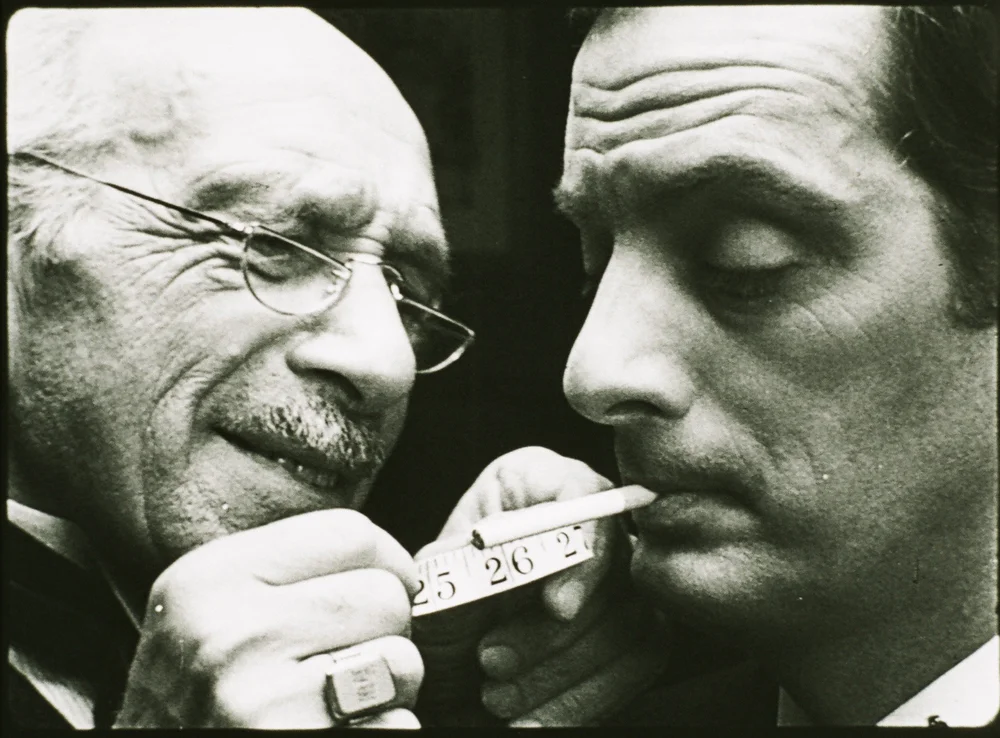
Refutation of All the Judgments, Pro or Con, Thus Far Rendered on the Film“The Society of the Spectacle” (1975)
Spectators do not find what they desire; they desire what they find.
Refutation of All the Judgments, Pro or Con, Thus Far Rendered on the Film “The Society of the Spectacle”
(film soundtrack)
The spectacular organization of the present class society has led to two widely evident consequences. The first is a general deterioration in the quality of both products and rationales. The second is the fact that those who claim to find happiness in this society are obliged to maintain a careful distance from the things they pretend to like — because they invariably lack the intellectual or other means that would enable them to attain a direct in-depth knowledge of them, or to incorporate them into a coherent practice, or to develop any genuine taste regarding them.
These consequences, which are already so evident when it is a matter of housing conditions, cultural consumption, sexual liberation, or the quality of wine, are naturally all the more pronounced when we come to revolutionary theory and to the formidable language with which that theory denounces our terminally ill world.
It is thus hardly surprising that this combination of naïve falsification and ignorant approval, so characteristic of the modern spectacle, is reflected in the diversely uncomprehending responses to the film entitled The Society of the Spectacle.
This particular incomprehension is inevitable, and will continue to be so for some time to come. The spectacle is an infirmity more than a conspiracy. Those who write for the newspapers and magazines of our time are not concealing their intelligence: what we see is all they’ve got. What could they possibly say of any pertinence about a film which attacks their habits and ideas en bloc, and which does so at a time when they themselves are beginning to sense the collapse of every one of them? The stupidity of their reactions stems from the breakdown of their world.
Those who claim to like my film have liked too many other things to be capable of liking it; and those who say they don’t like it have also accepted too many other things for their judgment to have the slightest significance.
The poverty of their discourse reflects the poverty of their lives. You need only look at their surroundings and their occupations, their commodities and their ceremonies, which are on view everywhere. You need only listen to those imbecilic voices giving you contemptuous hourly updates on the current state of your alienation.
Spectators do not find what they desire; they desire what they find.
The spectacle does not debase people to the point of making them love it, but many are paid to pretend that they do. Now that such people can no longer get away with assuring us that this society is completely satisfactory, they hasten to declare themselves dissatisfied with any critique of it. These dissatisfied people all feel they deserved something better. But do they really imagine that anyone is trying to win them over? Do they really believe there is still time for them to rally to such a critique, supposing that they suddenly became convinced of its truth? Do these ill-lodged inhabitants of the land of approbation suppose that they can continue to speak without it being noticed where they’re speaking from?
In a freer and more truthful future people will look back in amazement at the idea that pen-pushers hired by the system of spectacular lies could imagine themselves qualified to offer their smug opinions on the merits and defects of a film that is a negation of the spectacle — as if the dissolution of this system was a matter of opinion. Their system is now being attacked in reality and it is defending itself by force. Their counterfeit arguments are no longer accepted, which is why so many of these professional agents of falsification are facing the prospect of unemployment.
The most stubborn of these endangered liars still pretend to wonder whether the society of the spectacle actually exists or whether it is perhaps just an imaginary notion that I thought up. But since the woods of history have for the last few years begun to march against their castle of false cards and are continuing at this very moment to close ranks and move in for the kill, most of these commentators are now fawningly praising the excellence of my book, as if they were capable of reading it and as if they had already welcomed its publication in 1967 with the same respect. They generally complain, however, that I have abused their indulgence by bringing the book to the screen. The blow is all the more painful because they had never dreamed that such an extravagance was possible. Their anger confirms the fact that the appearance of such a critique in a film upsets them even more than in a book. Here, as elsewhere, they are being forced into a defensive struggle, on a second front.
Many complain that the film is hard to understand. Some say that the images prevent them from understanding the words; others that the words distract from the images. By telling us that they find the film exhausting, and by proudly elevating their individual fatigue into a general criterion of communication, these critics are trying to give the impression that they have no problem understanding — or even perhaps largely agreeing with — the same theory when its exposition is limited to a book. They are attempting to disguise as a mere disagreement between different conceptions of cinema what is actually a conflict between different conceptions of society, and an open war within the existing society.
But if my film is so far beyond them, how can we suppose they are any more capable of understanding everything else that falls to their lot in a society that has so thoroughly conditioned them to mental exhaustion? How could such easily fatigued people find themselves in any better position, amid the incessant cacophony of so many simultaneous commercial and political messages, to see through the crude sophisms designed to make them accept their work and their leisure, or the wisdom of President Giscard, or the taste of food additives? The difficulty is not in my film, but in their servile minds.
No film is more difficult than its era. For example, there are people who understand, and others who do not understand, that when the French were presented with a new ministry called the “Quality-of-Life Department,” this was nothing but an age-old ruling-class ploy, designed, as Machiavelli put it, “to allow them to retain at least the name of what they have already lost.” There are people who understand, and others who do not understand, that the class struggle in Portugal has from the very beginning been dominated by a direct confrontation between the revolutionary workers organized in autonomous assemblies and the Stalinist bureaucracy allied with a few defeated generals. Those who understand such things will understand my film; and I don’t make films for those who don’t understand such things, or who make it their business to prevent others from understanding.
Though all the reviews come from the same zone of spectacle-generated pollution, they are as apparently varied as any other present-day commodities. Several of the reviewers claimed that my film filled them with enthusiasm, but none were able to explain why. Whenever I find myself approved of by those who should be my enemies, I ask myself what error they have made in their reasoning. It’s usually easy to find. Faced with an unusual number of innovations and an insolence that is utterly beyond their comprehension, these avant-garde consumers vainly try to rationalize a ground for approval by attributing these fascinating eccentricities to a nonexistent individual lyricism.
One of them, for example, admires my film for its supposed “lyricism of rage”; another discovered by watching it that the passing of a historical epoch produces a certain melancholy; others, who greatly overestimate the refinements of present-day social life, attribute to me a certain dandyism. These are nothing but different forms of the perennial tactic of all ruling apologetics: Deny what exists and explain what does not. A critical theory that accompanies the dissolution of a society does not concern itself with expressing rage, much less with presenting mere images of rage. It seeks to understand, to describe, and to precipitate a movement that is developing before our very eyes. As for those who present us with their own pseudo-rage as a sort of newly fashionable artistic content, it is obvious that this is merely their way of compensating for the spinelessness, compromises, and humiliations of their actual life — which is why spectators so readily identify with them.
Political reactionaries are naturally even more hostile to my film. Thus an apprentice bureaucrat claims to admire my audacity in “making a political film not by telling a story, but by directly filming a theory.” Unfortunately, he does not like my theory. He senses that despite my apparent “uncompromising leftism,” I am actually shifting toward the right because I systematically attack “the men of the United Left.” The cretin’s mouth is full of such inflated terminology. What union? What Left? What men?
The “United Left” is, of course, nothing other than the current alliance of the Stalinists with other enemies of the proletariat. Each of the partners knows the others well. They clumsily plot against each other and stridently denounce each other every week. But they have now come together in an effort to sabotage the revolutionary initiatives of the workers, in order — as they themselves admit — to maintain at least the essentials of capitalism if they can’t save all the details. They are the same type of bureaucrats as those who are repressing workers’ “counterrevolutionary strikes” in Portugal, just as they did in Budapest not so long ago; the same as those who aspire to take part in a “Historic Compromise” in Italy; the same as those who called themselves “Popular Front governments” when they broke the French strikes of 1936 and sabotaged the Spanish revolution.
The United Left is only a minor defensive hoax of spectacular society, a temporary expedient that the system only occasionally needs to resort to. I only evoked it in passing in my film, though I naturally attacked it with all the contempt it deserves — just as we have since attacked it in Portugal on a broader and more beautiful terrain.
A journalist close to that same Left, who has since achieved a certain notoriety by invoking “freedom of the press” in order to defend his publication of an implausibly faked document, exhibited a similarly clumsy falsification by insinuating that I failed to attack the bureaucrats of Beijing as sharply as the other ruling classes. He also regrets that a mind of my quality has limited its expression to a “cinema ghetto” where the masses will have little chance to see it. This argument does not convince me. I prefer to remain in obscurity with these masses, rather than to consent to harangue them under the artificial floodlights manipulated by their hypnotizers.
Another sophist of similarly limited mental capacity presents a contrary argument: By publicly denouncing the spectacle, am I not thereby entering the spectacle? This sort of purism, which sounds particularly strange coming from a journalist, is obviously invoked in the hope of convincing people that no one should ever appear in the spectacle as an enemy of it.
Those who do not have even a subordinate post in spectacular society, and who thus have nothing to lose but their ambitious hope of eventually serving in one of its juvenile relief corps, have given a more frank and furious expression of their discontent and even of their jealousy. An anonymous individual of this sort has for some time been expounding the latest trendy ideas in a most appropriate forum: the weekly magazine of the laughable foot soldiers of Mitterand’s electoral constituency.
This anonymous individual concludes that it would have been fine to film my book in 1967, but that in 1973 it was too late. The reason he gives for this conclusion is that it seems crucial to him that from now on everybody should stop talking about everything of which he himself is ignorant — Marx; Hegel; books in general (because they cannot be an adequate means of liberation); any use of film (because it is merely film); theory, above all; and even history itself, which he congratulates himself for having anonymously abandoned.
Such decomposed thought could obviously have oozed forth only from the desolate walls of Vincennes University. Within living memory no Vincennes student has ever come up with a single theory. This is no doubt why we are currently seeing some of them advocate “antitheory.” What else could they parlay into an assistant professorship in that neo-university? Not that they content themselves with that — even the most talentless candidate-coopters are ringing every doorbell, applying for the position of film director or at least of series editor at some publishing house (the anonymous individual of whom I have been speaking does not hide his envy of what he imagines to be the lavish rewards of cinema work). We can therefore confidently predict that these antitheories will not easily be reduced to the silence that would seem to be their only logical implication, because in that case their authors would be deprived of the sole “qualification” that elevates them above the ranks of unskilled labor.
Our anonymous imposter gives away his real aim at the end of his review. The reason he wants to dissolve history is so he can elect another, so that he himself can designate the thinkers of the future. And with a straight face this blockhead nominates for that role Lyotard, Castoriadis, and other crumb-grubbers — people who had already shot their bolt more than fifteen years ago without managing to particularly dazzle their century.
No loser loves history. Moreover, once they have gone so far as to collectively repudiate history, it is hardly surprising to see these resolutely ultramodern careerists urging us to read coopted thinkers in their fifties. It’s no more contradictory than it is for someone to pride himself on having remained anonymously silent since 1968 while admitting that he has not even reached the point of scorning his professors. Our anonymous critic nevertheless has the merit of having illustrated better than the others the utter ineptitude of the antihistorical perspective he advocates and the real motivations behind these impotent people’s pretended disdain for reality. In postulating that it was too late to undertake a cinematic adaptation of The Society of the Spectacle six years after the appearance of the book, he overlooks the fact that there have not been three books of social critique of such importance published in the last hundred years. He also fails to consider the fact that I myself had written the book. There is no standard of comparison for judging whether I was relatively slow or fast in making the film since it is obvious that the best of my predecessors had no access to the film medium. Everything considered, I must admit that I found it very gratifying to be the first person to carry out this sort of exploit.
The defenders of the spectacle will be as slow to recognize this new use of film as they were in recognizing the fact that a new era of revolutionary opposition was undermining their society; but they will be obliged to recognize it just as inevitably. And they will follow the same sequence: first remaining silent, then speaking beside the point. The reviewers of my film have reached the latter stage.
The specialists of the cinema have said that my film’s revolutionary politics were bad; the left-wing political illusionists have said that it was bad cinema. But when one is both a revolutionary and a filmmaker, it is easy to demonstrate that their shared bitterness stems from the fact that the film in question is a precise critique of the society they do not know how to combat; and the first example of a kind of film they do not know how to make.
[Source Bureau of Public Secrets: New translation by Ken Knabb of the main voice-over soundtrack of Guy Debord’s fifth film, Réfutation de tous les jugements, tant élogieux qu’hostiles, qui ont été jusqu’ici portés sur le film “La Société du Spectacle” (1975). The complete script of this film, with illustrations, detailed descriptions of the images, and extensive annotations, is included in Debord’s Complete Cinematic Works (AK Press, 2003).]