
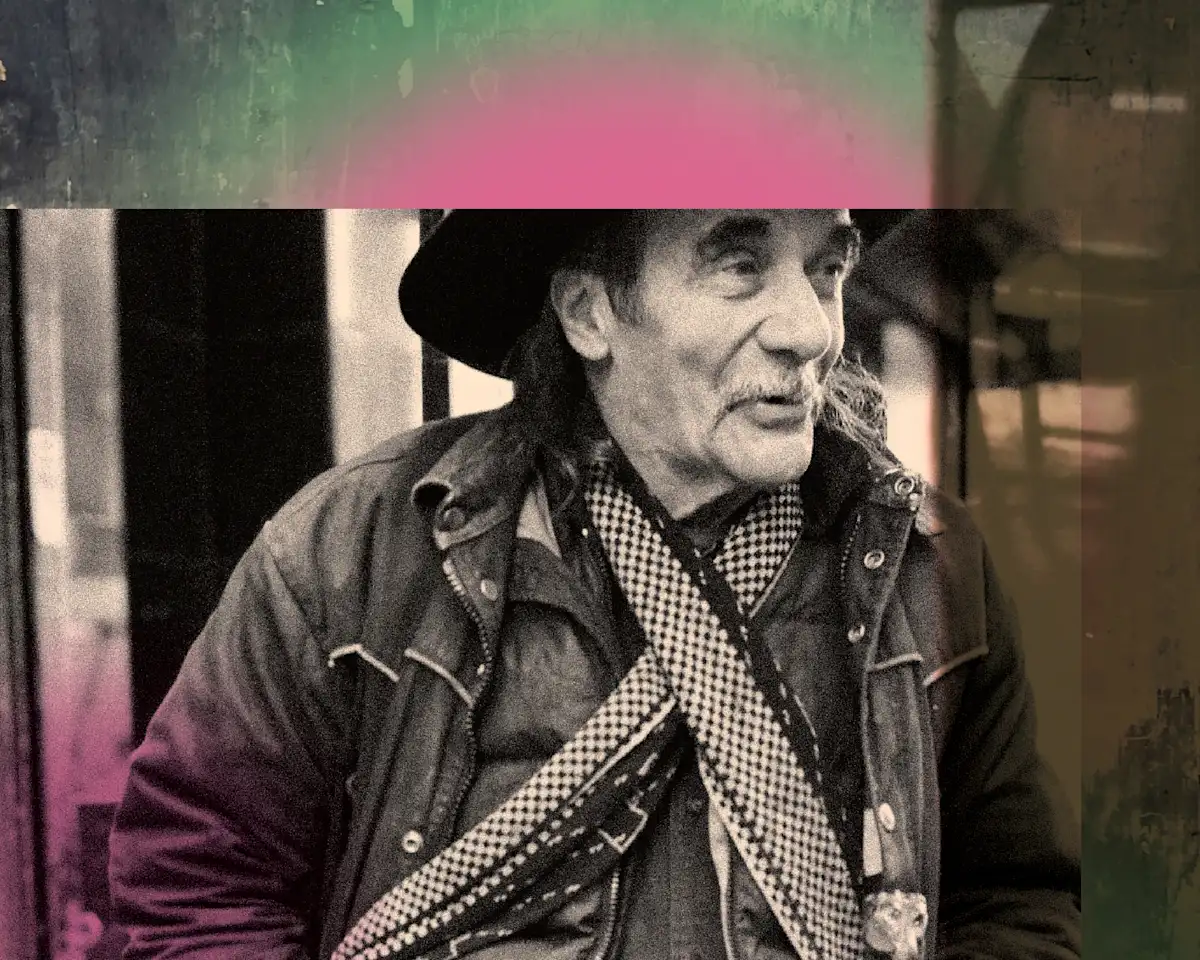
For Ben Morea, a eulogy and a collection of interviews.
A Life in Rebellion
Ariel Uesseler, May 7th, 2026, Ill Will
On Saturday May 2, 2026, our friend and comrade Ben Morea (1941-2026) — animist, artist, and lifelong revolutionary — passed away near his home in Colorado.
The following text forms the preface to the Japanese translation of Full Circle: A Life in Rebellion (Detritus, 2025; Kawade Shobo, forthcoming), an autobiographical dialogic account of Morea’s life. Coauthored by Morea and 1000 voices, the book was a labor of love by many. While leaving behind a trace of Morea’s extraordinary life, it asks what is possible and necessary for revolutionary change in the world today.
For more of Morea’s writings, check out “The Pancho Villa Syndrome,” an excerpt from Full Circle, as well as our two recent interviews: “The Ultimate Dilemma” (2016) and “We Wanted to Destroy the University” (2024).
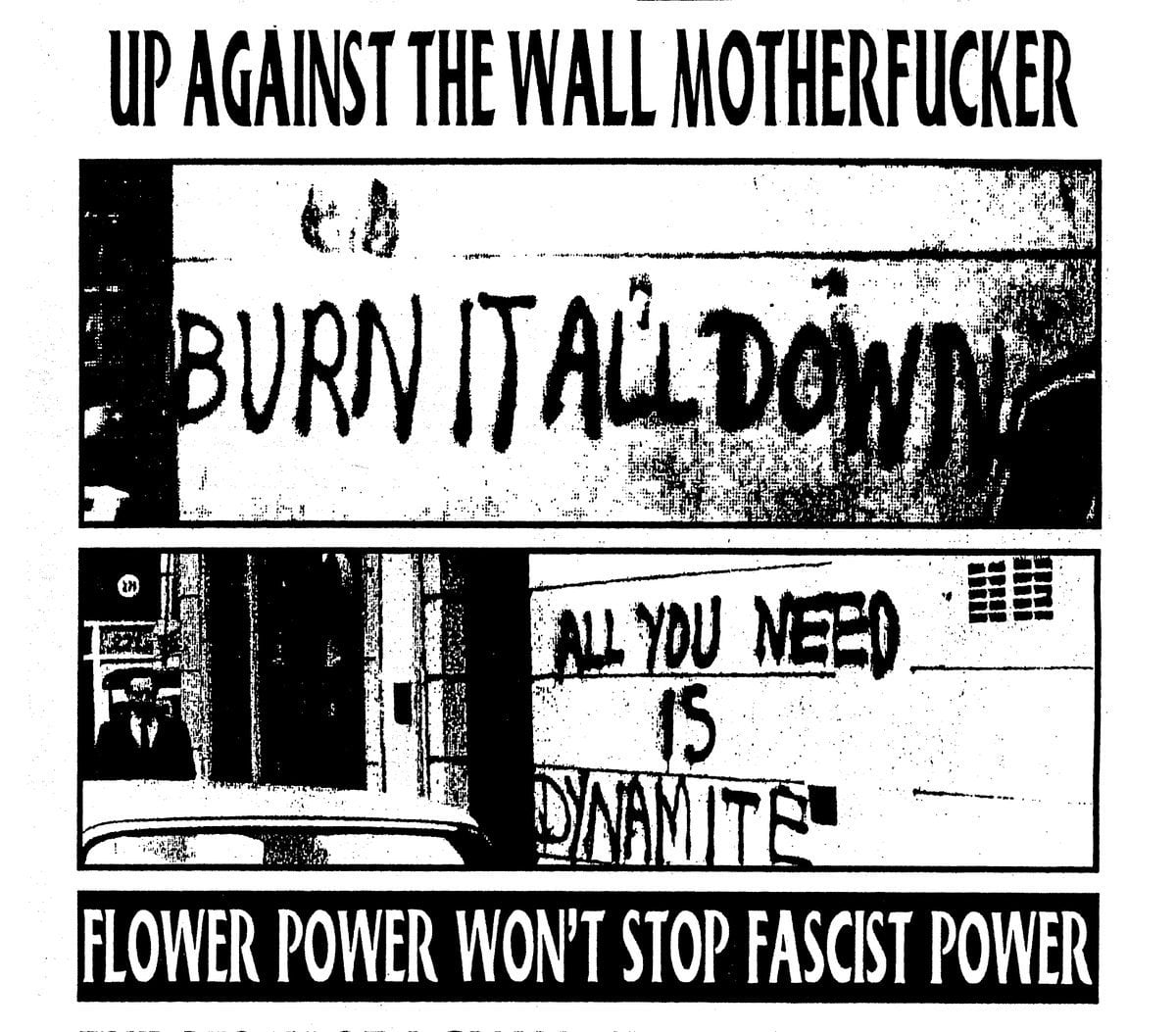
I first learned of Ben Morea from a zine. Authored anonymously and titled simply Black Mask and Up Against the Wall Motherfucker: The Story of a Small, Underground 1960s Revolutionary Group in New York City, this obscure artifact was circulated through anarchist scenes around the country when I was a teenager. At the time, in the early 2000’s, this 8-page zine was the only existent record of the group’s activities. In breathless prose, it told the story of a “tightly-knit guerrilla unit” whose essential quality was its militant yet creative oppositionality to almost everything: capitalism, authoritarianism, the Vietnam War, government and police, consumer culture, emotional and sexual repression, white supremacy, imperialism and indeed Western civilization, generally speaking. Deploying every tool at their disposal from psychedelics and street theater to organized crime and guns, their war against the existent mounted along with the mass revolutionary impetus of the late 1960s. The three years from the beginning of Black Mask in 1966 to the end of Up Against the Wall in 1969 were a perpetual festival of riotous activity: they shut down the Museum of Modern Art, cut the fences at Woodstock, broke into the Pentagon, helped to occupy Columbia University, and forced the Fillmore East to give them weekly use of the theater for free — to name just a few of their more audacious actions. Meanwhile their everyday struggle was two-fold: (1) to communalize life among the diverse underclass of the Lower East Side vis-a-vis crash pads, free stores, community defense street patrols, and dinners feeding hundreds of people multiple nights a week, all while (2) taking every possible opportunity to fight with the police. Then in 1969, they suddenly disappeared, presumably forced underground by the growing heat from both the local police and federal agencies. Or perhaps, as cryptically hinted in the final paragraph of the zine, they left the city for disparate locales around the country to explore new forms of revolutionary organization, dissolving their core group into “an occult network of resistance” beyond the scrutiny of the State, media, and indeed, the records of history.
Today, dozens of historical accounts and scholarship in multiple fields attest to the influence of Black Mask and Up Against the Wall and their radical interventions in the art, culture and politics of the 1960s. But for my friends and I in our teenage years, the only reference was this mysterious zine, and its subject was not a part of history, but rather a living legend, exciting our imagination and compelling us with their story. In the pure radicalism of our youth, it seemed to express the limit of what was possible for a small group of revolutionaries to achieve — in the words of the zine — “to join together to combat the whole of reality.”
At the time that I first saw the name “Ben Morea” in print, it never crossed my mind that he was a real person, still living his life — much less that we would eventually meet and work together to bring his life story into writing. I knew nothing of the turns his life took after 1969, when his notorious group disbanded and he himself apocryphally disappeared. Nor could I have realized that this moment marked the beginning of a whole new story, involving an extraordinary transformation even beyond the purview of what I had imagined as “revolutionary.”
In 1969, Ben and several of his comrades left New York City for the wild country of northern New Mexico, to join forces with the Chicano insurgents of La Alianza Federal de Mercedes — but that’s another story. For Ben, this was the last stand before going totally “off the radar,” disappearing into the wilderness of the Sangre de Cristo Mountains where he lived for five years with his wife and two horses, surviving off the land by hunting and foraging. As Ben says, it was this way of living which ultimately saved his life, not only from detection and assassination by the State, but also in the positive sense that it allowed him to reorient as a revolutionary. At that moment he was at a dangerous crossroads: he was armed and ready to die, but the revolution on which he’d staked his life was no longer possible. To continue the same militant struggle would be suicidal; he had to find a way to continue to fight, yet in another dimension. And what grounded him and kept him from a more self-destructive course was his life in the wilderness, struggling to survive in relation with the elements while enduring extreme deprivation and exposure. It was an experience of life pared down to its essential meaning: what do you need to live?
At the same time, what also saved Ben’s life was that he was open to allowing his life to radically transform. When he left New York, he says that he was searching for something, that was missing from the struggle in the city. He didn’t know what it was, but he felt that it was necessary, and he was drawn to Native American cultures and understandings. Then when he went out west, he encountered another world, which he entered not as a hardened militant, but as a child, ready to learn. Regarding this, Ben is very guarded about what he shares, determined not to expose that world to public scrutiny and exploitation; suffice it to say that he was welcomed into a Native community and ceremonial tradition, which he has continued practicing until today. Over fifty years later, Ben is now an elder in this tradition, one of very few who can still remember the old people and their ways, passed down in turn from their elders since the beginnings of the ceremony. Originating during a critical phase of Native resistance, at the moment when many tribes in the southwestern and central regions of the present-day US were finally forced to give up their ancestral lands and ways of life and move onto reservations, the ceremony has been a lifeline for generations of Native peoples around the country — both as a vital communal spiritual practice, and as a mode for the continued survival of Native life and spirituality. After several years in close contact with Ben, observing his conduct in the role that he plays as part of this powerful living tradition, I learned that, in a poetic way, the revolutionary had become a steadfast traditionalist, committed to passing on what he had learned from his elders, precisely without change.
It is not that Ben has lost the fervor to change the world. Today, at 84 years of age, he is still a total radical, not only in terms of his thinking, but in his whole way of living. It is not an exaggeration to say that Ben is as pure a revolutionary as anyone I’ve ever known — equally sincere as he is intense. I came to understand that, within him, the conjunction of revolutionary and traditional is no contradiction, but a matter of conflicting worlds: of which social reality is to be overturned, and which ways of life are to be fought for, to be upheld.
After disappearing into the wilderness, Ben remained in intentional obscurity for decades, working as a lumberjack while homesteading in the mountains of the Southern Rockies. As he says, many people from his former life assumed that he was dead, and he wanted to keep it that way. But eventually, he decided to reemerge. As he puts it, the situation in the world was only getting worse, and he wanted to share something from his experience to contribute to the struggle today. And so, sometime around 2006, he returned to New York City to speak publicly for the first time in nearly forty years. It is largely thanks to his return that more and more interest has gathered around Black Mask and Up Against the Wall; whereas, when I was a teenager, our only reference was a zine, now there are entire books written about them. Meanwhile, Ben has been meeting with people as much as he can, and he has become a beloved elder to a new generation of young people. When he holds events, they crowd into the room, eager to speak with him and hear his perspective on the potential for revolutionary struggle today. I recognize in them an intensity which is at once familiar, yet markedly different from that of myself and my friends at their age, just twenty years before. Having grown up under the premise of the end of the world, they speak with a gravity which corresponds to the insanity of this moment in human history. Ben doesn’t claim to have any answers; in fact he is insistent that he can’t tell anyone what they should do. But he full-heartedly shares their feeling. In my experience, these conversations are invariably somber, and yet at the same time, emboldening. They create a space to collectively bear the weight of the present reality — both the despair that the situation has never been worse, and the realization that the time to act is now, because there is no time to waste.
This book is the result of a long collective effort. It was a special collaboration between multiple generations. It came about organically; in the beginning, when we started meeting, we had no plan for publishing our conversations. But the more we sat and talked with Ben, the more we felt we had to learn, and we grew eager to find a way to share what we had learned from him with others. Together, we sought to create a medium for transmission, to draw insight and inspiration from Ben’s lifelong engagements as a revolutionary, and pass it on for the generations to come. And so what began as a visit to interview an old comrade turned into a four-year process to make this book.
Respecting Ben’s principled silence, we have edited the text to avoid identifying specific Native communities and traditions. Instead, the discussion is presented in general terms, revolving around what Ben calls “revolutionary animism.” According to Ben, animism is the understanding that all of creation is alive and interconnected, and that the human is a part of it — not above it or in control of it, but part of it. In this sense, he says, all Indigenous peoples were once animists, living ways of life founded on recognition of this connection. And the grave challenge for us today is to recover the essence of that awareness, or at least to move towards it, to begin to repair our relationship with life in the cosmos and on this planet. It is a problem which is not only urgently political and material, but metaphysical and spiritual, involving the whole of existence.
However removed the reader may be from the Indigenous ways which are everywhere today facing mass extinction, we believe that Ben’s story shows that there is still the choice to be made, or the question of how far you will go — to fight for life on Earth against the world-destroying forces of colonialist capitalist civilization, and to reestablish kinship with all living beings, to honor our role as part of creation.
This book aims to contribute to that struggle. It is shared with love, for the coming generations, in the spirit of total rebellion.
Full Circle: A Life in Rebellion is available now through Detritus Books.
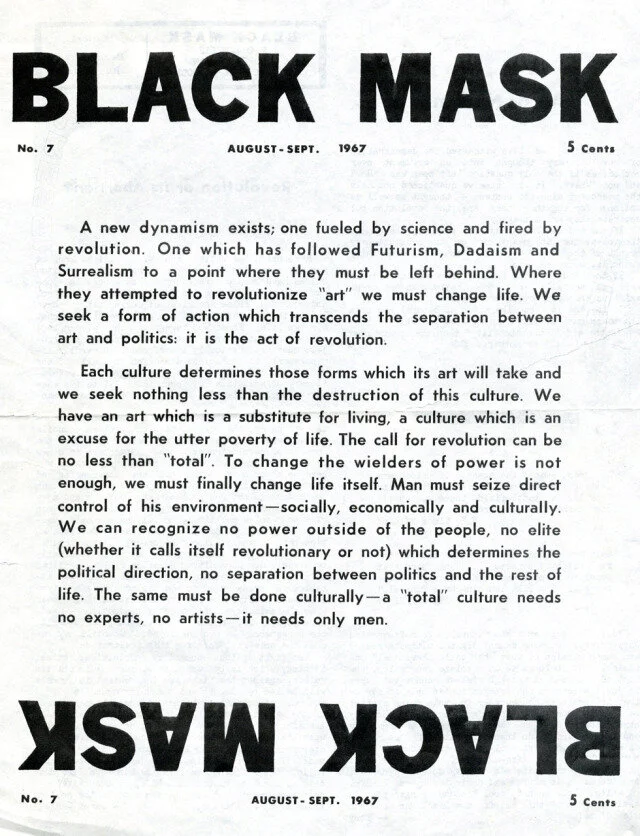
Up Against The Wall Motherfucker! – Interview with Ben Morea
libcom.org, 24/03/2012
Morea talks of the 1960s Black Mask and Up Against The Wall Motherfucker! groups and their activities – such as busting into the Pentagon during an anti-war protest, and “assassinating” a famous poet. He also discusses friendships with various characters, including the late Valerie Solanas – who shot Andy Warhol and wrote the SCUM Manifesto.
Ben Morea was interviewed by lain McIntyre in 2006.
Tell us about your background and how you came to find yourself involved in the radical scenes of New York during the 1960s.
Ben Morea: I was raised mostly around the Virginia/Maryland area and New York. When I was ten years old my mother remarried and moved to Manhattan. I was basically a ghetto kid and got involved in drug addictions as a teenager spending time in prison. At one point when I was in a prison hospital I started reading and developed an interest in art. When I was released I completely changed my persona. In order to break my addiction I made a complete break from the kids I grew up with and the life I knew.
In the late 1950s I went looking for the beatniks because they seemed to combine social awareness with art. I met the Living Theatre people and was highly influenced by their ideas despite never being theatrically oriented myself. Judith Malina and Julian Beck were anarchists and they were the first people to put a name to the way I was feeling and leaning philosophically.
I also met an Italian-American artist named Aldo Tambellini who was very radical in his thinking and who channelled all of that into his art rather than social activism. He would only hold shows in common areas like churchyards and hallways in order to bring art to the public. He influenced me a lot in seeing that having art in museums was a way of rarefying it and making it a tool of the ruling class.
I’m self educated and continued my pursuit of anarchism and art through reading and correspondence. I became aware of Dada and Surrealism and the radical wing of twentieth century art and sought out anyone who had information about it or who had been involved. I really felt comfortable with the wedding of social thought with aesthetic practice. I corresponded quite a bit with one of the living Dadaists Richard Huelsenbeck who was living in New York, but whom I never met.
At the same time I became friendly with the political wing of the anarchists meeting up with people who had fought in Spain, from the Durutti Brigade and other groups. They were all in their 60s and I was in my 20s.
I was also a practising artist working at my own art and aesthetic. I was mainly painting in an abstract, but naturalistic form as well as doing some sculpture. There was some influence from the American expressionists, but Zen was also an influence.
When did Black Mask come together as a group? How were you organised and who was involved?
Ben: It’s hard to say whether we started in 1965 or 1966, but the magazine definitely started in 1966. Black Mask was really very small. It started off with just a few people. As anarchists, and not very doctrinaire ones, we had no leadership although I was the driving force in the group. Both Ron Hahne and I had already been working together with Aldo doing art shows in public to promote the idea of art as an integral part of everyday life, not an institutionalised thing. Ron and I became close friends and found that we had a more socially polemical view than Aldo in wanting to go closer to the political elements of Dada and Surrealism as well as to the growing unrest in Black America. We wanted to find a place where art and politics could coexist in a radical way. Once we started publishing Black Mask and holding actions other artists and people on a similar wavelength were attracted to what we were doing. I’ve always favoured an organic approach where you don’t have meetings and people just associate informally rather than having a hierarchy and recruiting members.
Over time Ron became less interested in the political sphere and I became more interested in working with the people who were involved in fighting for civil rights and against the Vietnam war. I can honestly say that in both Black Mask and then later The Family we never held a meeting where we consciously sat down to decide our direction or exactly how we would deal with a particular action or situation. It all developed as a very spontaneous, organic outgrowth of whatever we thought was appropriate at the time.
One of Black Mask’s first actions was to shut down the Museum Of Modern Art (MOMA). Tell us about what happened and the group’s approach to direct action in general.
Ben: We felt that art itself, the creative effort, was an obviously worthwhile, valuable and even spiritual experience. The Museum and gallery systern separated art from that living interchange and had nothing to do with the vital, creative urge. Museums weren’t a living house, they were just a repository. We were searching for ways to raise questions about how things were presented and closing down MOMA was just one of them.
The action was a success. We’d announced our plans in advance and they closed the museum in fear of what we might do. A lot of people stopped and talked with us about what we were doing and this action and others attracted radical artists to our fold.
At other times we disrupted exhibitions, galleries and lectures. Most of these actions were just thought up on the spot and a lot of what we did was part of a learning process. Things weren’t completely thought out, but were a way for us to develop an understanding of our place in the ongoing struggle. A lot of political groups would have these big grandiose strategies and plans, but for us the actions were just a way of expressing ourselves and seeing how we could make a dent in society.
In 1966 the group also targeted the Loeb Centre at New York University (NYU). What happened with that action?
Ben: We had a strong sense of humour and of guerrilla theatre. I used to disrupt art lectures at NYU to raise issues other than those that the lecturers wanted to discuss. As a result I was challenged to a debate by some of the academics. I remember that particular event had such a pretentious approach that we had to do something. It was incredibly stratified and only meant for the elite and it seemed like they’d done everything possible to keep it away from the public at large. We handed out loads of leaflets advertising this free event with food and alcohol and they had to block off the streets all around because so many people showed up. We went down to the Bowery and handed out flyers so that all the drunks and street people would show up.
Black Mask clearly drew inspiration not only from the Dadaists, Surrealists and avant-garde movements of the past, but also from the contemporary black insurrections and youth movements of the 1960s. Tell us a little more about these influences and about your ideas and approach to politics and art in general.
Ben: From my perspective and that of the people I worked with we saw a need to change everything from the way we lived to the way we thought to the way we even ate. Total Revolution was our way of saying that we weren’t going to settle for political or cultural change, but that we want it all, we want everything to change. Western society had reached a stalemate and needed a total overhaul. We knew that wasn’t going to happen, but that was our demand, what we were about.
It also meant seeing that you need all types of people involved, not just political activists. Poets and artists are just as important. Revolution comes about as a cumulative effect and part of that is a change in consciousness, a new way of thinking.
How did Black Mask fit into the New York political and arts scenes because it seems as if you went out of your way to ridicule and challenge ideologues of all stripes?
Ben: A lot of political people questioned what we did saying we should only attack society on the political front and that we shouldn’t care about art. However we felt it was best to take action in the place where you were and that as artists these issues were important to us.
Many of the hippies distrusted us and the politicos hated us because they couldn’t control us or understand what we were doing. As for the people in the art world I’m sure most of them thought we were crazy.
Black Mask seems to have issued various challenges to the peace movement in criticising the moderates for their lack of militancy whilst also attacking the Left for its unconditional support of the National Liberation Front (NLF). Many radicals from the 1960s are now somewhat regretful or appear reticent to speak about their support for the North Vietnamese regime.
Ben: We supported the right of the Vietnamese people to resist American invasion, but were not going to support the North Vietnamese government’s own oppressive behaviour. It was a subtle point and most of the left couldn’t understand it. We knew the history of Spain where both the Francoists and Stalinists executed anarchists. We refused to support one side or the other.
I hated the knee jerk reaction of much of the Left who delighted in waving the NLF flag around. We didn’t cheer the killing of American troops who were stuck over there as cannon fodder like some others did.
In a sense we didn’t fit in anywhere and that meant we became a pole of attraction for all those other people who weren’t interested in a dogmatic or pacifistic approach. Much of the later evolution of Black Mask into The Family came about through more and more of these people joining with us and affecting where we were going.
Black Mask and later The Family were some of the first groups to encourage the concept of affinity groups as a way of organising. One Family member famously defined an affinity group as a “street gang with analysis.” How did this approach develop and the use of term come about?
Ben: Although we associated in similar circles with Murray Bookchin our group was always very different because we were very visceral and he was very literate. Murray was keen on using the Spanish term aficionado de vairos to describe these non-hierarchical groupings of people that were happening. We said “Oh my god, can you really imagine Americans calling themselves aficionado de vairos?” (laughter) “Use English, call them affinity groups.”
Tell us about the Black Mask magazine you produced which ran from 1966 to 1968 and spanned ten issues.
Ben: Ron and I mainly put the magazine together, but there was a. wider group who helped produce, print and distribute it. We sold it for a nickel, which wasn’t much money, but we figured if people had to pay for it then they would actually want and read it rather than just take one look and throw it in the trash.
We tended to sell it on the Lower East Side, which was the most fertile ground for us as there were many artists and activists. We occasionally went up town as well although that was more to stir the pot.
Black Mask was one of the first groups to take on countercultural figures like Timothy Leary and Allen Ginsberg for their timidity, orientation towards religion and status seeking, labelling them at one point “The New Establishment.” From 1967 onwards it seems as if Black Mask moved a lot of its critique away from the arts establishment and towards the growing hippy movement and New Left.
Ben: Although we were critical of them I was close to Allen Ginsberg and became close to Timothy Leary years later. What we were trying to say at that moment was that they were allowing themselves to be used as a safety valve. We wanted to attack the core of society and believed they weren’t doing that. At the time we thought they were being used by the likes of Time and Life magazine although in hindsight Time and Life probably wish they had never covered them, especially Timothy.
We were always trying to shake things up, to push everyone else as well as ourselves. There was always a lot of interchange with all sorts of other radicals and sometimes there was fratricide in that we would strike out at people we otherwise liked just to make a point.
In 1966 Black Mask magazine cited the Situationist International as a group moving in a similar direction to yourselves calling as they were for “the revolution of everyday life” and the abolition of art as a separate, specialized activity. However in late 1967 the SI expelled three of its British members for having supported “a certain Ben Morea, publisher of the bulletin Black Mask.” What was the source of friction between the groups and to what extent were you ever linked?
Ben: The Situationists and I never saw eye to eye. I thought that they were extremely doctrinaire and limited. The Situationists seemed to excommunicate more people than they kept. There was never really any connection between our groups and theirs.
What happened with the “assassination” of the poet Ken Koch in 1967?
Ben: Koch was a symbol to us of this totally bourgeois, dandy world. Myself, Dan Georgakas, Alan Van Newkirk and some of the other Black Mask people went to one of his readings. I think I came up with idea to shoot him with a blank pistol. Alan looked like the classic image of the bomb throwing anarchist. He was about six foot three, long and thin with a gaunt face and always dressed in black – the anarchist incarnate. So we decided “You’re the one, you’re going to shoot him.” (laughter) We printed a leaflet and all it had on it was a picture of Leroi Jones with the words `Poetry is revolution.’ On the night when Alan shot the blank Koch fainted and everyone in the audience assumed he was dead and started screaming. Some people threw the leaflet from the balcony into the crowd and then we all left.
Reactions after the event were split between people who thought it was the greatest thing they’d ever heard and those that thought we were a bunch of sophomoric assholes. Which was great because so much of what Black Mask and The Family was about was pushing people to decide “Do I belong with this group of people or this one?” We were determined to be outrageous in order to force people to decide where they stood on things. We wanted to push people, force them to think. “Why shoot Koch? He’s just a nice poet.”
What was Black Mask’s connection to Students for a Democratic Society?
Ben: We saw that SDS was becoming a real force for change and that all these traditional left groups and Maoists like Progressive Labor were trying to take it over and control its direction. We thought it was important for other kinds of people, like us, to get involved and show the students that there were many choices, many ways they could go.
I remember being at one of the SDS national conventions and people were getting into a heated debate about the differences between the Yankees, the East Coast based establishment, and the Cowboys, the Texan based establishment. I got up and said “This is all bullshit, I don’t know about you guys, we’re not the Yankees or the Cowboys- we’re the Indians!” Another time a member of The Family ran for a position and got up with a waste paper basket and said “Here’s my platform, throw all the position papers in here.”
With both Black Mask and later The Family we used guerrilla theatre and actions to show that there was another approach on offer other than boring politics as usual and the more volatile elements of SDS resonated with that. Some of the people who went on to form [US armed struggle organisation] The Weathermen hung out with The Family and, although it has never really been credited, borrowed a lot from our militant style and attitude. However once they melded with the more Leninist groups they took it all in a very different direction.
Tell us about Valerie Solanas, who you were close to and wrote a defence of following her murder attempt on Andy Warhol in 1968. There was a deafening silence in the underground press around her ideas and actions following the shooting. This seems a little odd given the fact that by this point the New Left had begun to increasingly glorify political violence.
Ben: Valerie used to stay with me quite a bit as she was fairly homeless and always on the move. There was a lot of parody and irony in her writing, but she was also, and I don’t mean this in a bad sense, a fairly crazy person. She saw a need to raise a lot of issues around what happens to women and the SCUM Manifesto was the best way she could express herself. I always loved people who were loose cannons, who didn’t fit the mould.
Sometime later when Black Mask had wrapped up and The Family had started we were involved in the occupation of Columbia University [1968]. Valerie came up there and found me and asked “What would happen if I shot somebody?” I said “It depends on two things – who you shoot and whether they die or not.” A week later she shot Andy Warhol.
After she shot him I wrote a pamphlet supporting her. I may have been the only person who did that publicly. I went up to MOMA and handed it out there. Everybody I met was very negative about it, but, hey, I disliked Andy Warhol immensely and I loved Valerie. I felt she was right in her anger and that he was way more destructive than she was because he was helping to destroy the whole idea of creativity in art. Some people dislike the term, but I feel that creativity is a kind of spiritual act, a profound thing for people to do. Warhol was the exact opposite, he tried to deny and purge the core of creativity and put it on a commercial basis. As a person he was really despicable, as well, and that’s why Valerie hated him. He used and manipulated people.
The attack on Andy was met with silence on the Left and I think that was because it raised issues that no one could deal with. This wasn’t violence occurring in some far off place. Also Andy had become a star, almost an honoured image, and here she was striking at it. Even the people who liked her feminist approach couldn’t deal with the fact that she would harm Andy. Black Mask and The Family drove the political people nuts because we didn’t fit into any of their blueprints, because we were loose cannons, so you can imagine how they looked upon Valerie.
Black Mask continued as a magazine until mid-1968. What was the process by which the group began to evolve and change into what became known as Up Against the Wall Motherfucker?
Ben: The Family/Up Against The Wall Motherfucker and Black Mask were related in that one grew into the other, but in reality they were very separate groups in terms of the people involved and what they did. There was no decision to start a new group, no blueprint, it was just an evolutionary thing where one died away and the next thing came to be. It’s hard even to say exactly at which point one ended and the next began.
The Family went over the edge, was extremely volatile and didn’t have as much inclination toward the cultural sphere. It included a lot of artists, but also people from all persuasions who wanted to live a life more real, more visceral than what was offered. Something less limiting than just pursuing politics or art, something freer.
We weren’t really hippies or politicos. We were separate from other groups even though we were part of the wider counterculture. Some people would have placed us as hippies. Those that knew something about the counterculture could sense that we were a much more guttural breed. But outwardly we did have the trappings of the hippies in terms of long hair and ethnic clothing. We also took a lot of LSD. Even though we were also radicals no one would have mixed us up with the Young Communist League. (laughter)
What were some of the differences between Black Mask and The Family?
Ben: The Family was much bigger and more vital than Black Mask which was more of a esoteric group. We never called ourselves Up Against The Wall Motherfucker, although we signed our posters and leaflets UAW/MF which anyone in the group could produce, with that name. Amongst ourselves we were The Family, which might sound weird now because of the association of that name with Charles Manson with whom we had no connection and nothing in common with. Whereas I was the main figure in Black Mask The Family was quite different because it involved a large group of people who were all equal in strength and in determining the direction of the group. It was essentially a loose confederation of affinity groups living across a series of crash pads who shared a tribal outlook and lifestyle. Different people from the core group would gravitate to a particular address where a lot of young hippies and runaways would also stay.
The fact that we rejected the nuclear family model and lived collectively was never arrived at in a polemical fashion or laid out as a blueprint. We just had a sense that there were other roots to living other than what the West had to offer, whether it was from Native Americans, gypsies or Africa. The hippies had some of that too, but we really leaned heavily towards this tribal, ethnic outlook. We felt that there was some strength there that transcended the Western world. We tried to understand and incorporate some of these elements, both in our appearance and actual living style. Our whole lives were directed towards free flow, living organically.
Tell us about the actions The Family were involved in.
Ben: The first real action we did as The Family was to take garbage to the Lincoln Centre in February 1968. There was a garbage strike in New York and there was tons of refuse mounting up in the ghettos. The commercial and wealthier areas were able to hire private contractors to clean their streets so we decided to take some of the garbage from the Lower East Side up to the Lincoln Centre. One of our members proposed this as a cultural exchange – garbage for garbage (laughter). Although others tended to focus on our aggression and militancy we really had some beautifully witty people.
We put out a leaflet explaining why were doing this, but those of us involved realised that we weren’t really Black Mask anymore and so we didn’t want that name on it. There was a poem by Leroi Jones with the line “Up Against The Wall Mother Fucker” in it and I suggested we put that on there. Somehow it stuck and from then on in everyone referred to us as that. It wasn’t a deliberate thing on our part. It would have been fairly pretentious to just name ourselves “The Motherfuckers”. (laughter) Black Mask continued as a magazine for a little longer and then UAW/ MF started creating flyers and posters and doing things for papers like The Rat.
How were those broadsheets and statements put together?
Ben: They were part of our artistic politics and we enjoyed putting them together either individually or as a group. We wanted to do something that was creative and visually exciting, but which also made a statement. With The Rat two to six members of The Family would go up to their office each week and do our page. Whoever felt inspired would come along and we’d all collaborate. People who have reprinted our work, both at the time and since, often failed to appreciate our sense of humour. We believed in what we were doing, but we didn’t want to be too serious. We could laugh at ourselves. The best influence we felt we could have was not just to inject militancy, but also joy and humour into the struggles of the time.
We had our own mimeograph machine so people were constantly running off leaflets and posters. A lot of the time I would see one on the street that I didn’t even know had come out. The beauty of our family was that it was multi-armed and had no central brain so people were often doing actions and producing things that the rest knew little about.
In the group’s writings an affinity group was defined as a “street gang with analysis.” How much of the traditional street gang mentality was a part of your outlook though?
Ben: Some members were more into the street thing than others. We weren’t territorial or into dead end opposition however. We were “street tough” rather than street toughs. Osha Neumann who penned that particular definition (though I had coined the term Affinity Group) saw it as meaning that we had street smarts and an intense bond not that we were irrational bullies.
In 1968 students struck and occupied buildings at Columbia in a protest against the redevelopment of land earmarked for social housing and the university’s links to weapons research. How were you guys involved?
Ben: There were five buildings occupied at Columbia and the one we were in was the only one the police didn’t attack. We didn’t put a call out, but everyone who was a fighter gravitated towards that building. We were so fortified and aggressive that having evicted all the others they decided to negotiate rather than force their way in.
We didn’t operate from any plan, we just saw situations and took our chances. We were edge dwellers. During the anti-war protests at the Pentagon we saw the doors weren’t heavily guarded so we went for it and broke them open. We’d gone along with all the other protesters, but pretty soon we attracted a core of a few 100 people who were like us. We saw an opportunity, made a move and they came along.
During 1968 and 1969 The Family were also involved in resisting police harassment and violence on the Lower East Side. How did you go about dealing with these problems?
Ben: Our response would include everything from peaceful protests to not peaceful battling depending on the situation. We were extremely volatile and it often depended on how hard we were pushed.
Eventually they decided that we had to be dealt with. One night we barricaded the streets to traffic and threw a party. The police came, but saw we had too many people and were too strong so they left us alone. However that was the beginning of the end. We’d become too cocky and uncontrollable and they began busting us for anything they could.
In October 1968 you personally faced trial on charges of attempted murder in Boston. What led up to this and your eventual acquittal?
Ben: While I was in New York we heard that young freaks, we never called ourselves hippies, were being harassed by this group of vigilantes in Boston. It was pretty bad and a few kids had been hospitalised so I suggested to some Family members that we should go there and look into it. We went up and stayed with the street kids and freaks and sure enough they were attacked while we were there. The attackers were repelled and I was charged by the police.
I was in jail for about two weeks before I raised bail. After I stood trial we heard that these vigilantes were still hurting people and decided to go back because we were concerned that we may have made things worse. The same guys turned up again, but this time they backed down and disappeared which was lucky for me because it wouldn’t have done my cause any good.
I didn’t get a lot of support for my case as the political community couldn’t have cared less about the hippies whilst the hippies were for the most part non-violent. However various people helped out and the story got some coverage in the underground press. In the end I was acquitted, but the foreman told me that it was all down to one juror. On the first vote it was 11 to 1 in favour of convicting me, but one guy managed to convince the others that there was enough doubt to let me go. I don’t know who he was, but I owe that one guy my liberty.
Other than supporting people against the police and opening crash pads The Family also ran a free store and was involved in various other activities aimed at street level survival. Tell us about these activities.
Ben: We were always trying to connect the hippy part of the Lower East Side community with the street and homeless part. With the influx of thousands of runaways into the area during the late 1960s they were sometimes one and the same, but the two communities didn’t always comfortably coexist. We set up a store front to give homeless people as well as ourselves a place to hang out. We had free clothes, doctors and lawyers on retainers, a mimeograph, information for people who wanted to dodge the draft and get fake ID, information on crash pads, etc. It was a general help centre. We did free food a couple of nights a week, but also held free food events in a hall or a church on the others where we would feed up to 300-400 people. We got some papers from a church saying we were a non-profit and that allowed us to get day old or incorrectly marked stuff from the produce markets and food outlets for free. Some people worked, others made donations and the same papers also helped us to hustle up grants from liberal churches to rent places, etc.
As with a lot of other countercultural groups at the time The Family drew a line between `life drugs’ and `death drugs.’ Tell us about that and the group’s approach to illicit drugs in general.
Ben: We differentiated between hard drugs like cocaine and heroin and those like grass, hashish and psychedelics. We saw that LSD and grass were helping to break down the structures between suburban youth and helping them to rethink their place in the universe. Some of us had had problems with hard drugs and saw that they were destructive. Unlike Leary and others we didn’t see psychedelics as a cure all, but they could and did make a positive contribution.
People would sometimes bring kids to me who were on bad trips. I would take LSD and try to go with them to the place where they were in trouble and help them come back. If you want to talk about putting yourself out there, that was it. You wouldn’t see many Maoists doing that. (laughter)
In late 1968 The Family went head to head with rock promoter Bill Graham over the issue of community involvement in the Fillmore East venue. What were the origins of the dispute and how did it all pan out?
Ben: At root this was a clash between the grassroots and those who exploit them. We didn’t want control of the Fillmore East or anything like that, but we wanted to have one free, non-commercial night for the street people. Given the money they were making out of the community we figured that they could give something back.
At first Graham refused and during one meeting in his office he pulled out three silver bullets and lined them up saying “The Hells Angels made similar demands on me and sent me these three bullets and I didn’t give in.” I got up and said “There’s one difference between us and the Angels, we’re not giving you anything to put on your desk.” That wasn’t a literal threat, but a statement that one way or another we were going to get what we were demanding.
One night the Living Theatre people were performing at the Fillmore East and we arranged to come up on stage after them. I made a statement saying that they were finished, but we were going to stay on stage for as long as it would take to get what we wanted. It might take one night, two nights or two weeks, but we were going to stay. We occupied the stage and fights broke out through the night with Graham and his goons, but they lost and at about one or two in the morning he gave in and we got the Thursday night for free.
What sort of events happened on the free Thursdays?
Ben: A lot of rock bands including Canned Heat, the MC5 and Country Joe McDonald came and played for free and we gave out free dope and food. I’ve been told that the MC5 clashed with some sections of the crowd, but I remember staying at their place in Michigan some time later so I’m not sure what happened there. After three weeks Graham came to me with a letter from the police informing him that they were going to shut the whole venue down if these nights continued due to the free drugs policy. We accepted that that was it, but in the end it didn’t matter that it had only lasted three weeks because we got to challenge the whole commercial world of rock n roll.
Woodstock provided us with another opportunity to challenge the music industry. These young kids said “You always say the music’s free, well we’re going to make it free.” Like most of the things we did nothing was planned. We just went along and some of us thought it would be a good idea to cut the fences and let everyone in. When it began raining we found where the organisers were storing camping equipment for sale and liberated all the tents and sleeping bags. We cut a hole in the storage tent and just gave them out.
Did The Family interact much with groups from other parts of the country and world?
Ben: A tremendous number of people came through New York and spent time with us around the time that The Family began. They included some UK Situationists who became the King Mob group, members of the Zenga-Kuren from Japan, Jean Jacques Leibel who was one of the leaders in the `68 uprising in Paris and also some Provos from Holland. All of these groups overlapped with our approach in one way or another.
We were also doing a lot of travelling ourselves. I spent time with The Diggers in San Francisco. They were coming from a very similar place in terms of radicalism and the rejection of the entrepreneurs who were profiting from the counterculture, but our approaches were very different. There was a lot of support from the West Coast groups, even [LSD manufacturer] Owsley gave us some money. There were also small groups of people all over the country who identified with us and stayed with us.
What prompted the decision to leave the Lower East Side?
Ben: The police felt threatened by us. They began following us closely and engaging in constant harassment. Some of our people were also charged in the second wave of indictments that came out of the Chicago protests.
These things in themselves didn’t drive us out, but we were evolving and exploring new directions. The tribal element became more strident and many of us began to wonder why we were stuck in the ghetto anyway. A lot of the young runaways were being preyed upon and we felt it would be safer to move them out. We took about twenty of them to California at one point and helped others find homes elsewhere.
The group didn’t end all of a sudden, but dispersed with most of us getting involved in various land oriented projects and communes. I personally stopped writing and went into the mountains and didn’t come out for five years. I became inspired by Wilhelm Reich’s The Murder of Christ and its idea that you don’t ignore the wider issues, but move on to tackle them one person at a time.
With the US government on a permanent war footing overseas whilst simultaneously cracking down on civil liberties and dissent at home it sometimes seems as if the left wing movements of the 1960s never existed. What do you see as the legacy of groups like Black Mask and the New Left in general?
Ben: Part of the reason I re-emerged [after more than 30 years of anonymity] to talk about what we did back in the 1960s is the fact that things have gotten so bad in the US. It’s at a point where you can’t ignore it, it’s worse than ever.
I figured that I’d start letting people know about our history and then go from there. All I can tell people is that when it looked pretty dismal in the past we took action and it did have an effect. A lot was achieved and yet a few years beforehand no one would have expected that we could take on the behemoth of American capitalism. It’s counter-productive to sit back and say “You can’t do anything.” It’s not my place to tell people exactly what they should do, but there is always some way to respond and take action, just look around.
Selections from: Breanne Fahs, “Reading Between the Lines: Ben Morea on Anarchy, Radicalism, and Revolution”, Left History, Vol. 16 No. 1 (2012)
As an advocate of radicalism and a champion of all social movements that seek freedom from state intervention, Morea spent much of the late 1960s stagingprotests and events that drew from lessons learned from other social movements(particularly radical art movements throughout the world). Here Morea reflects on the historical and contemporary role of radicalism in shaping political consciousness and as having the potential for revolution. From the seemingly personal events of our lives (Morea never married in a state-sponsered sense but has maintained a relationship with his companion for over 40 years) to the blatantly political spaces we inhabit, Morea argues that radicals must live their ideologies. By framing lessons learned from all revolutions—from the Russian revolution to current upheavals in Egypt—Morea conceptualizes the role of radicalism in making, unmaking, and remaking the world.
FAHS: Can you tell me a little more about what you think radicalism does or can do or has done?
MOREA: It’s moved the world continually. You could go back to the 1800s oryou could go all the way back, but I mean, what we call the American Revolution came about through radicals. The French Revolution, the Russian Revolution. Regardless of whether they were betrayed at some point, they were beneficialmovements to humanity. It doesn’t matter that it went corrupt and we ended upwith communism and Stalinism. It’s just like what’s happening in the MiddleEast. You can see it right now. The Egyptian, Tunisian, Libyan uprisings are a benefit to mankind, regardless of what’s going to happen eventually. Some corruption, authoritarianism might creep in, but it doesn’t matter. It’s a breath offresh air and that’s what radicals believe. They’re looking for that breath of freshair. They don’t say to themselves, “Oh, well, we ended up with Stalin, so how good could the Russian revolution be?” We look at it like the Russian Revolution was a boom to mankind. It pushed man to the next step and the American Revolution did the same. We don’t look at the American Revolution and say,“Everything that is stood for is being undermined and corrupted now.” We don’tlook at it like that. We look at the fact that it was a boom to mankind. That’s the difference. Radicals don’t fear events. They feel that they propel events. Liberals are always afraid.
FAHS: What you’re saying is that the context and the time and place matters to apoint but not as much as the bigger story, right? The bigger story of upheavaland rebellion?
MOREA: Right. Rebellion is a creative act. It’s a propelling of man that movesforward. After the American Revolution, man had a chance to be freer, or afterthe French revolution, man had a chance to be freer than he could be before it. After the Russian revolution, man had a chance to be freer than he could beforeit. It doesn’t matter at some point that the anti-revolution sets in. It doesn’tdiminish that moment, that breath of fresh air that the rebellion represented. Like, for instance, Egypt today. Even if Egypt slid into a military dictatorship at some point, we would never say that the Egyptian revolution was in vain. Itcannot be in vain. It is. It’s a beautiful act. It’s a work of art. So, even if it slidesinto a negative place, it doesn’t diminish the act or the aesthetic or the art of it. Can you see?
FAHS: Yes. One of my biggest frustrations in general with liberalism in general is that it’s so preoccupied with only the outcome and not with the process.
MOREA: Absolutely.
FAHS: I’m teaching a class on radicalism, and it’s hard to shift the discourse sothat it’s not always about where we land.
MOREA: It’s never about end. It’s always a process. That’s what revolution is:process. It’s not end. It’s not regime change. It’s about process. Expansion of the human condition, moving forward. And without revolution, you have stagnation. Say like Cuba for instance. That was fantastic that those guys in the mountains overthrew Batista. It doesn’t matter that Fidel became a dictator. That doesn’t diminish what they did in the mountains, and that they overthrew Batista, and that they overthrew the American dream of a gambling paradise. That’s what Cuba represented to America—the next exploitative paradise for the wealthy and gambling classes to go, with no concern for the people of Cuba that were oppressed. So, it doesn’t matter to us if Fidel became a dictator. It doesn’t diminish the act itself. The Cuban revolution is still a beautiful thing. Does that make any sense?
…
Reflecting on his own life — including radical actions with his affinity groups in New York and his disappearance in 1968 — Morea considers the role of anarchy in shaping the forces of social change. By considering the importance of avoiding or resisting co-optation, Morea argues that radicals must always remain onestep ahead of the state and its accomplices. In this final section, Morea considers a host of subjects often ignored by radicals—particularly self-care, creativity, andspirituality—in framing his vision of a more radical future.
FAHS: Tell me what you think of the role of anarchy today and what vision you have for anarchists moving forward.
MOREA: It’s in the ascendancy right now. If you just look around the world, it’severywhere. An anarchist does not see anarchy as the dominant political forces would like you to see it as, as some form of chaos. Anarchy to us is self-regulation, non-oppressive situations, room for people to grow and express themselves independent of ideology. It’s everywhere, in Greece, Spain, Portugal, France, in the Middle East and North Africa—they’re all anarchists, even if they don’t use the word anarchy. A lot of those kids who propelled the upheaval in North Africa had anarchistic leanings. It wasn’t ideological, either Islamic or socialist orcommunist, but rather, much closer to anarchist. They don’t have an agenda. They don’t have a “party.” They have a desire to be free. They’ve gotten a lot of criticism for this, that they don’t have a platform, but to us as anarchists, that’s beautiful. They’re just moving, trying to be free. Take the analogy of a room with no air. You want to get air, you want to bust a window. You don’t want to think to yourself, “What do I do with a broken window?” You just want to break the window, get some air. That’s how anarchists feel. In other words, we don’t need to have a blueprint. Hopefully man will figure out what to do with his life as he goes forward, but we need the air, we need to breathe. And you’re not going to breathe with Mubarak or Gadhafi blowing smoke. Or al-Qaeda. The only way that you’re going to defeat al-Qaeda or Islamic extremism is self-regulatory extremism, people desiring to be free. If we don’t help it or grasp it, it’sgoing to slip. The Islamic movement will take advantage of it and recapture what the youth in the freedom-seeking people have accomplished. Fundamentalists are the problem. Fundamentalism is the problem. It doesn’t matter if it’s Islamic fundamentalism like al-Qaeda or American fundamentalism. Palin is as much a problem as Osama Bin Laden. Rush Limbaugh is as much a problem as Bin Laden, as far as I can see. The problem is fundamentalism. So here you have a movement that has shaken the nation to its core and it’s not fundamentalists. We should be embracing it. Instead, we don’t know what to do with it. We’re confused. “Who really controls it?,” they keep saying. The truth is, nobody controls it, and that’s the beauty of it. But, somebody will end up controlling it. That always happens. So, we should be able to push it towards them, the freedom end of the spectrum.
FAHS: Radicalism moves the center and lurches it out of being stagnant orstuck.
MOREA: Right. Exactly.
FAHS: I’m also interested to hear about your disappearance, how you’ve lived off the grid for 40 years, and why you left, why you came back.
MOREA: I can tell you a little about that. I don’t want to be too specific. It started in ’68, ’69 when a lot of radicals were being assassinated and killed by the government, like different Panthers. I was going to the Chicago protests in ’68. I was on my way there and my girlfriend at the time had a blue Volkswagen that I often traveled with her in. On my way to Chicago, I was stopping in different places, visited friends, and I kept getting calls about blue Volkswagens getting stopped around Chicago. The cops had my picture and they approached the car armed as if they were waiting for some provocation, weapons unsheathed. After the third call telling me the same thing, I didn’t go to Chicago. I took off and never came back. And I went into the mountains on horseback for five years.
FAHS: Did you know how to survive doing that?
MOREA: In my childhood, I was a rural country kid. I was always around horses. I worked in stables and I slowly learned survival as a child. I became a survivalist. I could teach people about edible plants. When I disappeared, I slowly changed my identity and just stayed out, so to speak, until four years ago.
FAHS: And why did you decide to come back?
MOREA: That was somewhat serendipitous also. Some lady I knew that I hadn’t seen since the 60s (and I don’t know how she knew how to get a hold of me or where I was), she asked me if I would appear someplace, as myself and talk to people. I laughed and told her, “Absolutely not. Are you nuts?” I thought about it, though, and how we’ve reached that “dead end point” again (if not worse) like the 60s. I thought to myself, “What are you going to do now? Are you going to just ignore how bad things have gotten?” I called her back and said, if you keep it to a small audience—because I haven’t spoken to anyone in 40 years about these types of things and I’m not used to it or comfortable with it—I’ll try it. So, I went to New York at some event with radical people, 20 or so, and I felt a little comfortable with it even though I was also apprehensive. And it just kept growing and other people contacted me. I live out of New York State but I visit often.
FAHS: Are you worried about your safety now?
MOREA: Not as much obviously, but still, it’s always there. It’s not as prevalent as it was forty years ago. There’s a lot of interest from radicals about how we did what we did. That’s why I decided to reemerge. I have a lot of information. I knew a lot of people. Lots of stories haven’t come out. We cut the fences at Woodstock. Nobody knew that until I reemerged and let people know that the fences didn’t just fall down. I came back because I felt like I’m getting older and God forbid something happens to me, do I want to take all that information with me? I wanted to leave some of it, like, you know, Eldridge Cleaver asked me to run for Vice President. I laughed it off. I said, “Are you crazy? I’m an anarchist!” Our connection to the black struggle was so strong. In other words, I want to share things with people so that they can make up their own minds about how things should be done in the future.
FAHS: I know someone who says that no one’s born a radical. Would you agree?
MOREA: It depends how you define radical. We’re all born and we all have consciousness, so that consciousness is shaped partially by the environment, partially serendipitous when you run into certain things, and it may change you. There are so many myriad events that you can never give one cause. It’s a combination of environment, your own mental capacities, what you see, how you take it. They all shape you and some people see it in a light that leads to radicalism.
FAHS: Radicalism is also tricky because it has so much energy around it that it can be overwhelming. Students tell me radicalism makes them feel disorganized. I think it’s hard to reconcile day-to-day life with the energy of radicalism. How do you put those things together?
MOREA: Well you’re absolutely right. It’s difficult, and the way we did it in the60s cannot be done again. In the 60s there was a whole cultural upheaval going on at the same time that we were part of. We were part of that whole counter-cultural upheaval. Now it’s talked about like “The fish in the sea.” That was our sea, so it’s going to be a little different this time around and it’s a little more difficult. Young people will find a way. I’m sure the Internet is going to play a big part in it. It already has. Each generation has defined the tools and the media and/or environment that they need to flourish. There is no blueprint, but people will still find their way. Being a radical, being the kind of person I am, I had to find a way to make a living that I was comfortable with, so I got to selling antiques and collectibles, which I do now. Before that, I was a lumberjack, which is very independent and artistic. I was a rancher. I had livestock. You find ways that suit your personality and/or conviction. I could never be a banker. You find ways and obviously art is one of the ways. People gravitate to where they can survive. I don’t take part in any of the social media use of the Internet. I don’t do Facebook or Twitter or whatever. I don’t do that. I use email and obviously I do my blog, which is very simple and small, so I’m not super preoccupied with the computer. In Egypt or Iran, the Internet wasn’t successful yet, but it helped. It alerts people to how to proceed day-to-day, where to meet or where to converge. In a repressive society, it can really help, even though it has a potential for its own repression. There’s always a duality to things. The act of revolution carries its own downfall with it. They coexist, just like life and death.
FAHS: Yeah, I struggle with that to because it seems like every time we get creative and come up with this new way of empowering people or fighting against repressive regimes or radically changing people’s personal lives, it’s so soon after that it gets appropriated again, and we have to just go back to work. It’s so unbelievable.
MOREA: Cooptation is the game. You always have to stay one step ahead of cooptation. You’ve got to use things without being co-opted. That’s a dance. I don’t think you can tell anybody how to dance. You need to feel rhythm or you don’t. Each person has to figure out a way to do this.
FAHS: So what you’re saying is that people should try hard to sense when cooptation and oppression are coming and then shift their strategy first?
MOREA: I think so, yes. Cooptation not only can happen, but will happen. Be aware of it so that you’re precluding it happening by what you do. I’ll show you an example. In the 60s, people who thought like I did sensed how easy cooptation was. We would do certain things to minimize cooptation. I would never allow myself to be photographed or become a “personality.” That might seem like a small thing, but Abbie Hoffman and those guys did the opposite. They wanted to be shown. Whenever they saw a camera, they would run to it. They were co-opted so fast. You sense things. Like our name—Up Against the Wall, Motherfucker—was one of those. We didn’t choose that as a name, but it actually helped us because you couldn’t write about us in a lot of the regular media.That helped us from being co-opted. I think everybody should be aware that cooptation is working. You have to be aware of it and guard against it all thetime. The desire to be a star is always there so you’ve got to fight it.
FAHS: How can radicals care for themselves then, given that they’re dealing with extremes and the rejection that comes from doing something that deeply upsets the norm? Radicals are basically messing with the ideas that keep people safe, like what does it mean to be alive, or what is truth.
MOREA: It’s difficult, but it’s important to see things as a process rather than an end. If you’re looking for a result, an end, it’s easier to be cast aside. If you’re not looking for an end, you’re just staying in motion and it’s much harder for you to be “captured” so to speak.
FAHS: I would imagine that the same will probably be said for you on some level, that once you put these things in motion that it doesn’t end with your death or your disappearance, right?
MOREA: Absolutely it doesn’t end. It’s in a sense eternal. It just is. It’s a wave, like sound waves and light waves. It’s a wave and once it’s out there, it’s known but you need a receptor. Otherwise, it just remains a wave. It exists, but if it doesn’t have a receptor, you cannot hear it or see it. So, I guess we look for receptors, ways to get things out in the world, and maybe that’s why I came back after 40 years, to keep that wave from dissipating or being lost in the millions of other waves. My whole thought pattern throughout the 60s was never limited to one field. I was never a political person solely. I always felt that politics, art, and culture were equally important. To me, cutting the fences at Woodstock was just as important as breaking down the doors at the Pentagon (which we also did). I didn’t have a hierarchy of thought. That’s what made me really different from most people because most people were really limited to each field. There were people who were totally artists, people who were involved in the political world, and there were people who were involved with the cultural and counter cultural world. There was almost nobody who tried to join all of them. I think that’s what helped save me because I could jump from one to the other or move between them. My identity wasn’t so fixed. In a sense, I couldn’t fail. I could fail politically, but artistically, culturally, I was okay. I always added the spiritual side as important. No political person ever saw spirituality—the spiritual act of creating—as important. I mean it in the non-religious sense. It’s almost anti-religion.
FAHS: And you’ve said radicalism is creation, right? And the project of creation is in some ways so existential and huge that it has to have spiritual dimensions.
MOREA: Yes it does. It’s totality. I used to use that word a lot: Totality. Or even in terms of connecting it to revolution, total revolution. In other words, I never limited the change necessary to one arena: political, artistic or cultural. They were all needed. I think the spiritual arena is even going to become more important because the Right Wing is fixated with religion, so the only way we’re going to fight that is through a spiritual consciousness that is anti-religion. We replace religion with spirituality. Then you undermine their whole game. You show them up for what they are: small-minded bigots, who use religion just like they used Christ, killed him and used him. But Christ was just a rebel, too, a spiritual, anarchistic person. They wanted to make him into a God so they had a way to force you to follow them.
FAHS: That reminds me of the point you made about sexuality, this connection between religion and various kinds of pornography maybe, where they corrupt the fundamental creativity of sex and spirituality.
MOREA: It distorts it, and it uses it then to become a weapon, a weapon of control. So they control you—sexually, religiously—they control you. The whole game is to control. That’s why I felt that we had to fight them on more fronts than just political because they wanted to control everything. It’s so fundamental. They want you to believe that some book is the word of God. It’s the word of man. God doesn’t write. And I don’t even like the word God. It was man who wrote it and they were writing it to keep you following his agenda, not your agenda.
FAHS: So resistance can happen in small ways all over the place, bubbling up, everything from people choosing different ways of dressing to different ways of eating.
MOREA: That’s exactly it. At some point if one area is more controlled, it bubbles up in another area, so that way resistance continues its fermentation. It stays. It bubbles. It moves. At one point in time, it might have been a more political face, one point a more artistic face, but it keeps percolating, this idea of resistance. The radicals don’t write history. Even the idea of history is already a problem, rather than his or herstory.
FAHS: So tell me this. Given that radicals don’t write history, what do you imagine is the project of trying to have people learn from previous generations, pass down knowledge to later generations?
MOREA: Well, you have to trust people’s instincts and creativity. You can’t get the whole story, but you can get little glimmers of it, glimpses of it. Your creativity and your instinct has to help you sort through that. Read between the lines. I always think of looking for beacons. You don’t even know the whole story of these people and maybe they weren’t quite like you think they were, but there’s some light that you glimpse and so you try to absorb it. Anarchists look for those lights while the political Marxist types want to read about it. Anarchists have to be able to sift through everything that’s out there. Like cave paintings. When you realize these were human beings who were up against tremendous odds to survive and here they were creating. Or the aborigines in Australia who spent 20 hours a day to find food and shelter yet they created this tremendous amount of art. You’ve just got to find little things that completely resonate with you. You’ve got to read between the lines. Then, those writing the history can’t control you because you’re not going by the history. You’re going by a bigger picture. You’re making your own history.
An interview with Ben Morea, recorded after an art show and talk he gave in Kingston, Ontario entitled “Revolutionary Animism – The Unified Field: Art, Politics and Spirituality.” Ben Morea is best known as a key figure in the Black Mask group, The Family (popularly known as Up Against The Wall Motherfucker), and the Armed Love commune movement. In this interview Ben recounts stories from his life, reflects on some of the challenges facing anarchists and revolutionaries of yesterday and today, and shares some thoughts on animism, indigenous ways of life, conflict, art, and more. From Embers, 26/04/2024.
Libcom.org has a selection of material on and by Ben Morea. Click here.