
From lundimatin #525 (23/06/2026)
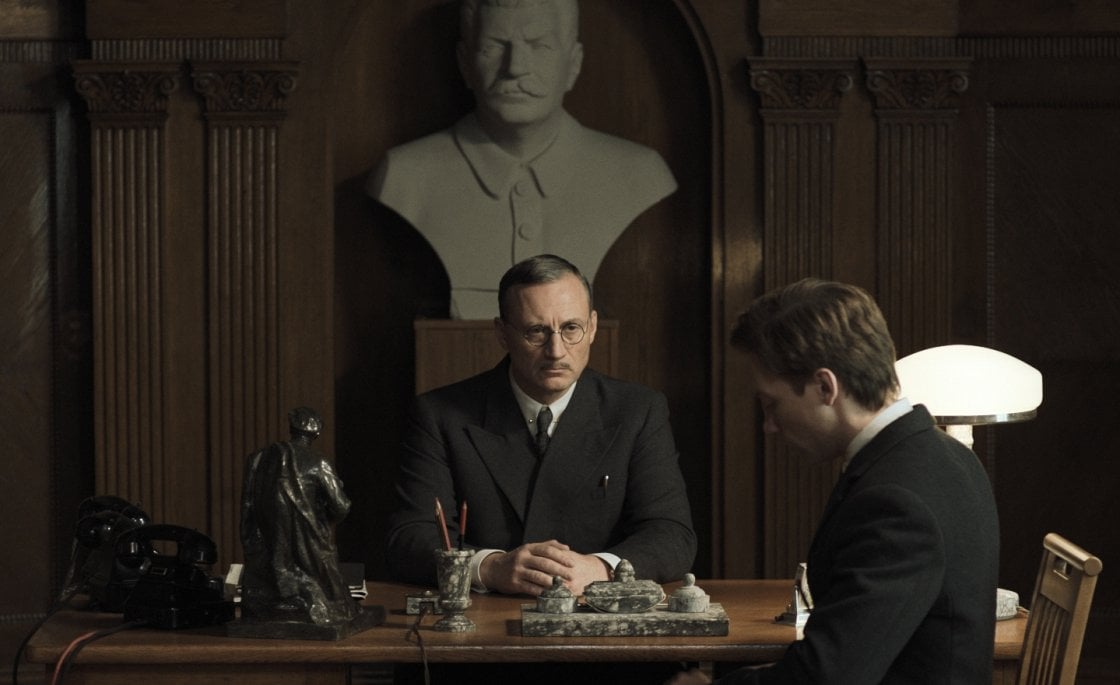
At the start of Ukrainian director Sergei Loznitsa’s film, Two Prosecutors (2025), two NKVD Chekists – torturers working in a “special detention” centre – exchange a joke that makes them laugh heartily. The prison commander tells his subordinate, a guard, the following story: “It’s the story of two Bolsheviks,” he says. “One asks the other: ‘What were you doing during the revolution?’ The second replies: ‘I was waiting in prison.’ ‘And after the revolution?’ ‘Prison was waiting for me.’” The tone is set. Nothing can shake the system in which these two thrive.
A professional ethos that gives them a sense of “duty fulfilled” – a satisfaction that no doubt justifies the pleasure they derive from it. Humour, within its circle of complicity, allows them to form a community without needing to justify themselves in any way; in short, a hallmark, an exclusive circle that protects them and lends their power a good-natured air, confident in its legitimacy. Their knowing laughter reveals this reality that eludes us: the unspoken nature of their role.
In the Soviet Union, in the year 1937, the NKVD is hunting down anti-social elements, saboteurs and all those who resist it and denounce its crimes. Stalin is bringing Russian society, the Red Army and the Party under his control.
In the film’s opening scene, in a prison cell, thousands of letters from prisoners are burnt on the orders of the prison administration, the NKVD. The letters appeal to justice and the values of the new Soviet state. They denounce the dehumanising treatment the prisoners are subjected to, believing it to be a miscarriage of justice or an overzealous act by local authorities, wanting to believe that their case is an isolated one, that the Politburo is unaware of these abuses and this outburst of unjustifiable cruelty. These letters were written in the hope that justice would finally be done. However, against all expectations, one of them somehow finds its way onto the desk of a young local prosecutor – Alexander Kornev. Newly appointed, he takes the teachings he has received at face value. And the principles of “socialist justice” guide his actions. He goes to great lengths to meet the author, an elderly Bolshevik who survived the Civil War. The man had written it in his own blood in his cell, between sessions of torture – abuse intended solely to break him physically and mentally, to humiliate him and dehumanise him. The man, though at the end of his strength, refuses to admit defeat. He resists. He is a veteran fighter from the very beginning. The young prosecutor sincerely believes there has been a mistake. His quest for justice will take him all the way to the office of the Attorney General in Moscow, who is none other than the sinister Vyshinsky – what he has failed to realise is that the men of the NKVD are the henchmen of this architect of all-out repression. The young prosecutor, fresh from the provinces, has not realised that the man he is dealing with is serving Stalin’s political agenda and that his mission is to rid the country of the old Bolshevik guard by any means necessary, including lies and false promises.
Director Sergei Loznitsa is Ukrainian. He was born in 1964 in what was formerly Soviet Belarus. His film, “Two Prosecutors”, was selected for the 2025 Cannes Film Festival where it won the François Chalais Prize. The director reminds us that the only success of the 1917 Bolshevik revolution, the one that survived its turpitudes, was the creation of the Cheka, ancestor of the GPU, the NKVD, and the current FSB, whose work Putin continues more than a hundred years after its creation – moreover, in Putin’s Russia, the anniversary of its creation – December 20, 1917 – is celebrated – a celebration that dates back to the 1920s. The dictator has made his legacy flourish; this talent must be acknowledged. And, seemingly strangely, but on closer inspection, ultimately quite coherent, he has supporters in France where his methods fascinate figures in the Bolloré sphere – as could be observed during his attempted invasion of Ukraine – and who adopt almost word for word his rhetoric and seem to envy his paranoid omnipotence. Their thirst for power, taken to its extreme, commands respect, and perhaps even more.
This film—shot in black, gray, brown, and dark blue—is as cold as a guillotine blade and as sharp as the sound of the cleaver as it falls on the condemned man’s neck—which, it was said at the time of its creation, was a significant improvement over the clumsy executioner’s axe. Sergei Loznitsa not only provides us with a valuable history lesson, but he also achieves a formal purity. It is a return to the source. It is not a detour but a refocusing on a historical reality specifically stemming from Bolshevism and implemented from the moment they seized power. The director reveals the face of an apolitical prison system—devoid of any moral justification—a means that has become an end in itself. His admirers, past and present, dream of similarly enjoying a judicial and police machine—all in one—completely disconnected from moral considerations, one that would, in the name of its efficiency, allow for a perverse pleasure freed from ethical constraints. The efficiency of dictatorship is desirable. Its supporters remain steadfast in this belief.
The victims of the NKVD are primarily old Bolsheviks or competent managers, technicians and servants of a forced industrialization desired by the regime, all unaware of the crime of which they are accused. The language they use, this innocence they claim in their defence, incriminates them. It was in the name of revolutionary purity and the cult of the virtues of purification, which they implemented with messianic enthusiasm, that they and their families were arrested, tortured, and deported to Siberia or executed with a bullet to the back of the neck in the Lubyanka cellars. Men and women of conviction, such were the victims of the powerful and far-reaching Cheka, which, long before Lenin’s death, would become the damned soul of the new society. A blank check given to the armed wing of the revolution, which Stalin used to push his terrorist methods to the extreme of their paranoid logic. Vice adorns itself with the virtues it enshrines in its language. A system where private vices become the virtues of an all-powerful body that combines the functions of police, judge, and jailer, guardians of the temple and guardians of re-education camps, agents of an industrial totalitarianism. From denunciation to public confessions, the grammatical framework necessary for their revolutionary profession of faith is the heir of the Revolutionary Catechism (1869) written by the nihilist Sergei Nechaev and his ideal of revolutionary purity.
Confessions obtained through extortion or voluntary action will be a means of formulating a truth in accordance with the will of the accusers – they will be, along with torture and humiliation, dishonor and disgrace, the product of a skillful calculation at the basis of Bolshevik justice confiscated by Stalin. Whatever abuses they may suffer, many of them, including some of the most prominent figures like Bukharin, will sometimes choose to save the regime through ludicrous confessions or will bravely maintain a sacrificial silence—where what they know is kept secret. They cannot bring themselves to denounce the regime’s excesses; they cannot believe it has become what it is—the inconceivable cannot exist. And yet, it was far worse than anyone could have imagined, and even today, we struggle to grasp the full extent of its foul nature. As with Dostoevsky’s Grand Inquisitor, the reversibility of Good into absolute Evil owes nothing to Mephistopheles. This is a futile sacrifice. The dictator will push this logic to its extreme, making his political enemies within the Party complicit in his crimes and then eliminating them—a mafia-like logic so vividly portrayed in Hollywood films. Power is no longer political. It has become its own end. The regime seeks ever more power, to maintain it, to anticipate threats, real or imagined, since its survival depends on its ability to destroy them before they materialize. This relentless struggle, which anticipates its own downfall because it knows how it acquired and maintains power, justifies the existence of a structure dedicated to combating it—and this is why the reflexes of civil war are necessary. A permanent state of emergency. Integrity and naiveté—a will to believe in their ideal—seem to have disarmed the victims in the face of this machine, which runs at full speed, with efficiency and speed, with its perfectly lubricated gears.
Once this inclination is unleashed, the regime remains consistent with its logic of the October 1917 coup and the hunt for opponents of all kinds. The NKVD commands the Party. It embodies power in its own language; it is its method.
Contrary to the oft-repeated refrain, the system is not absurd. It is relentlessly logical. Its rationality is frightening, certainly, but predictable. It is structured according to precise codes, well-established customs, and immutable rules: those of secrecy, imprisonment, and terror. This bewildering language obeys the necessities of controlling consciences, as Orwell highlighted. It is the linguistic structure of an omnipotent police organisation. This language is, in short, a solid, complicit sign of recognition. It neutralises the individual. Between Roman law and Bolshevik justice—the Soviet law of socialist Russia—seemingly similar words may, at best, be used for convenience, a feigned complicity, but have no connection to one another—they are, at most, a metaphorical evocation of a justification that is no longer necessary. The reality lies elsewhere. Police practice is no longer accountable to this language. It is the rhetoric of usage that is both necessary and disconnected from the reality it masks. Socialism, revolution, saboteurs—these terms designate a reality based on a logic foreign to the political will of the February 1917 revolutionaries, the soviets, and the Marxist workers of the 19th century. This tragic language abolishes the legal distinction between innocent and guilty, a distinction that has become an abstraction disconnected from the concepts it wields. Its logic lies elsewhere; perhaps in the executioner’s gaze, in his jokes. They are not absurd. They bear witness to his existence. They are the expression of his clear conscience. The heavy tread of the jailer moving through the prison needs no lengthy explanation. It speaks volumes. His tranquillity is not a threat; it signifies his power, the very source of the unattainable feeling of his legitimate importance. In short, it is self-evident.
Two heavy steel doors open onto the prison at the beginning of the film, and the same two heavy doors close at the end. Inside, the sound of locks punctuates prison life. Seemingly idle guards lock and unlock the doors of a floor, a corridor, a cell—the silence is more terrifying than death. It is a perfect metaphor. A triumph of collectivism, since individual will is powerless against a destiny that will prove fatal to those who believed in the promises of justice in whose name they fought… even unto death.
This is a kind of ideological fate against which nothing can be done. Except perhaps to describe it, as the author of this short story, Georgy Demotov (1908–1987), physicist, engineer, and writer, arrested in 1938 in Kharkiv, a prisoner of the Gulag whose work would not be recognized until 1990, did.
Two Prosecutors was written in 1969.
Jean-Luc Debry